New Delhi, July 7 - The Congress on Monday termed the government's claim that India is among the most equal countries in the world as 'fraudulent' and 'intellectually dishonest', saying the Modi government cannot ignore the reality of growing inequalities in the country by simply 'cutting up data'.
The attack by the opposition party came after a government release citing World Bank data claimed that inequality in India had come down significantly between 2011-12 and 2022-23, making it the fourth most 'equal' country in the world.
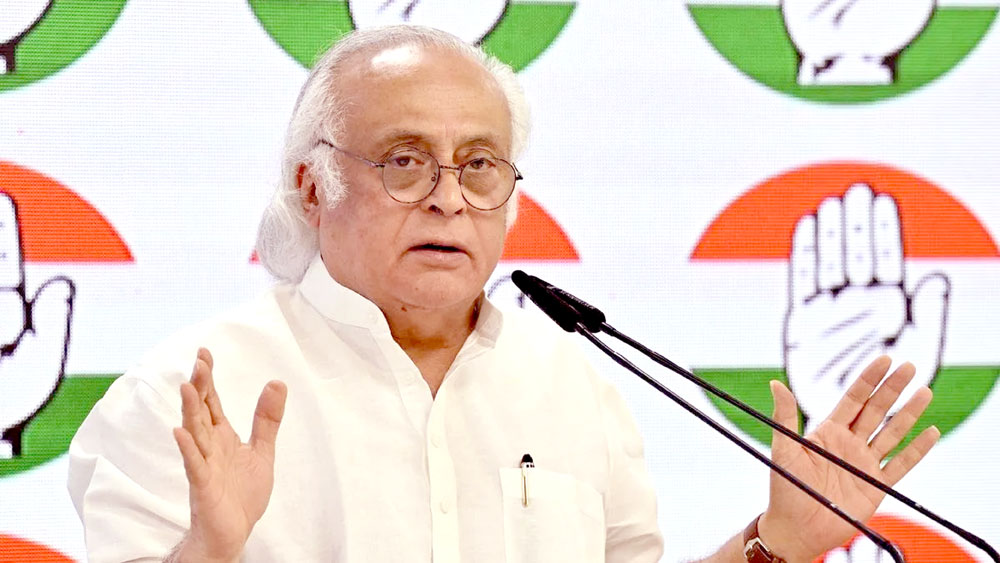
The Congress demanded that the Press Information Bureau clarify the origin of this press release and withdraw it immediately. Congress General Secretary in-charge of communications Jairam Ramesh said, “Let us understand the chronology. The World Bank released its poverty and inequality data for India in April 2025. Soon after, the Congress issued a statement identifying several warning signs that the World Bank had raised for poverty and inequality in India – including warnings about under-reporting of inequality through government data.”
Ramesh said in a statement that three months after its release on July 5, the Modi government’s propagandists and cheerleaders in the ‘Press (Mis)Information Bureau’ issued a press release that made the ‘shocking’ claim that India is one of the most ‘equal’ societies in the world.
He said that in a press release issued on July 6, the Congress once again warned that the government’s data interpretation is based on the limited availability and uncertain quality of existing data, as well as the choice of outdated measures to measure poverty. He added that it has now emerged that the Modi government was not only “careless” in its analysis of the World Bank report, but was also completely “intellectually dishonest”.
He claimed that to reach its conclusion, the Modi government deliberately used two different measures: consumption inequality in India and income inequality in other countries. “We need to use the same measure to compare between the two,” Ramesh said. This is not just a basic principle of economic analysis, but also a principle of common sense.”
He said that the choice to measure consumption inequality in India was also deliberate. Ramesh explained that consumption inequality is always lower than income inequality because the rich save a large portion of their income. He claimed, “When we compare India’s income equality with the rest of the world, India’s performance looks very poor: in 2019, India was ranked 176th out of 216 countries. In other words, India is not the fourth most equal society – it is actually the 40th most unequal society in the world.”
Congress rejects government's claims about 'equality' in India as 'intellectual dishonesty'.