The Crisis of Education Expensive Unequal and Directionless

For generations in India, education has been considered the most reliable path out of poverty and uncertainty. Families are forced to live in hardship but invest most of their capital in school education, believing that higher education will ensure a better future for their children. Today, this belief is in serious crisis. Education is no longer just about learning or empowerment; it is rapidly becoming expensive, unequal, and alarmingly directionless. The cost of education is rising faster than household incomes.
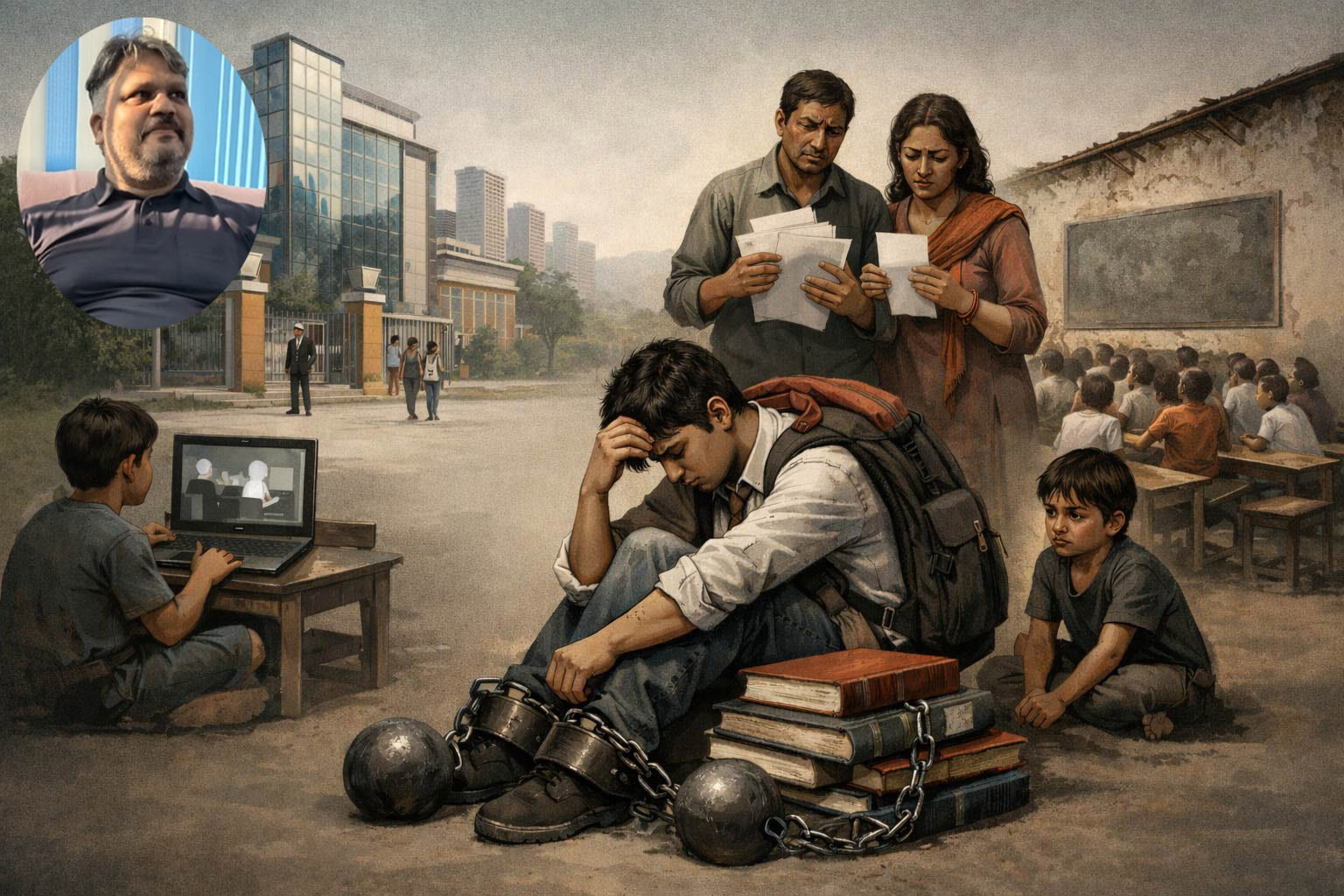
For generations in India, education has been considered the most reliable path out of poverty and uncertainty. Families are forced to live in hardship but invest most of their capital in school education, believing that higher education will ensure a better future for their children. Today, this belief is in serious crisis. Education is no longer just about learning or empowerment; it is rapidly becoming expensive, unequal, and alarmingly directionless. The cost of education is rising faster than household incomes. Private schools, colleges, and universities now operate more like commercial enterprises than centers of learning. Annual fees, transportation expenses, activity costs, uniforms, books, and coaching fees together become a heavy burden for many families.
Professional courses cost lakhs of rupees, forcing students into long-term debt even before their first job. For middle- and low-income families, education is no longer a guarantee—it has become a gamble. Government schools and colleges, once the backbone of public education, are now struggling with lack of funds and staff shortages. Shortage of teachers, dilapidated buildings, overcrowded classrooms, and administrative negligence have eroded public trust. Instead of strengthening these institutions, policies often seem to accept their decline. Parents fear their children will fall behind and are compelled to choose private options regardless of cost. This shift has turned education into a commodity, where quality is linked to purchasing power rather than merit or need.
Inequality in education mirrors societal inequalities. Urban students have access to better schools, opportunities, and resources, while rural children struggle for basic facilities. English-medium education has become a marker of privilege, creating barriers among students even before entering the job market. World-class institutions are worlds apart from ordinary colleges. Outdated curricula and limited teachers fail to prepare students for the future. Education is widening social gaps instead of reducing them. The digital world, often touted as a solution, has made these divides clearer. During online education, many students fell out of the employment race due to lack of resources. Technology has increased inequality rather than democratizing education.
Beyond cost and access, a major problem is the lack of direction. A large part of the education system is trapped in an exam-centered, rote-based model that prioritizes memorization. Students are trained to score marks, not to think critically, solve problems, or connect with the world around them. Career guidance is scarce, leaving youth confused and anxious about their future. Degrees are increasing, but employability is not. Employers complain of skill shortages, while graduates struggle to find respectable work. This imbalance reflects a system whose purpose is lost.
Education policy reforms are announced with ambition, but implementation remains uneven. Teachers are expected to bear the burden of reform, but they lack proper training, support, and respect. Regulating the rapid expansion of private institutions is challenging, allowing profiteering to flourish under the guise of education. Students and parents struggle in this complex landscape.
It would be easy to blame this crisis solely on government failure, but the reality is different. Education is a shared responsibility. Governments need to make foundational investments. Institutions should prioritize education and skill-building over branding. Teachers should be empowered as professionals. Parents and society must abandon the notion that expensive means better, and that success is defined only by degrees and salaries. Skills are innate. The skilled can find their path even in business.
At its core, education should enable individuals to live with dignity, contribute meaningfully to society, and think independently. When it becomes a source of economic stress, social division, and uncertainty, it is not just a failure for students but for the entire nation. An education system that excludes, confuses, and burdens cannot support long-term development or social unity.
The path forward demands new solutions. Public schools and colleges must be strengthened with adequate funding, trained teachers, and modern infrastructure. Curricula must connect knowledge with skills, ethics, and civic responsibility. Access must be expanded, not limited, so a child's future is not determined by family income or address.
Education cannot be left solely to market forces. It must be treated as a public good, guided by equality, relevance, and purpose. Education needs to become a direction for skills and achievement, not an obstacle disguised as hope.
- Davinder Kumar