
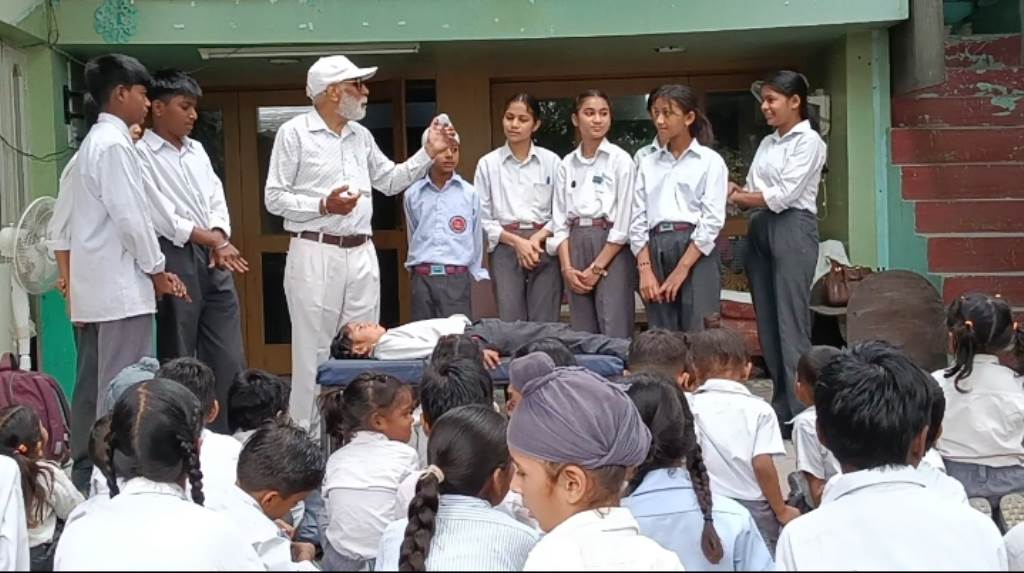
Patiala:- In today's time, when natural, seasonal, and man-made disasters occur daily—ranging from fires caused by electricity, gas, petroleum, or flammable chemicals, gas leaks, electric short circuits, electrocution, heart attacks, cardiac arrests in children and players, fainting, epileptic seizures, asthma attacks, to fluctuations in blood pressure and sugar levels—it is necessary to examine how prepared school administrators and teachers are to save precious lives during such emergencies.
Medical science has proven that in cases of cessation of breathing or cardiac arrest, where the supply of oxygen and glucose to the brain is cut off, victims can die within 2 to 3 minutes. Deaths are also occurring within minutes due to being trapped in gas, smoke, water, or debris, or due to foreign objects stuck in the throat/airway. Internal injuries to the head, chest, or abdomen, or internal bleeding resulting in blood reaching the brain, can cause victims to go into a long-term coma.
To prepare students, teachers, staff, and citizens for health, safety, support, disaster management, civil defense, first aid, CPR, recovery positions, artificial ventilation, fire safety, and the use of gas cylinders, 20 questions have been sent to the Director of the Punjab School Education Board and the District Education Officer (Secondary), Patiala, so that maximum students and teachers can be made aware. It is believed that 90% of students and teachers do not know the answers to these questions or how to demonstrate the practical training/exercises for them:
How to save a victim from dying during fainting? How to save victims from dying during heart attacks, cardiac arrests, or angina? How to prevent a victim fallen due to a drop in blood pressure or sugar from dying or going into a coma? How to prevent a victim from going into a coma due to a severe rise in blood pressure or internal injuries to the head, nose, or jaw causing brain hemorrhage or internal bleeding? How and why to perform A.B.C.D. (Airway, Breathing, Circulation, Disability) on an unconscious person? What is the normal pulse rate and breathing rate per minute for an average human? How to save an unconscious person from dying due to electrocution? What to do if something gets stuck in the throat/airway (CHOKING) of a child, youth, or elderly person? What should be done immediately if gas leaks in homes/canteens? How to save an unconscious person rescued from water, debris, gas, or smoke? Describe the types of flammable materials and fires at home/institutions, and the methods to extinguish them.
What should be done to stop an LPG gas leak? When and how to perform CPR, recovery position, and artificial ventilation? How to stop bleeding from any part of the body? What to do if a bone in the leg or arm is broken? What should be done if a child has an epileptic seizure? What should be done if a sharp object or glass is stuck in a body part? What should be done to reduce the effect of poison? What to do immediately if bitten by a dog, cat, monkey, mongoose, cow, buffalo, horse, etc.? What should be done immediately if a child has diarrhea/vomiting leading to dehydration? What should be done to reduce fever if the temperature of a child, youth, or citizen exceeds 104°F?
We provide training in disaster management, civil defense, first aid, and fire safety to educational institutions, police, factory workers, NSS volunteers, and NCC cadets, and conduct mock drills so that trained students, teachers, and staff can act as helping angels to reduce accidents and save precious lives and property during emergencies.