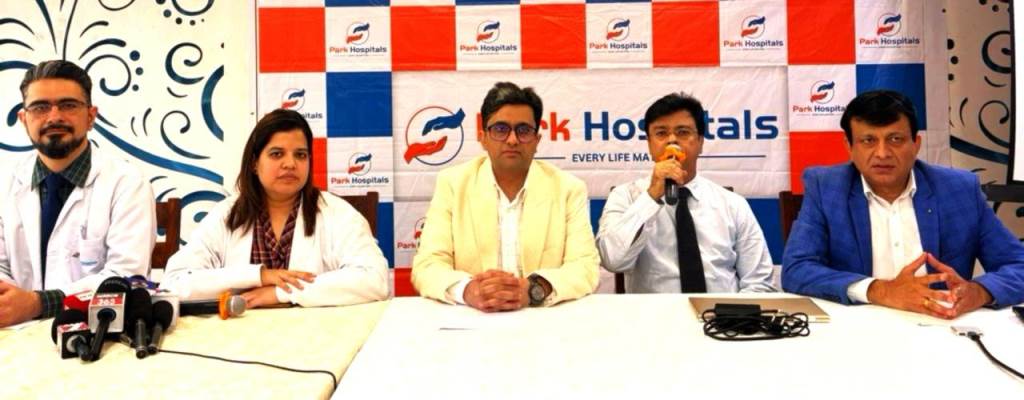
Chandigarh- On the eve of World Stroke Day, to create awareness about brain stroke and its latest treatment options, a team of experts from Park Hospital Mohali, including Group Director Interventional Radiology Dr. Sandeep Sharma, Consultant Radiologist Dr. Gaurav Dhawan, Consultant Neurologist Dr. Sangeeta Pradhan, and Consultant Neurosurgery Dr. Anil Sofat, shared important information on stroke during a press conference here on Tuesday.
Park Hospitals is North India's largest super-specialty hospital network with 19 hospitals, 3,500 beds, 800 ICU beds, 14 cath labs, 45 modular OTs, and over 1,000 doctors.
Dr. Sandeep Sharma, Group Director, Interventional Radiology, said, "Brain stroke is emerging as a new epidemic worldwide, with 1.5 to 2 million new cases of stroke occurring across India each year. The actual number is likely higher, as many of these patients never reach healthcare facilities. Approximately 3,000-4,000 strokes occur in India every day, and only 2% to 3% receive treatment."
He explained that the worldwide stroke rate is 60-100 cases per 100,000 population, while in India it is around 145-145 cases per year. India accounts for 60 percent of all stroke patients globally.
Dr. Sandeep Sharma further explained that the rising incidence in India is due to a lack of awareness about the disease and prevention methods. Brain strokes account for more deaths annually than those caused by AIDS, tuberculosis, and malaria combined, yet it remains a silent epidemic. Consultant Neurologist Dr. Sangeeta Pradhan explained that thanks to a new technique called mechanical thrombectomy, now available at Park Hospital Mohali, brain stroke patients can be treated for up to 24 hours in select cases. In this technique, the clot is either aspirated or removed from the brain with the help of a stent without opening the brain.
She also shared that Park Hospital has performed over 500 successful neurointerventions.
Dr. Anil Sofat explained that the American Stroke Association recently revised its guidelines and recommended mechanical thrombectomy treatment for brain stroke patients. He added that simply reaching a hospital is not enough; access to a hospital prepared for brain stroke is essential.
Consultant Radiologist Dr. Gaurav Dhawan said, "The important thing about brain stroke is that time is crucial. Every minute after a brain stroke, 1.90 million brain cells die. Therefore, patients should be transported to the nearest treatment center as soon as possible." For comprehensive brain stroke care in a hospital, a multidisciplinary team of emergency physicians, neurologists, interventional neuro-radiologists, neurosurgeons, anesthesiologists and critical care physicians is necessary.
India reports 15 to 2 million new cases of brain stroke every year Dr Sandeep Sharma