
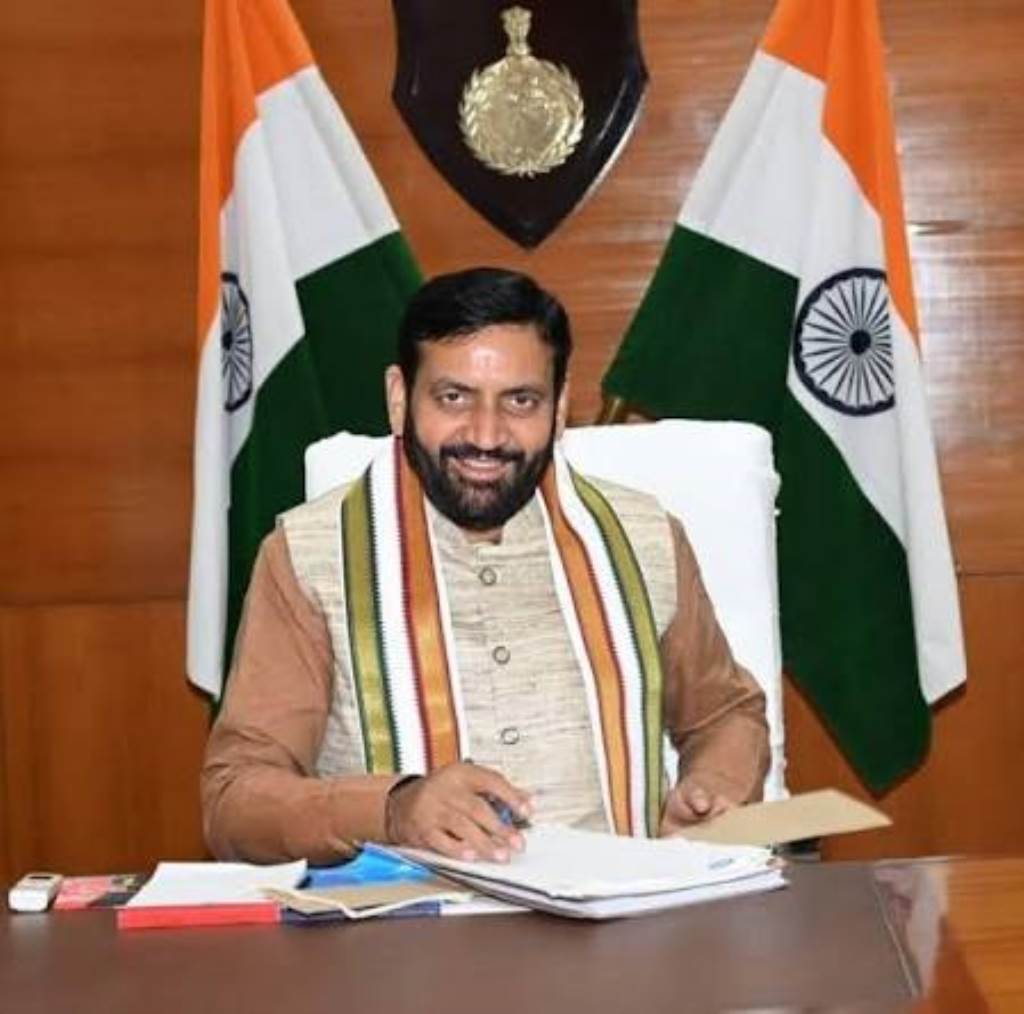
Chandigarh, July 3:- Haryana Chief Minister **Nayab Singh Saini** has directed officials of the Agriculture and Farmers’ Welfare Department to immediately begin the scientific testing of water from farmers’ tubewells across the state so that farmers can receive timely scientific advice based on the quality of their soil and irrigation water. He said the state government will conduct water quality testing of all tubewells in Haryana and ensure that the entire process is simple, transparent, and farmer-friendly.
The Chief Minister was reviewing the implementation of the state government's Budget announcements, Chief Minister’s announcements, and commitments made in the Sankalp Patra-2024 during a high-level meeting held in Chandigarh. The meeting focused on various schemes and projects of the Agriculture and Farmers’ Welfare Department.
The meeting was attended by Chief Principal Secretary to the Chief Minister Rajesh Khullar, Additional Chief Secretary, Agriculture and Farmers’ Welfare Department Vijender Kumar, Principal Secretary, Department of Future, Amneet P. Kumar, Director General, Agriculture Department Raj Narayan Kaushik, OSD to the Chief Minister Virender Badhkhalsa, OSD to the Chief Minister and Director General of Swarna Jayanti Haryana Institute for Fiscal Management Dr. Raj Nehru, along with other senior officials.
**Free Tubewell Water Testing to Be Integrated with the ‘Meri Fasal-Mera Byora’ Portal**
The Chief Minister directed that free testing of tubewell water samples be made available to farmers through designated laboratories. He said the entire system should be integrated with the **'Meri Fasal-Mera Byora'** portal so that every water sample, its test report, and the corresponding agricultural advisory are digitally available.
He instructed officials to test important water quality parameters, including carbonate, bicarbonate, calcium, magnesium, sodium, chloride, and other essential chemical components. Based on these test results, farmers should be clearly advised about which crops are suitable for their water quality, which crops should be avoided, and what farming practices and nutrient management strategies should be adopted.
The Chief Minister emphasized that the government's objective is not merely to provide water quality reports but to develop a scientific **“crop selection based on water quality reports”** system. Farmers will be able to submit water samples from their tubewells at their nearest laboratory for testing at any time.
**Boost to Natural and Organic Farming; Financial Incentives for Eligible Farmers**
The Chief Minister directed officials to expedite implementation of the provisions announced in the **2026–27 Budget** to promote natural and organic farming across the state.
He instructed the department to strengthen certification systems, provide institutional support, and ensure necessary assistance to farmers adopting natural and organic farming practices.
The meeting also reviewed arrangements for providing an annual incentive of **?10,000 per acre** to APEDA-certified farmers and those practicing natural or organic farming. Officials were directed to simplify and streamline the eligibility, application, certification, verification, and grant disbursement processes to ensure transparency and timely benefits.
The Chief Minister also reviewed plans to promote natural and organic farming on nearly **800 acres** of land owned by the Agriculture Department. He directed that this land be utilized effectively to encourage more farmers to adopt sustainable farming methods.
He further instructed officials to provide adequate support infrastructure for natural farming, including financial assistance of up to **?30,000** for purchasing indigenous cows, enabling farmers to adopt cow-based natural farming practices. He emphasized that certification, incentives, training, land utilization, marketing, and sale of organic produce should all be integrated into a comprehensive system to ensure farmers receive support from production to marketing.
**Promotion of Phosphorus-Based Organic Fertilizers**
During the meeting, the Chief Minister stressed the need to encourage the use of phosphorus-rich organic fertilizers to improve soil health, reduce dependence on chemical fertilizers, and strengthen natural and organic farming.
He directed officials to create awareness among farmers about the availability, benefits, and proper use of phosphorus-based and other organic fertilizers and integrate them effectively with natural and organic farming programmes.
**Focus on Increasing Sugarcane Production Through Incentives and Modern Technology**
The Chief Minister also reviewed schemes related to the sugarcane sector with the objective of increasing farmers' income and boosting sugarcane production.
He directed officials to explore the possibility of increasing incentives for higher sugarcane yields to encourage farmers to adopt advanced cultivation techniques. He also asked the department to take concrete steps to make sugarcane harvesters available to reduce cultivation costs and provide relief to farmers.
Emphasizing the importance of tissue culture technology, he said it could significantly improve sugarcane productivity and quality by providing farmers with superior planting material, higher yields, and better income.
Officials were instructed to adopt an integrated approach towards sugarcane-related schemes, incentives, mechanization, and modern technologies to accelerate sugarcane production across the state.
**Subsidy Support to Promote Cotton Cultivation**
The Chief Minister directed officials to take effective measures to promote cotton cultivation by providing necessary financial assistance and subsidies to farmers.
He instructed the department to facilitate grants for handheld battery-operated cotton-picking machines and fuel-operated cotton-picking machines to reduce production costs, provide relief to cotton growers, and encourage cotton cultivation across Haryana.
**Benefits of Agricultural Schemes Must Reach Farmers Directly**
The Chief Minister directed officials to ensure that every commitment made in the Budget announcements, Chief Minister’s announcements, and the Sankalp Patra is implemented within the stipulated timeframe.
He emphasized that the benefits of all agriculture-related schemes must directly reach farmers and instructed the department to ensure regular monitoring of every project for effective implementation.