
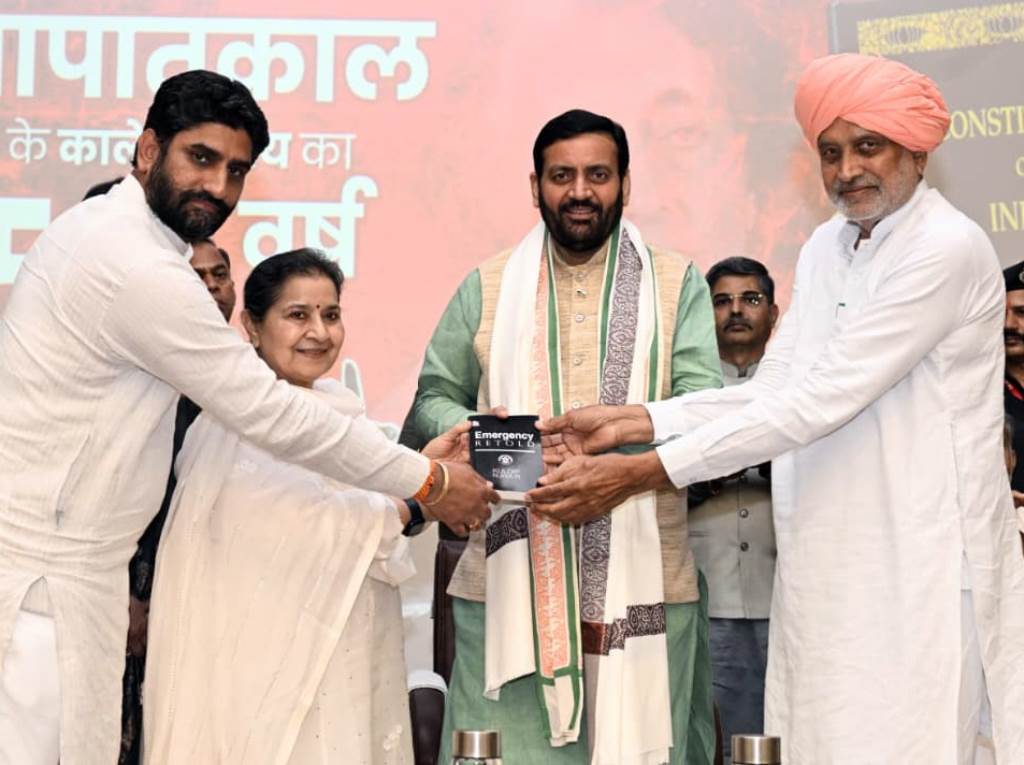
Chandigarh, June 25:- Haryana Chief Minister Nayab Singh Saini said that the sacrifice and dedication of those democracy warriors who spent their lives struggling to strengthen Indian democracy and protect the Constitution will continue to inspire generations of Indians. He stated that June 25, 1975, remains recorded as a dark chapter in the history of Indian democracy, when democratic rights were suppressed under the patronage of those in power and the Emergency was imposed across the country.
The Chief Minister was addressing a “Constitution Murder Day” programme organized in Panchkula to mark 51 years since the imposition of the Emergency. On the occasion, he honoured democracy warriors by presenting them with ceremonial shawls and certificates of recognition.
He said that the 21 months of the Emergency represent the darkest chapter in the history of Indian democracy. In the arrogance of power, attempts were made to weaken democratic institutions, opposition leaders were imprisoned, freedom of the press was curtailed, and every voice of dissent was suppressed. Thousands of people who fought to protect democracy endured hardships but refused to compromise on their principles.
Nayab Singh Saini said that after the Allahabad High Court declared the election of the then Prime Minister invalid on June 12, 1975, instead of respecting democratic traditions, the Emergency was imposed on the entire nation at midnight on June 25. The fundamental rights of millions of citizens were suspended, and the spirit of the Constitution was severely undermined.
The Chief Minister recalled that Loknayak Jayaprakash Narayan had already given the call for “Total Revolution” from Gandhi Maidan in Patna on June 5, 1974. It was a historic call for safeguarding democracy and mobilizing people against authoritarianism. To suppress this movement, several prominent national leaders, including Jayaprakash Narayan, Nanaji Deshmukh, Morarji Desai, Atal Bihari Vajpayee, Lal Krishna Advani, George Fernandes, Biju Patnaik, Chandrashekhar, and Sardar Parkash Singh Badal, were imprisoned.
He said that during the Emergency, more than one lakh citizens were jailed, 253 journalists were arrested, and 1,564 people from Haryana were also sent behind bars. It was one of the most severe attacks on democratic rights and freedom of expression.
The Chief Minister stated that Haryana also played a significant role in this struggle. Due to its geographical proximity to Delhi on three sides, Haryana became a major centre of repression during the Emergency. Several national leaders were kept under detention in the state. Many political and social activists, along with hundreds of volunteers of the Rashtriya Swayamsevak Sangh (RSS), were arrested. He added that an RSS training camp being held in Rohtak had to be closed prematurely after the Emergency was imposed, and the organisation’s offices were sealed.
Saini said that despite widespread repression and atrocities, Haryana never bowed down. Awareness campaigns were conducted in villages and blocks, satyagrahas were organized, and hundreds of people fearlessly courted arrest. This struggle, he said, is proof that the soil of Haryana never surrenders before injustice and dictatorship.
The Chief Minister described democracy warriors as an endless source of inspiration. Just as freedom fighters secured India’s independence, democracy warriors sacrificed everything to protect democracy and the Constitution. He quoted Jayaprakash Narayan, saying, “Freedom is not won once and for all; it must be won every day.”
He said the Haryana Government has always prioritized the welfare and honour of democracy warriors. In 2015, the first “Loktantra Senani Samman Samaroh” was organized in Rohtak. Democracy warriors and their spouses were provided medical facilities equivalent to those available to government employees, travel concessions in Haryana Roadways buses, and their monthly pension was increased to ?20,000. At present, 501 democracy warriors and their widows are receiving this honorarium.
The Chief Minister said that the Emergency teaches three important lessons. First, every citizen must remain vigilant to protect democracy. Second, strong institutions such as the judiciary, legislature, and executive are the foundation of democracy. Third, in a democracy, the people are supreme, and when they unite to defend their rights, no force can suppress them.
He added that under the leadership of Prime Minister Narendra Modi, India is moving forward toward further strengthening democratic values. The “Hamara Samvidhan, Hamara Swabhiman” campaign, launched on the occasion of 75 years of the Constitution, reflects the nation’s commitment to democracy and constitutional values. Over the past 12 years, India has achieved remarkable progress in development, good governance, and public participation, and is rapidly emerging as one of the world’s leading economies.
The Chief Minister also recalled that last year, on the completion of 50 years since the “murder of democracy,” Prime Minister Narendra Modi had called for observing the entire year as a “Smriti Varsh” (Year of Remembrance). He said this is not merely an opportunity to remember the past but also a campaign to educate and inspire the younger generation about the importance of safeguarding democracy.
**Preserving Democracy’s Priceless Legacy is Our Collective Responsibility**
Nayab Singh Saini said that remembering the struggle during the Emergency and the sacrifices of democracy warriors is not merely about revisiting history but about drawing inspiration for the future. He called upon the people of Haryana to actively contribute to strengthening democracy, the Constitution, and national unity so that India continues to progress as one of the world’s most powerful, vibrant, and inspiring democracies.
Among those present on the occasion were Haryana Agriculture and Farmers’ Welfare Minister Shyam Singh Rana, Kalka MLA Shakti Rani Sharma, Rajya Sabha Member Rekha Sharma, Mayor Shyam Lal Bansal, former Assembly Speaker Gian Chand Gupta, State Vice-President Banto Kataria, former Minister Aseem Goel, former Minister Ram Bilas Sharma, District President Ajay Mittal, Media Secretary Praveen Atre, and several democracy warriors.