
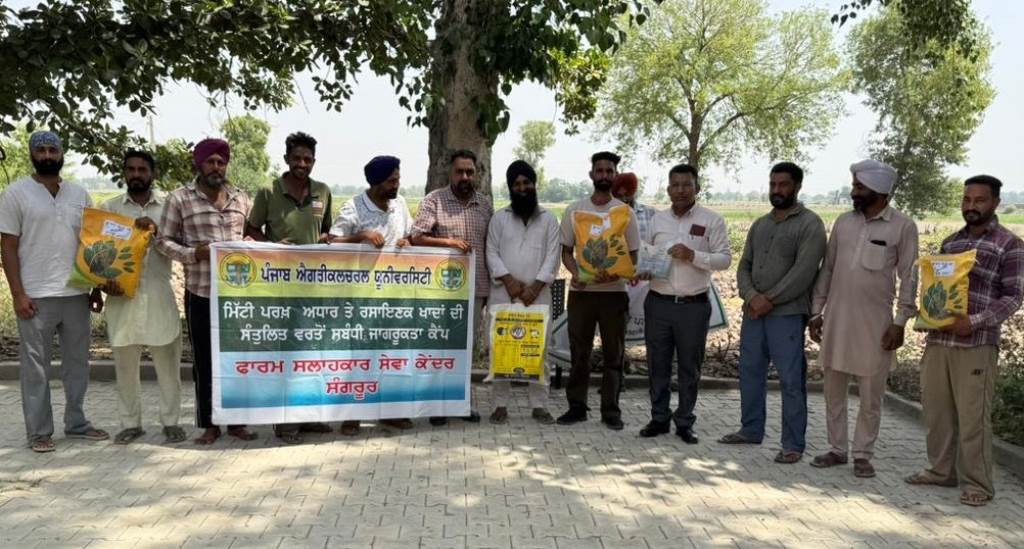
Sherpur, May 22- Under the guidance of Punjab Agricultural University (PAU), Ludhiana, the Farm Advisory Service Centre (FASC), Sangrur organized a Kisan Goshti at village Herike on recommended paddy and basmati varieties, soil test-based nutrient management, and judicious use of phosphatic fertilizers.
Farmers showed keen interest in scientific farming practices during the programme.
Addressing the gathering, Dr. Ashok Kumar Garg, Senior Extension Scientist, emphasized that indiscriminate use of fertilizers not only increases the cost of cultivation but also adversely affects soil fertility and the environment. He urged farmers to apply fertilizers strictly on the basis of soil testing and highlighted that balanced nutrient management can help achieve higher productivity with reduced input costs.
Dr. Garg also demonstrated the right method of soil sampling in the field and provided practical guidance to farmers regarding proper soil sample collection. He advised farmers to avoid unnecessary use of DAP fertilizer in paddy and basmati cultivation and stressed the need for judicious use of urea fertilizer.
He particularly cautioned farmers against the practice of applying excessive urea before puddling.
He further informed that zinc deficiency in paddy should be ameliorated only as per the recommended dose. Highlighting the importance of bio-fertilizers, Dr. Garg explained that Azospirillum inoculation in paddy seedlings not only enhances crop productivity but also plays an important role in improving soil biological health.
During the camp, detailed information was also provided regarding the benefits of green manuring crops such as dhaincha and sunhemp. Dr. Garg also shared recommendations regarding identification and management of “dwarfing plants” in paddy nursery and encouraged farmers to regularly monitor their nurseries.
He elaborated upon PAU-recommended paddy varieties including PR 131, PR 128, PR 126, and the newly recommended PR 133. He informed that PR 133 matures in about 111 days after transplanting and has the potential to yield nearly 30.5 quintals per acre.
Information was also shared regarding nutrient management and seed treatment practices for the management of false smut disease in basmati varieties such as Pusa Basmati 1509 and Pusa Basmati 1847.
Farmers were also made aware about various academic courses being offered by PAU Ludhiana, and rural students were encouraged to pursue higher education in agriculture.
The successful organization of the programme was supported by S. Ravinder Singh, S. Jaspal Singh, S. Kuldeep Singh (Secretary), S. Ajaypal Singh, and S. Gagandeep Singh, who contributed actively towards mobilizing and guiding the farmers.
During the camp, PAU-recommended PR 126 seed, Azospirillum inoculants, mineral mixture for livestock, bypass fat, premix, and agricultural literature were also made available to farmers for sale. Scientific and systematic answers were provided to various agriculture-related queries raised by the farmers.
The participants expressed keen interest in soil testing and adoption of recommended fertilizer management practices.
At the end of the programme, soil samples were collected after demonstrating the proper method of soil sampling directly in the field. Later, the team of FASC Sangrur also visited a six-acre summer moong crop cultivated by S. Ravinder Singh and reviewed the crop condition in the field.