
The Disappearing Natural Shade

It is a great irony that the more modern our cities become, the more difficult it is for humans to live in them comfortably. In the afternoon, the roads bake like fire, concrete walls continue to radiate heat long after evening falls, and stepping out of the house feels less like a routine activity and more like a test of endurance. Cities are turning into spaces where human life and well-being are gradually being left behind. In summer, along with the continuously rising temperatures, power load-shedding has made the situation even more severe. In many areas, houses become heat traps where there is neither proper ventilation, nor shade, nor comfort. Due to the lack of natural shade and trees, people are becoming entirely dependent on air conditioners and fans; however, when the electricity itself fails, this entire comfort becomes useless.
It is a great irony that the more modern our cities become, the more difficult it is for humans to live in them comfortably. In the afternoon, the roads bake like fire, concrete walls continue to radiate heat long after evening falls, and stepping out of the house feels less like a routine activity and more like a test of endurance. Cities are turning into spaces where human life and well-being are gradually being left behind. In summer, along with the continuously rising temperatures, power load-shedding has made the situation even more severe. In many areas, houses become heat traps where there is neither proper ventilation, nor shade, nor comfort. Due to the lack of natural shade and trees, people are becoming entirely dependent on air conditioners and fans; however, when the electricity itself fails, this entire comfort becomes useless.
The same situation is observed during the monsoon. When it rains, the very cities that are considered the face of development are submerged in water. Due to the weakness of the drainage system, roads turn into ponds, traffic comes to a halt, and daily life grinds to a standstill. Surprisingly, the cities in India that are labeled as Tier-1 or the most progressive are the ones most immediately affected in both summer and monsoon conditions. The heatwaves that have been steadily increasing over the past decade have made it clear that this is no longer just a matter of seasonal variation. Yet, cities are still being planned in the same manner as if nature were always static. Trees are being chopped down to widen roads, open spaces are being converted into buildings, and cement and iron alone are being understood as symbols of progress. The result is that cities absorb heat during the day and release that same heat slowly at night. In scientific terminology, this is called the "Urban Heat Island" effect, but for ordinary people, it is a lived realization that cities are now hotter than ever before.
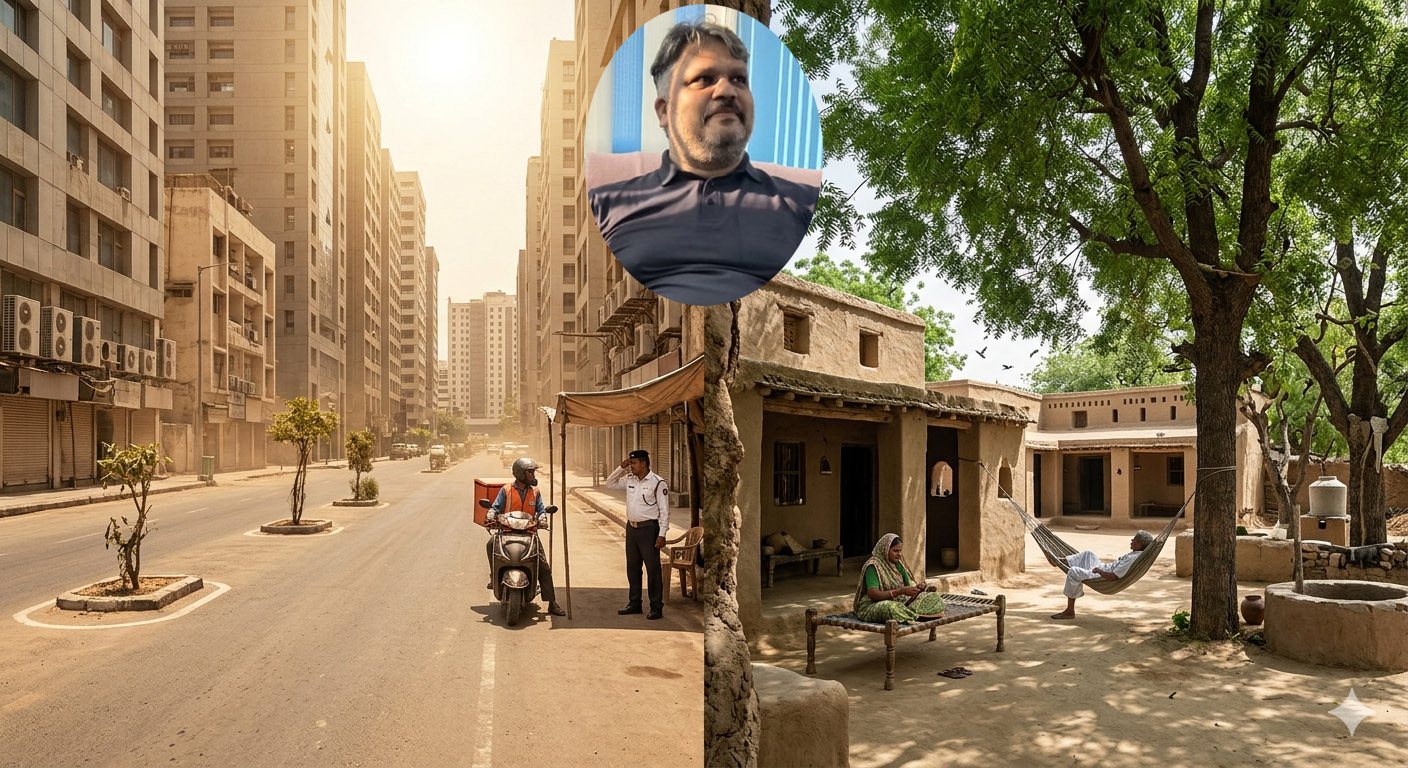
The greatest impact of this rising heat falls upon those who have fewer means to escape it. Street vendors, laborers, delivery workers, sanitation workers, traffic police, and thousands of others who work under the open sky are forced to endure this scorching heat all day long. On the other hand, the city's solution is an increasing reliance on air conditioners. Buildings are being constructed in such a way that without mechanical cooling, they simply become unlivable. We need to look back at the wisdom of our ancestors. There was a time when houses did not clash with nature, but rather shared a bond with it. Before building a house, consideration was given to the soil type, wind direction, the intensity of sunlight, rainfall patterns, water availability, and the habitat of living creatures. First, the nature of the region was understood, and then human needs were molded accordingly.
In many regions of India, including Punjab, mud houses, thick walls, courtyards, verandahs, and windows for natural ventilation used to be commonplace. Mud walls possessed the quality of keeping the house cool in summer and warm in winter. Courtyards facilitated the smooth circulation of air. Trees were planted near houses so that natural shade and coolness could be achieved. Lime, wood, stone, mud, and other local materials were used, which were compatible with the regional climate.
The irony today is that the mud house, which was once a symbol of simplicity and ordinary living, has now become a luxury experience. People spend large sums of money to stay in "eco-resorts" or mud houses built in villages just to experience natural coolness and peace. What used to be the home of an ordinary person is now turning into a hallmark of luxury. Conversely, we are erecting identical concrete buildings in cities that often disregard regional climate and environmental needs. We need to understand that modernity does not mean completely abandoning our ancient wisdom. Glass buildings are more appropriate for those countries and regions that face a scarcity of sunlight, but blindly copying them, we are constructing such buildings here even where sunlight is available in abundance.
What is needed is that we merge modern technology with ancient wisdom. The use of local materials should be encouraged in house construction, providing employment to local artisans and masons, and buildings should be constructed that are climate-resilient. Natural ventilation, courtyards, shaded pathways, rainwater harvesting, and larger green zones must be made an integral part of urban planning. Because ultimately, no matter how shiny the concrete may be, it can never replace the shade of a tree, the open air, and the soothing coolness of a home connected with nature.
— Davinder Kumar