
History of Una District Himachal Pradesh

Una district of Himachal Pradesh has been historically, religiously, and culturally very rich. Since ancient times, this region has served as a meeting point of Punjab and hill cultures. Situated on the banks of the Swan River, Una has been an important center of trade, faith, and administration.
Una district of Himachal Pradesh has been historically, religiously, and culturally very rich. Since ancient times, this region has served as a meeting point of Punjab and hill cultures. Situated on the banks of the Swan River, Una has been an important center of trade, faith, and administration.
Ancient and Medieval History:
In ancient times, the Una region was ruled by various small kings and princely states. It remained under the influence of the Katoch dynasty and other hill states. During the Mughal period, the area retained strategic importance as it connected the plains of Punjab with the hilly regions.
Founder of Una – Baba Sahib Singh Bedi Ji:
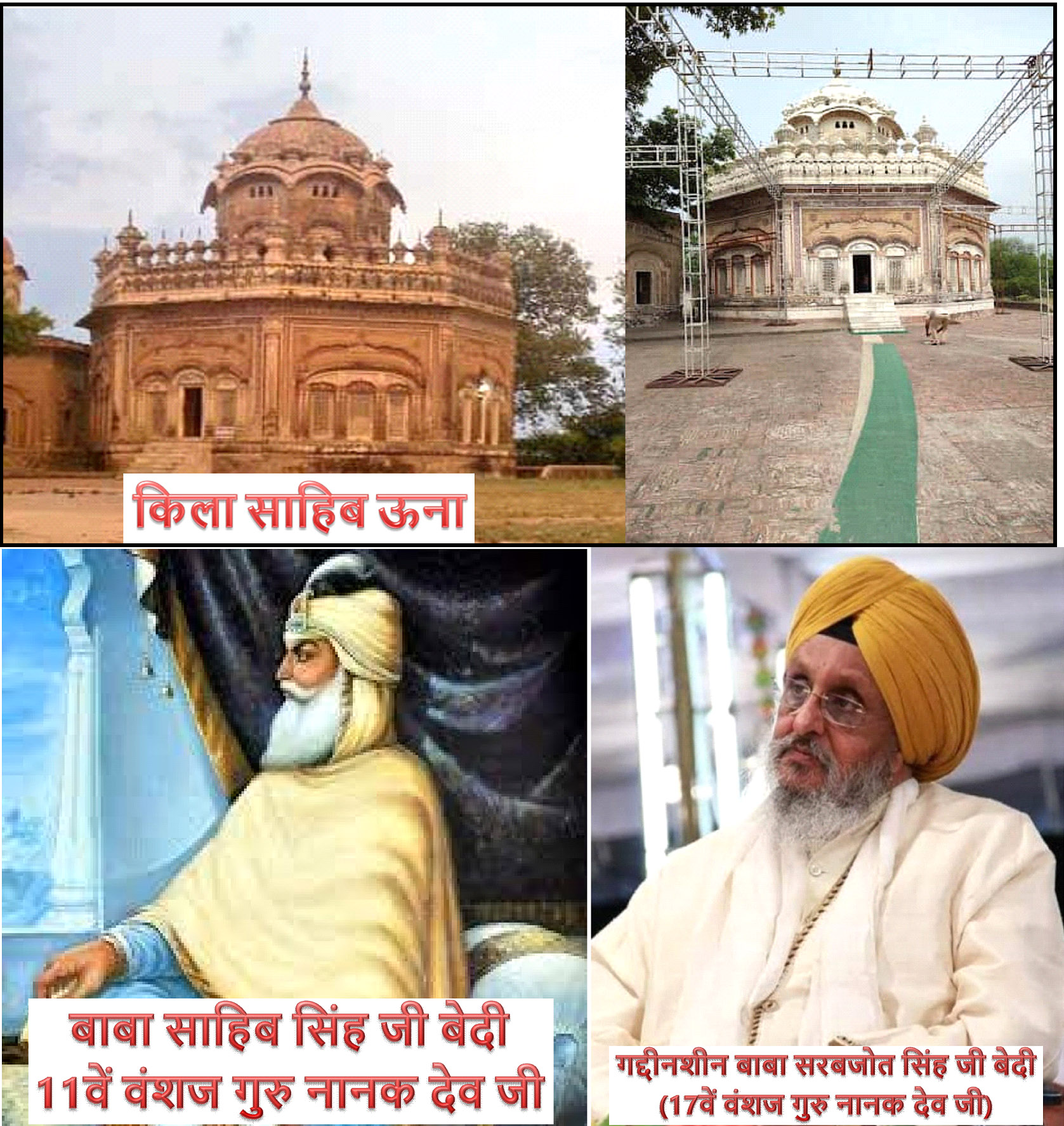
The most significant figure in the history of Una is Baba Sahib Singh Bedi Ji, who is regarded as the founder of the town.
Birth and Lineage:
Born: 1756, Dera Baba Nanak
Father: Baba Ajit Singh Ji
Mother: Mata Saroopa Devi
He was a descendant of Guru Nanak Dev Ji
His ancestor Baba Kaladhari Ji was a contemporary of Guru Gobind Singh Ji
It is believed that at Gurpalaha Sahib near Santokhgarh, Guru Gobind Singh Ji blessed Baba Kaladhari Ji with the prophecy of Baba Sahib Singh’s birth.
Religious and Political Contributions:
Baba Sahib Singh Bedi Ji was skilled in both scriptures (Shastra) and warfare (Shastra). In 1775, at Anandpur Sahib, he took Amrit and adopted the Miri-Piri principle. He played a vital role in the spread of Sikhism.
He ruled over 117 villages and maintained an army of around 14,000 soldiers.
Coronation of Maharaja Ranjit Singh:
On the occasion of Baisakhi in 1801, Baba Sahib Singh Bedi Ji performed the coronation of Maharaja Ranjit Singh. He also played a crucial role in uniting various Sikh misls and establishing the Khalsa Raj.
Una Fort and Historical Sites:
In 1784, a historic fort was constructed in Una, which served as the administrative center of the 117 villages. Later, the British destroyed this fort using cannons.
Major Religious Sites:
Gurudwara Tapovan (about 4 km from Una)
Gurpalaha Sahib (near Santokhgarh)
Shrine of Baba Teg Singh Ji inside the fort
The tradition of Langar here was so vast that approximately 35 maunds of salt were used daily.
Tradition of Parikrama:
Before going to battle, Baba Sahib Singh Bedi Ji used to perform a ceremonial circumambulation (parikrama) of the town, which was considered a protective ritual. Even today, on his birth anniversary (27 March), Nagar Kirtan and parikrama are organized.
Belief:
It is believed that due to Baba Ji’s blessings, the Swan River has never caused harm to Una despite potential floods.
Lineage and Present:
The current spiritual successor is Baba Sarbjot Singh Bedi, who has been carrying forward the legacy since 1989. He has made significant contributions in social and religious fields and established Prem Ashram for specially-abled children.
Birth Anniversary Celebrations (26–28 March):
Every year on March 26, 27, and 28:
Devotees from across India and abroad gather
Nagar Kirtan and Parikrama are organised
The life and contributions of Baba Ji are remembered
Conclusion:
The history of Una is not just the story of a district, but a glorious saga of Sikhism, social unity, and bravery. Baba Sahib Singh Bedi Ji not only founded Una but also made it a significant religious, social, and political center.
Rajveer Chopra
Santokhgarh (Una)
Himachal Pradesh