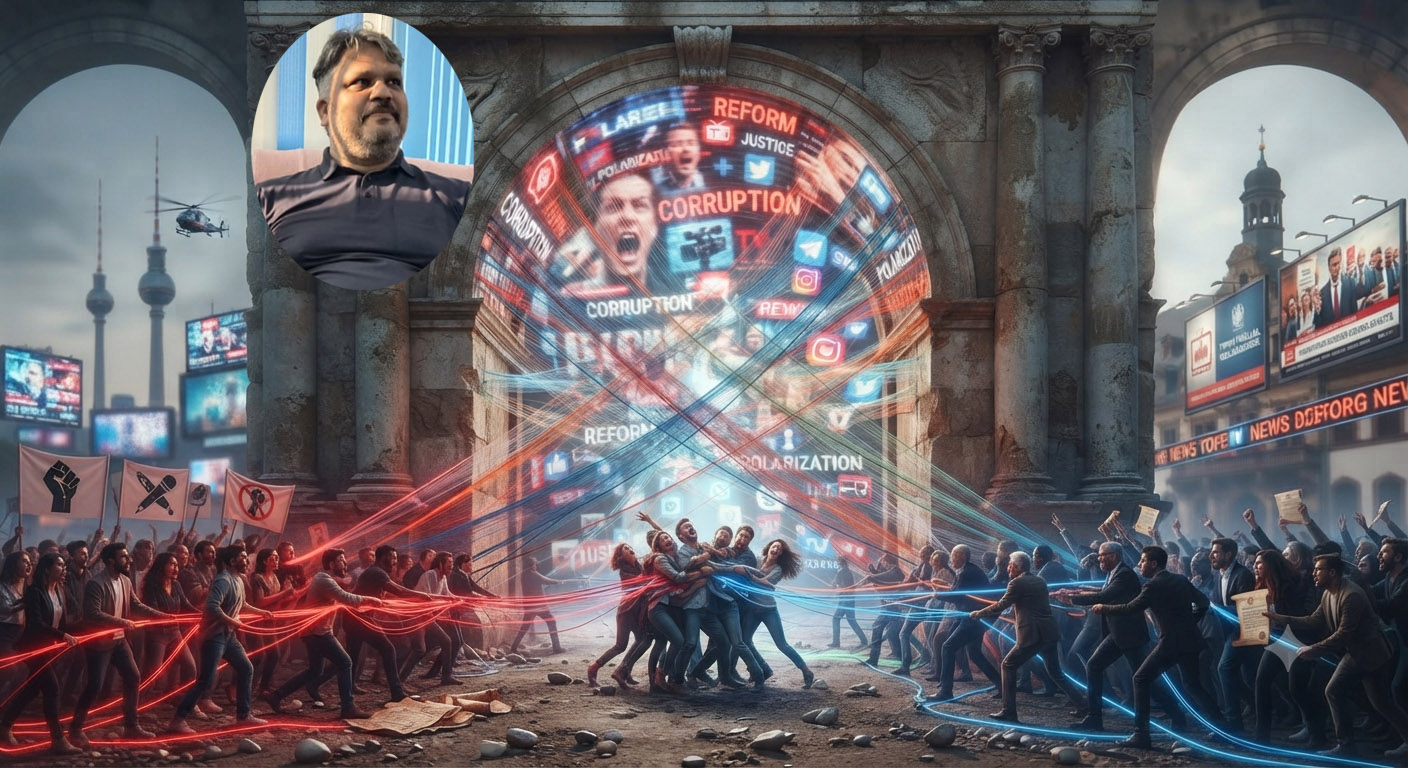
Protest war of narratives and test of democracy

The protests held at Jantar-Mantar in Delhi this week have once again raised the question as to what is the real meaning of protests left in today's democracy. In any democratic system, citizens have the right to express their dissent. This right is the basic identity of democracy. But today protests are not limited to only streets or grounds. At the same time they are also fought on media, social media, political platforms and digital platforms. Because of this today's protests are no longer just a fight of demands or issues, but have also become a fight of "narrative".
The protests held at Jantar-Mantar in Delhi this week have once again raised the question as to what is the real meaning of protests left in today's democracy. In any democratic system, citizens have the right to express their dissent. This right is the basic identity of democracy. But today protests are not limited to only streets or grounds. At the same time they are also fought on media, social media, political platforms and digital platforms. Because of this today's protests are no longer just a fight of demands or issues, but have also become a fight of "narrative".
In democracy it is not important whether the protester is a student, a scientist, a farmer, a labourer, associated with a political party or a member of a social institution. What is important is that his point is placed in a constitutional and peaceful manner. Whenever elements like violence, damage to government or private property or intimidating people get included in any movement, then the discussion shifts from the main issue and gets limited to law and order. Due to this not only the credibility of the protest gets affected, but the real demands also get left behind. Therefore violence cannot be supported from any side.
In the present time along with every protest another war also goes on, the war of narrative. Earlier the success of a movement was estimated by the number of people involved in it, but now it is seen which side influenced public opinion more. Debates of television channels, posts of social media, video clips, hashtags, political statements and digital campaigns today play a big role in making public perception of any event. Sometimes presentation proves more effective than reality.
In this situation new challenges have arisen before governments also. Now only taking administrative decisions is not enough. People also expect that the government clarifies the reasons for its decisions, answers the questions being raised in time and if any confusion is spreading regarding any fact then does effective communication to remove it. If the government lags behind on this front then the narrative presented by other sides can make a strong place among the public, whether it is completely based on facts or not.
On the other hand, it will also not be correct to consider every protest as only a political conspiracy or propaganda campaign. Sometimes real problems of people themselves take the form of big movements. The identity of a responsive government is that it has the ability to differentiate between real issues and only political narrative.
One aspect is also that today our political system appears to be under the influence of narrative to a large extent than before. Sometimes public opinion appears to be formed on the basis of such stories, campaigns or ideologies, whose roots are not in our own social or political context. Today there is no border of information.
A campaign running in one country also becomes a subject of discussion in another country. Algorithms of social media rapidly push emotional and conflicting content forward. Because of this it is possible that sometimes public opinion gets influenced more by global or external narratives than local facts.
This question is not limited to any one government, any one party or any one movement. It is a matter of thought for the whole democratic system. If the direction of policies and public discussion starts getting decided by only rapidly spreading narratives instead of facts, dialogue and constitutional processes, then the quality of democracy can get affected. Therefore today there is need not of victory of any one side, but of strengthening of democratic institutions.
Protests should be peaceful, governments should be accountable and ready for dialogue, media should give priority to verification of facts and citizens should also investigate any narrative instead of accepting it without checking. The real strength of democracy lies in the fact that decisions are taken on the basis of facts, constitutional processes and public interest. In today's era this itself is the biggest challenge and the biggest test before democracy.
- Davinder Kumar