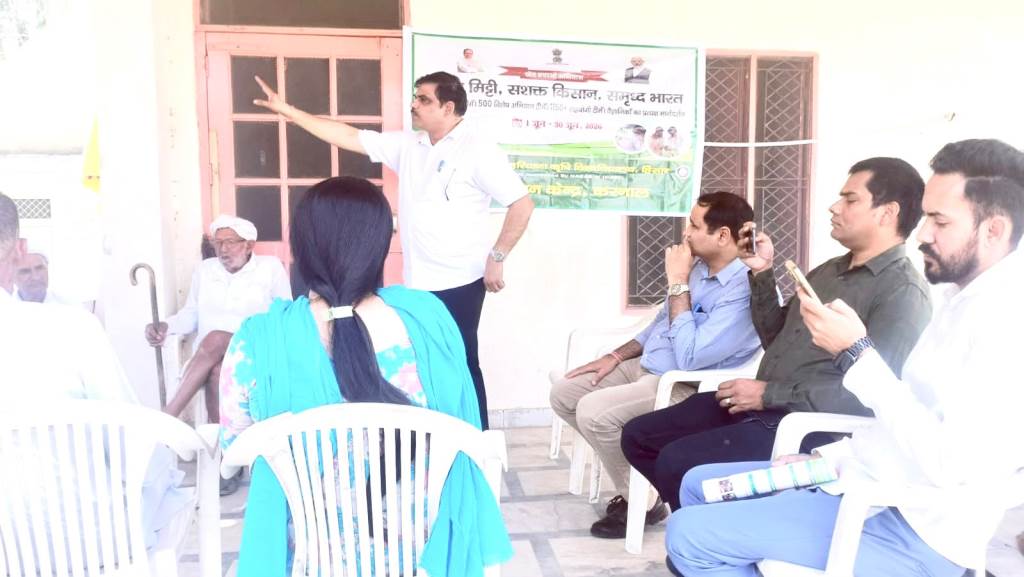
Karnal, June 15: The Department of Farmers' Welfare is conducting the "Save the Farm" (*Khet Bachao*) campaign as part of various outreach programs organized to celebrate the completion of 12 glorious years of the Central Government. On Monday, the Krishi Vigyan Kendra (KVK), Uchani (Karnal)—part of Chaudhary Charan Singh Haryana Agricultural University, Hisar—organized farmers' meetings in Jhimri Kheda and Dera Gama villages of Assandh block in collaboration with the Department of Agriculture, Karnal. The primary objective of this program was to educate farmers on minimizing the use of chemical fertilizers, conserving soil health, adopting natural farming practices, and exploring ways to increase their income.
The underlying intent behind the "Save the Farm" campaign launched by the Central and Haryana governments is to reduce dependence on chemical fertilizers, promote better alternatives to such fertilizers, and devise new methods to multiply farmers' income through soil and water conservation. Haryana Agricultural University, KVK Uchani, and other agricultural research institutions are organizing group meetings and seminars to disseminate these messages and ideas to farmers in every village. The program was jointly organized by Dr. Vijay Kumar Kaushik (District Extension Specialist - Farm Management) from KVK Uchani, scientists from the Central Soil Salinity Research Institute (CSSRI), Karnal, and officials from the Department of Agriculture.
Addressing the gathering, Dr. Vijay Kumar Kaushik emphasized the need to pay special attention to soil health. He explained that just as only a healthy mother can give birth to healthy children, only healthy soil can yield good crops. He noted that the excessive use of chemical fertilizers is making the soil dependent and unhealthy rather than robust; soil health can be improved through proper nutrition—such as the use of farmyard manure, the cultivation of green manure crops like Moong and Dhaincha, and effective crop residue management. He stated that farmers should use fertilizers only in the quantities recommended by agricultural universities. Using chemical fertilizers beyond the recommended amounts significantly increases farming costs without yielding the expected increase in production; consequently, farmers risk incurring losses rather than boosting their income.
Dr. Kaushik advised farmers to adopt agriculture-based enterprises alongside traditional farming to increase their earnings. Citing numerous examples, he explained how farmers—whether individually, in groups, or through Farmer Producer Organizations (FPOs)—could multiply their income by engaging in ventures such as dairy farming, fish farming, shrimp farming, mushroom cultivation, beekeeping, and the value addition of agricultural products. Speaking from the perspective of an economist, he noted that modern farming should be viewed as a business and that remaining vigilant is essential to securing a good income.
Dr. Gajendra Yadav, a scientist from CSSRI, Karnal, advised farmers to apply fertilizers based on soil test results and emphasized the importance of maintaining soil quality through limited and balanced fertilizer use. Program organizers from the Agriculture Department—ATM Rajesh Sharma and Agriculture Supervisor Himanshu—also encouraged farmers to adopt natural and sustainable farming practices and provided information about departmental schemes.
The farmers present at the event held detailed discussions with the visiting scientists regarding various agricultural challenges and issues. They asked questions concerning balanced fertilizer use, natural farming, and modern agricultural techniques, all of which were addressed in detail by the scientists.
Save the Farm Campaign in Villages to Mark 12 Glorious Years of the Central Government