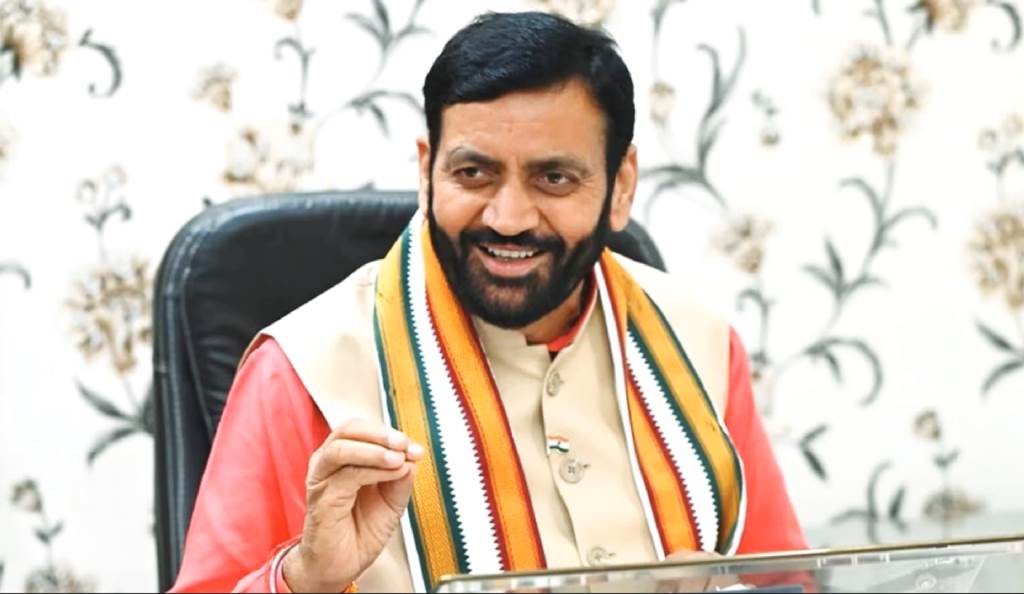
Chandigarh, May 20:- Haryana Chief Minister Nayab Singh Saini said that the Haryana Government has formulated a Beekeeping Policy to promote apiculture in line with Prime Minister Narendra Modi’s call to move from the “White Revolution” to the “Sweet Revolution.” Under this policy, the state aims to increase the number of beekeepers to 7,750 and achieve honey production of 15,500 metric tonnes by 2030.
The Chief Minister was addressing a programme organized by the Haryana Horticulture Department on the occasion of World Bee Day at the Red Bishop Convention Centre in Sector-1, Chandigarh. Haryana Agriculture and Farmers Welfare Minister Shyam Singh Rana was also present on the occasion.
Earlier, the Chief Minister inspected stalls displaying honey and honey-based products put up by beekeepers from different parts of the state and showed keen interest in them.
Extending greetings on World Bee Day, Nayab Singh Saini said the state government is fully committed to promoting beekeeping at the grassroots level. Considering the immense potential in this sector, several schemes have been launched. Beekeepers are being provided subsidies of up to 85 percent on bee boxes, colonies, and equipment.
He said that to protect beekeepers from market fluctuations and uncertainty, beekeeping has also been included under Haryana’s Bhavantar Bharpai Yojana. Under this scheme, the protected price of honey has been fixed at ?120 per kilogram, ensuring guaranteed income for farmers. On this occasion, the Chief Minister released an incentive amount of ?1.02 crore into the accounts of 30 farmers under the scheme.
He further announced that beekeeping would also be included in the Chief Minister Horticulture Insurance Scheme to protect beekeepers from losses caused by natural disasters. More than 3,000 beekeepers from Haryana are registered on the National Beekeeping and Honey Mission portal, making Haryana the leading state in beekeeper registrations.
The Chief Minister stated that World Bee Day is dedicated to a tiny creature that plays a huge role in sustaining life on Earth. Scientists across the world have repeatedly warned that if bees disappear, life itself could be endangered. To spread awareness about their importance, World Bee Day is celebrated every year on May 20. He also highlighted the significance of honey and bees in Indian culture, Vedas, and scriptures, where honey is regarded as a symbol of prosperity, purity, and health.
He said bees are not only protectors of nature but also the backbone of the agricultural economy. At a time when the world is battling climate change, environmental pollution, and food security challenges, the importance of bees has increased even more. However, he expressed concern that bees are under threat due to excessive pesticide use, pollution, deforestation, and climate change.
Appealing to farmers, he urged them to adopt beekeeping alongside the cultivation of mustard, sunflower, cotton, berseem, fruits, and vegetables. He said that apart from increasing honey production, pollination by bees also enhances crop yields.
The Chief Minister said the significance of bees is not limited to agriculture alone. Today, beekeeping has become a strong source of employment and rural economic growth. This low-cost business requiring minimal land and resources is providing livelihoods to lakhs of people. Besides honey, bees also produce valuable products such as royal jelly, beeswax, propolis, bee pollen, and bee venom, all of which have high demand in pharmaceutical and cosmetic industries.
Nayab Singh Saini said the Haryana Government is continuously working to expand beekeeping activities. To support scientific and professional beekeeping, the country’s first Integrated Beekeeping Development Centre based on Israeli technology has been established at Ramnagar in Kurukshetra. The centre provides training in beekeeping, honey extraction, storage, processing, and national and international marketing. Around 800 tonnes of honey trade has already been carried out through this centre.
He noted that although Haryana has comparatively less forest and orchard area due to extensive agricultural land use, progressive farmers in the state have made significant contributions to the National Beekeeping and Honey Mission. Currently, Haryana produces around 5,000 metric tonnes of honey annually. He added that horticulture and beekeeping have become key pillars of crop diversification in the state. The horticulture area in Haryana has increased from 1.17 lakh acres in 2014 to more than 2.73 lakh acres today.
The Chief Minister said shrinking landholdings make beekeeping a profitable alternative for farmers. Since it requires little land, even landless individuals, less-educated persons, and women can successfully run this business after training. He added that women self-help groups in several states are already engaged in honey production and marketing. Haryana’s youth can also launch honey brands as startups, increasing both income and the state’s identity. The government will provide financial assistance and technical guidance to develop Haryana into a “Honey Hub.”
On the occasion, the Chief Minister honored 11 progressive beekeepers with incentive awards of ?11,000 each along with certificates of appreciation. He also released a book published by the Horticulture Department titled *“Haryana Strides Ahead in Horticulture.”*
Earlier, Agriculture and Farmers Welfare Minister Shyam Singh Rana said Haryana is an agriculture-based state and plays a significant role in the country’s economy. Under the leadership of Chief Minister Nayab Singh Saini, the state government is continuously working to increase farmers’ income through several schemes. He noted that Haryana is the first state in the country to procure 24 crops at Minimum Support Price (MSP). Organic and natural farming are also being promoted across the state, and laboratories are being set up in 10 districts to support these initiatives.
The event was attended by former ???????? Speaker Gyan Chand Gupta, BJP State Vice President Banto Kataria, newly elected Mayor Shyam Lal Bansal, senior officials, agricultural experts, and beekeepers from across the state.
Haryana Moving from White Revolution to Sweet Revolution Target of 15500 Metric Tonnes Honey Production by 2030 Chief Minister