
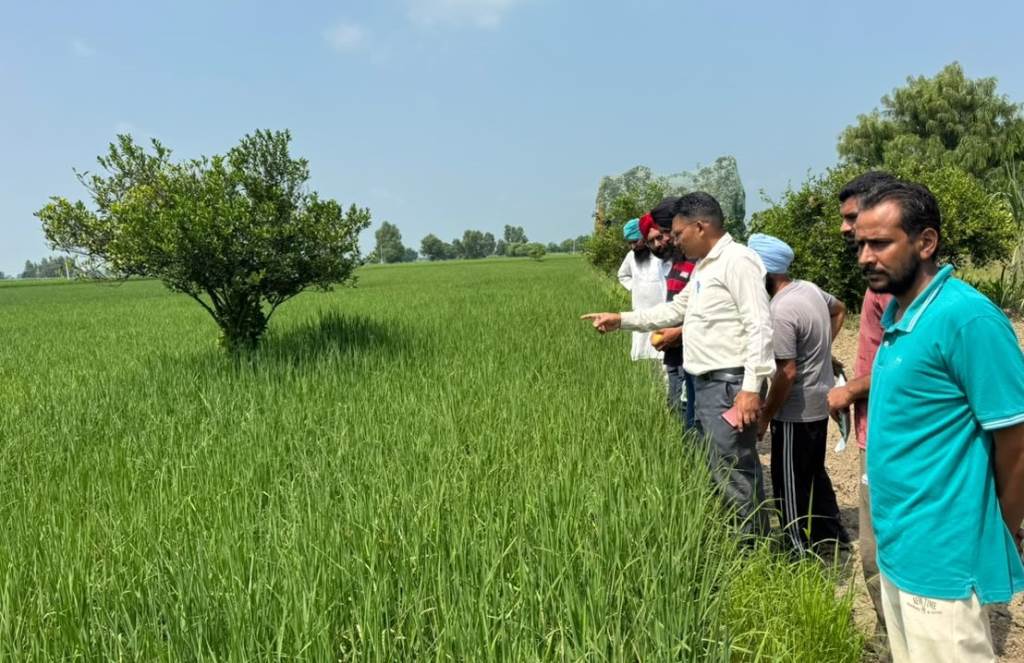
Sangrur, September 7:- Under the guidance of the Director of Extension Education, Punjab Agricultural University, Ludhiana, the PAU-Farm Advisory Service Centre (FASC), Sangrur organized demonstrations on the cultivation of winter vegetables in kitchen gardens at village Sangatpura. The initiative aimed to encourage rural families to make productive use of available space around their homes and grow fresh, nutritious vegetables according to their household requirements. Dr. Ashok Kumar Garg, Senior Extension Scientist and In-charge, PAU-FASC, Sangrur, provided farmers with practical and scientific information on the selection of suitable winter vegetables, appropriate sowing time, balanced use of fertilizers, irrigation management, and scientific maintenance of kitchen gardens.
Dr. Garg emphasized that kitchen gardening has gained considerable importance in the present-day context as an effective means of improving household nutrition and reducing expenditure on vegetables. He said that even a small area around the house can be utilized efficiently to grow a variety of vegetables according to the daily needs of the family. A well-managed kitchen garden can provide a regular supply of fresh, clean and nutritious vegetables, while also reducing dependence on market purchases and thereby helping to lower household expenditure.
He further explained that kitchen gardening does not necessarily require a large area of land. Suitable spaces in the courtyard, backyard, vacant areas, or even land available near tube wells in agricultural fields can be utilized for growing vegetables for household consumption. Such an approach enables families to make efficient use of limited land and available resources while ensuring a continuous supply of fresh vegetables during different seasons.
Awareness created about potassium nitrate application in paddy
During the programme, farmers were also sensitized about balanced nutrient management in paddy and the use of potassium nitrate (13:0:45) for managing sterility and improving grain filling.
Dr. Garg explained that a 1.5 per cent foliar spray of potassium nitrate (13:0:45) at the booting stage is recommended for improving grain filling and reducing the proportion of unfilled grains in paddy. For this purpose, 3 kg of potassium nitrate can be dissolved in 200 litres of water and sprayed per acre. He emphasized that fertilizers should be applied judiciously as part of balanced nutrient management and in accordance with PAU recommendations.
Farmers urged to participate in PAU Kisan Melas
Dr. Garg also apprised the farmers about the Kisan Melas being organized by Punjab Agricultural University during September 2026. He encouraged farmers to participate in these events in large numbers to gain first-hand information about new agricultural technologies, improved crop varieties, farm machinery, crop management practices and the latest recommendations of the University.
He stated that scientific farming, together with household-level vegetable production, can make an important contribution towards improving family nutrition, reducing household expenditure and promoting efficient use of natural resources. He encouraged farmers to adopt modern and scientific agricultural technologies and follow PAU recommendations for sustainable and profitable farming.
The demonstrations were successfully organized with the special cooperation of village residents S. Sukhtar Singh, S. Gurwinder Singh, S. Gobinder Singh, S. Pargat Singh and S. Karamjit Singh (Fauji).
At the conclusion of the programme, Dr. Garg also visited the basmati crop of S. Sukhtar Singh and the bed-sown paddy field of S. Karamjit Singh. He assessed the crop condition and provided need-based technical guidance regarding nutrient management and other crop-production practices in accordance with the recommendations of Punjab Agricultural University.