
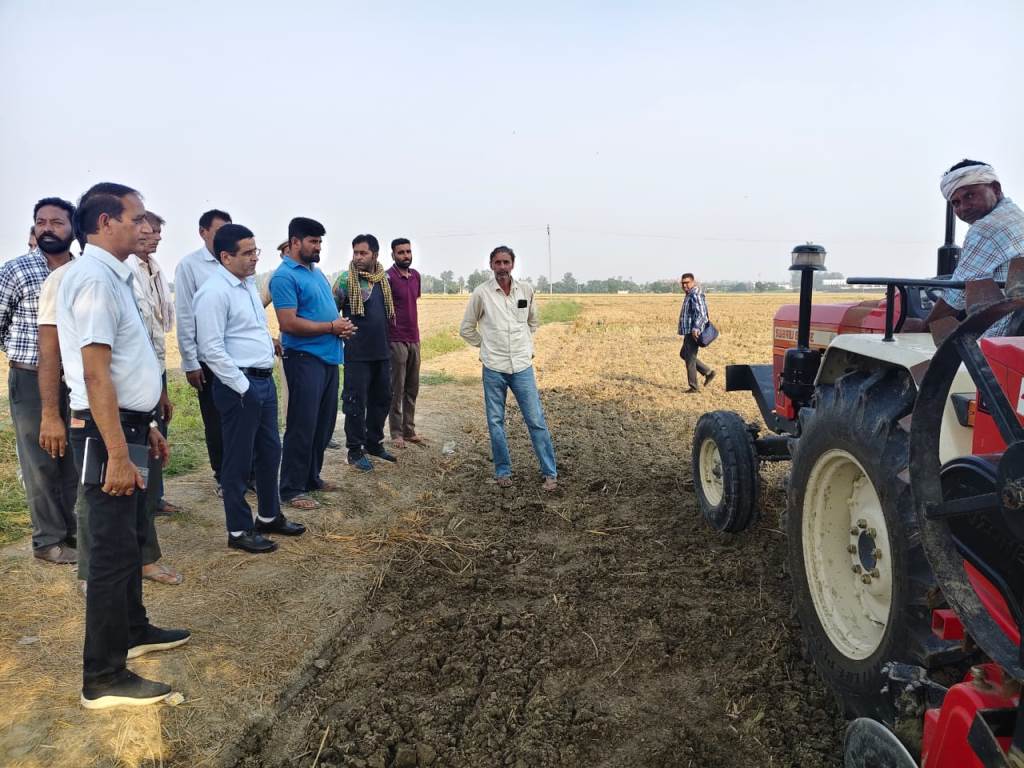
Karnal, November 26: Dr. Wazir Singh, Deputy Director of the Agriculture and Farmers Welfare Department, stated that this year, paddy crops were planted on 425,000 acres in the district, and harvesting has almost concluded. He added that an 85 percent reduction in stubble burning cases has been recorded in the district. This reduction was made possible by conscious farmers and the crop residue management campaign.
Dr. Wazir Singh stated that a total of 13 cases of stubble burning have been detected through satellite surveillance so far, compared to 84 last year. Additionally, seven cases of stubble burning have been detected by village-level enforcement teams. He stated that FIRs have been filed against 15 farmers, and fines of up to ?30,000 have been imposed on them, along with a red entry on the Meri Fasal Mera Byora portal. These farmers will not be able to sell their crops at the MSP for the next two seasons.
Efforts Under the Crop Management Campaign
Deputy Director Wazir Singh stated that efforts were made in collaboration with the district administration to reduce stubble burning. District, block/tehsil, and village-level committees/enforcement teams were formed, with approximately 750 officers and employees deployed. To prevent such incidents, door-to-door campaigns were conducted to encourage farmers to avoid burning stubble and crop residue and to manage their crop residue. Gram Sabhas were held in each village with the support of the Sarpanch and aware farmers. Announcements were made in the morning and evening to discourage burning of stubble in temples and Gurudwaras, and legal action was taken against farmers who set fires.
He stated that flag marches were held several times in each block, attended by the respective SDM, BDPO, senior police, and agriculture department officials. During the flag marches, farmers were urged to adopt crop residue management and make stubble a source of income instead of burning it. Additionally, control rooms were established at the district and block levels to address complaints related to stubble burning. Information about the in-charges of these control rooms was provided to farmers through newspapers, ensuring timely resolution of any problems related to crop residue management.
He stated that this year, all combine harvester owners were issued notices to install a Super Straw Management System while harvesting paddy, and no combine harvester was permitted to harvest paddy without a Super Straw Management System. These inspections were also conducted by district-level, block/tehsil-level, and village-level committees/enforcement teams, and any combine harvester found harvesting paddy in Karnal district without a Super Straw Management System was subject to legal action.
The Deputy Director of Agriculture stated that under the Crop Residue Management Scheme, online applications were also invited this year for 50 percent subsidy on agricultural equipment such as Super SMS, Baling Machine, Happy Seeder Rotary Slasher/Shrubmaster, Paddy Straw Chopper/Mulcher, Hydraulic Reversal MB Plow, Zero Till Drill, Super Seeder, Surface Seeder, Tractor-Driven/Automatic Crop Reaper/Reaper Cum Binder, Loader, and Tender Machines. A total of 1110 farmers were selected from all the applications.
He informed that by using all these agricultural equipment, all the farmers can manage the crop residues through ex situ and in situ methods, mixing the residues in the field, preventing burning, direct sowing of the next crop and collecting them and making bales for fodder or other uses. By doing this, the farmer is given an incentive amount of Rs. 1200 per acre under the Crop Residue Management Scheme.
Dr. Wazir Singh has requested the farmers not to set fire to the stubble and crop residues left in the fields and by becoming aware farmers, take advantage of the incentive amount of Rs. 1200 per acre under the Crop Residue Management Scheme.