Chandigarh, April 24:- The Haryana government will set up 23 new CAAQMS for accurate monitoring of air quality in NCR. Also, an aggregator policy will be brought soon to regulate cab and ride-sharing services operating in the state.
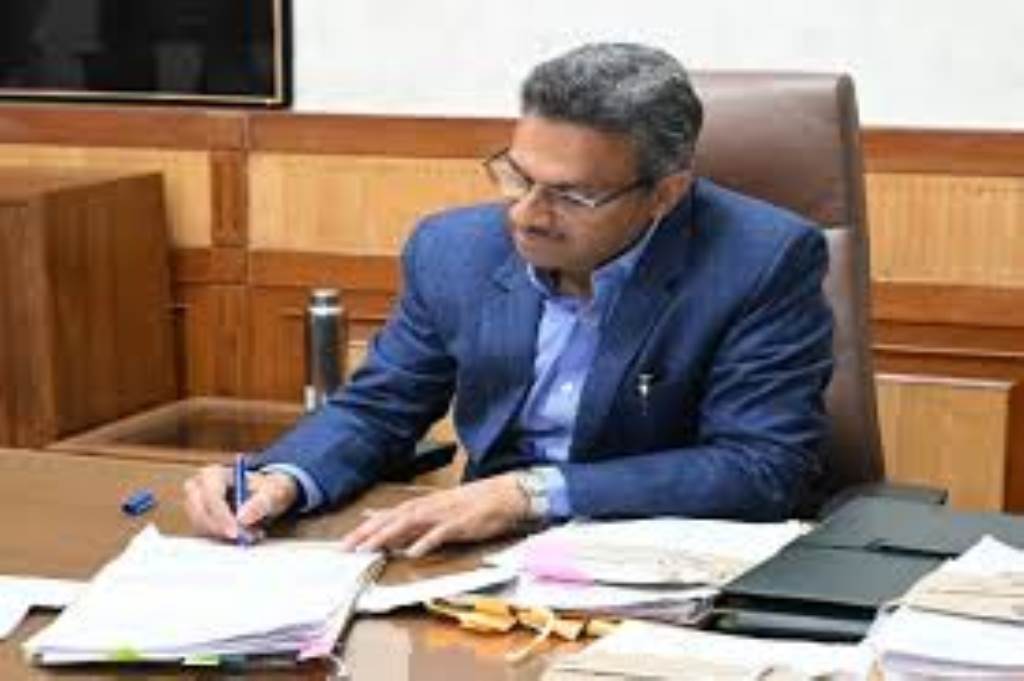
Chief Secretary Shri Anurag Rastogi conducted a comprehensive review of various initiatives related to air pollution control and air quality management in the National Capital Region (NCR). In this high-level meeting, special emphasis was laid on the effective implementation of the multi-sectoral action plan with the target of reducing pollution by 30-35 percent.
The Chief Secretary directed the Municipal Commissioners of NCR and the Metropolitan Development Authorities of Gurugram, Faridabad and Sonipat to identify at least five major roads and develop them as model dust free roads. In this regard, a comprehensive and time-bound action plan should be prepared for the year 2026 from preparation of the detailed project report to completion of the work.
He said that pollution from transport, construction and demolition activities and industrial emissions will have to be controlled effectively through precise planning and time-bound implementation.
Additional Chief Secretary of Environment, Forest and Wildlife Department, Mr. Sudhir Rajpal stressed on the need for a thorough investigation of pollution from vehicles in the region. He said that compliance with vehicle pollution standards should be strictly enforced at the ground level and action should be taken against vehicles emitting high levels of pollution by conducting special inspection drives on the major roads of NCR. He stressed on the use of state-of-the-art technology for monitoring the emission of running vehicles and issuing challans on its basis.
Chief Secretary Mr. Anurag Rastogi directed the Transport Department to collect data from the pollution testing centres to ascertain in which cases the certificate was refused and in which cases the emission standards were found to be more than the prescribed limit.
Additional Chief Secretary, Transport Department Mr. Raja Shekhar Vundru said that an aggregator policy would be brought soon to regulate cab and ride-sharing services operating in the state. This would bring a large fleet of private vehicles under the regulatory framework and ensure that vehicles associated with aggregators comply with the prescribed emission standards and contribute to the overall efforts to reduce pollution from transport in the region.
He also said that as per the directions of the Commission for Air Quality Management (CAQM), diesel autos have been almost completely banned in major districts of NCR and in the remaining areas they will be banned in a phased manner by December 31, 2026. Giving information about the Nawan Safar Yojana, he said that under this, about 1.9 lakh old trucks and 16,000 buses will be replaced with BS-6, CNG and electric vehicles. Facilities like financial incentives and tax exemptions will be provided under the scheme.
Haryana State Pollution Control Board Chairman Shri J. Ganesan said that for accurate monitoring of air quality in NCR, the number of CAQMs will be increased from 29 to 52 by July, 2026. Tenders for this will be floated in the first week of May.
Board Member Secretary Mr. Yogesh Kumar said that 889 industrial units were directed to install Continuous Emission Monitoring System (CEMS), out of which 871 units have installed the system and 735 units are actively sharing data. All large and medium industries have been directed to upgrade pollution control equipment by July and mini industries by September, 2026.
Director General of Agriculture and Farmers Welfare Department Mr. Raj Narayan said that there has been a reduction of more than 90 percent in the incidents of paddy stubble burning as compared to the year 2016. He also informed that a shortage of about 13,000 CRM machines has been identified, which will be completed before the paddy harvesting season.
Chief Secretary Shri Anurag Rastogi also reviewed the City Action Plans of the seven Municipal Corporations of NCR for the year 2026. The Municipal Commissioners participated in the meeting through video conferencing. These action plans adopt a 360 degree approach to reduce air pollution, ensuring the coordination role of the departments of Transport, Police, GMDA, FMDA, SMDA, Haryana State Pollution Control Board, Forest, Public Works, NHAI, Energy and Industries. The action plan includes road dust control, reduction in construction and demolition emissions, resolution of traffic congestion points, expansion of air monitoring network, last mile connectivity, end-to-end pavement of roads, expansion of green space, development of electric buses and EV charging infrastructure and expansion of parking facilities. Also, the target has been set to completely eliminate old solid waste by March 31, 2027.
Municipal corporations are also planning to set up processing plants for construction and demolition waste management and a secondary collection point in every 25 sq km area.
The meeting also reviewed the progress of dust control measures through mechanized road sweeping machines, water sprinklers and anti-smog guns.
Air quality will be monitored accurately in NCR 23 new CAAQMS will be set up