National Conclave on BioE Highlights Indias Path Towards IndustryReady Biomanufacturing

SAS Nagar, Mohali, 31st August, 2026:- The National Conclave on “BioE³ (Biotechnology for Economy, Environment and Employment): Enabling Scales for Industry-Ready Biomanufacturing” was held today at the Biotechnology Research and Innovation Council–National Agri-Food Biotechnology Institute (BRIC-NABI), Mohali, marking two years of the transformative BioE³ Policy. The Conclave brought together policymakers, scientists, academic institutions, industry leaders, startups and other stakeholders to deliberate on strengthening India’s biotechnology ecosystem and accelerating the translation and scale-up of scientific innovations into industry-ready biomanufacturing solutions. The programme focused on the role of biotechnology in advancing the vision of Viksit Bharat, with discussions spanning agriculture, healthcare, sustainability, carbon capture and utilisation, bio-based products and emerging technologies.
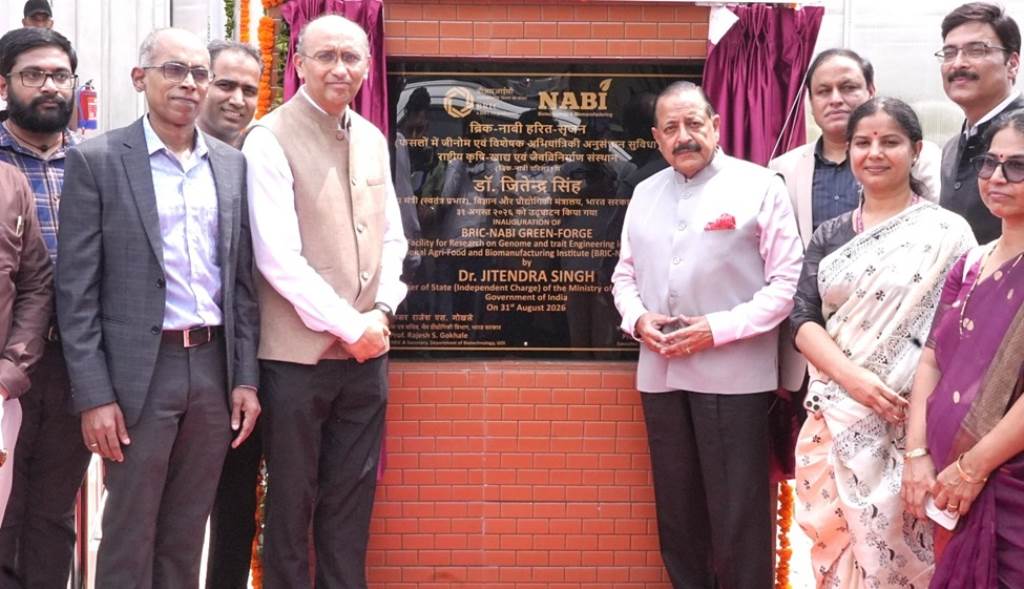
The Conclave was graced by Dr. Jitendra Singh, Hon’ble Minister of State (Independent Charge), Ministry of Science and Technology and Ministry of Earth Sciences, Government of India, as the Chief Guest. Prof. Rajesh S. Gokhale, Secretary, Department of Biotechnology (DBT), Director General, Biotechnology Research and Innovation Council (BRIC), and Chairman, Biotechnology Industry Research Assistance Council (BIRAC), also graced the occasion. The event was held in the esteemed presence of Prof. Ashwani Pareek, Executive Director, BRIC-NABI, Mohali, Dr. Sangita M. Kasture, Head, Biomanufacturing Directorate, DBT, along with Dr. Dhananjay K. Tiwari, Managing Director, BIRAC.
A major highlight of the Conclave was the inauguration of “GREEN FORGE – Shaping the Crops of Tomorrow”, showcasing the potential of controlled-environment technologies, biotechnology and advanced research approaches for developing next-generation agricultural solutions.
Addressing the gathering, Prof. Rajesh S. Gokhale highlighted India’s transition towards a new era of biotechnology, where biological systems are increasingly integrated with Artificial Intelligence, automation, sensors, robotics and advanced manufacturing. He explained that this convergence can enable programmable biomanufacturing, smart biofactories, AI-powered biofoundries, precision therapeutics, climate-smart agriculture and circular bioeconomy platformsThe Conclave further focused on strengthening public–private partnerships for scaling innovations under BioE³. The discussions emphasised the importance of creating mechanisms that can bridge the gap between research and commercial deployment and enable promising technologies to reach industrial scale. The D.E.S.I.G.N. for BioE³ initiative also recognised young innovators, with Certificates of Merit awarded to 36 winning teams from the December 2025–April 2026 cycle, while 28 winning solutions from the January–March 2026 cycle received prizes of ?1 lakh each. The students also interacted with the Hon’ble Minister, sharing insights into their winning innovations under D.E.S.I.G.N. for BioE3 and discussing their ideas for advancing biotechnology-led solutions. The programme also witnessed the launch and announcement of an Interactive Platform for Biofoundry and the Sustainable Aviation Fuel (SAF) Flagship Project on Bio-SAF and Bio-SMART under the India–HE programmes.
In his address, Dr. Jitendra Singh congratulated BRIC-NABI for hosting the Conclave and expressed confidence that the Institute would emerge as a torchbearer of India’s biotechnology revolution. He highlighted the potential of GREEN FORGE to recreate precisely controlled environmental conditions, including light, humidity and temperature, for advanced agricultural research, and noted that integrating such capabilities with Artificial Intelligence could further accelerate innovation in agriculture and allied sciences. He also appreciated the participation of young innovators, describing their enthusiasm and innovative work as a strong promise for the emergence of a new India.
The Conclave also provided an opportunity to showcase BRIC-NABI’s advanced research and infrastructure through a visit to the Param Smriti SuperComputing Facility, DBT SPEEDY-SEEDS and Biofoundry (Agri-Food Bio-Mug). The visit provided participants with an overview of the Institute’s capabilities in advanced computing, agricultural research and biomanufacturing infrastructure.
The deliberations reaffirmed the importance of connecting research, innovation, entrepreneurship, industry and policy to build a robust and scalable biomanufacturing ecosystem. The programme closed with valuable recommendations from the dignitaries, setting a clear direction for strengthening collaborations and accelerating the scale-up of biomanufacturing innovations.