
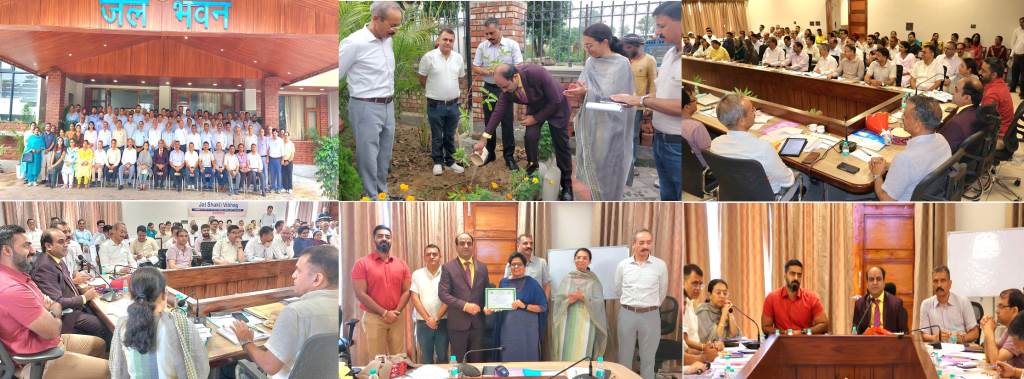
Una, July 2: A state-level review meeting and workshop were held in Haroli on Thursday as part of ongoing efforts—led by Deputy Chief Minister and Jal Shakti Minister Mukesh Agnihotri—to make the functioning of the Jal Shakti Department technology-driven, more accountable, and citizen-centric. The meeting was presided over by the Department's Principal Secretary, Dr. Abhishek Jain. He stated that the department aims to ensure the timely, effective, and citizen-centric delivery of all services, including drinking water supply, irrigation, sewerage, water conservation, and flood management. To achieve this, he emphasized the need to further strengthen technology-based operations, regular field monitoring, accountability, and public participation.
The Principal Secretary instructed officials to ensure that public grievances, received through any channel, are resolved within a maximum of 10 days. If an immediate resolution is not possible for any reason, the complainant must be informed accordingly. He stressed that interactions with the public should be sensitive and positive, and every complaint must be treated seriously.
The meeting was attended by Deputy Commissioner Jatin Lal; Engineer-in-Chief (Project, Mandi Zone) Dharmendra Gill; Engineer-in-Chief Anju Sharma; Chief Engineer (Hamirpur Zone) Rohit Dubey; and Chief Engineer (Shimla) Anil Mehta. Also present were Jal Shakti Department officials, technical experts, consultants, representatives of Panchayati Raj institutions, and beneficiaries of departmental schemes from Una, Hamirpur, and Bilaspur districts, as well as the Jogindernagar, Dharampur, and Chauntra areas of Mandi district (which falls under the Hamirpur Zone).
Dr. Jain stated that the objective of these state-level review meetings is not merely to examine progress reports but to assess the ground-level reality of the schemes. Officials should regularly visit villages to interact with the public and improve scheme implementation based on their needs and suggestions. He noted that this series of meetings began in Kullu; following today's meeting in Una, the next meetings will be held in Palampur and Shimla. **Public Participation: Key to the Success of Schemes**
He stated that public participation plays a crucial role in the success of the Jal Shakti Department's schemes. Priority should be given to suggestions from Panchayat representatives, water committees, and local residents. Emphasizing the need to increase women's participation, he noted that their role in water management at the household level is vital. A sense of ownership should be fostered among the public, making them feel that these departmental schemes belong to them and that the responsibility for their preservation lies with society.
**Officials to Conduct Regular Inspections**
The Principal Secretary directed that SDOs personally inspect schemes costing over ?1 crore every month, while Executive Engineers should inspect those costing over ?5 crore. Inspections should be surprise checks rather than pre-scheduled visits, and reports must be submitted regularly to headquarters. He instructed officials to stay overnight in remote areas to gather feedback from the local population.
**Directives for Resource Mapping and Creating Digital Records**
He ordered resource mapping and the creation of digital records for the department's land, buildings, machinery, and other assets. He emphasized the need for an updated digital database of all departmental assets to ensure their effective management, monitoring, and preservation.
The Principal Secretary stressed the importance of documenting the department's achievements and creating short videos, while also making maximum use of new technologies, best practices, and studies related to management, leadership, and smart governance.
He directed that the district administration be informed immediately if any drinking water or irrigation scheme is threatened by illegal mining. Additionally, effective measures should be taken to conserve traditional water sources—such as *bawris* (stepwells) and *khuis* (traditional wells)—and to minimize leakage as well as transmission and distribution losses in drinking water schemes.
**Emphasis on Monsoon Preparedness; Special Focus on Vulnerable Schemes**
Placing special emphasis on monsoon preparedness, the Principal Secretary instructed officials to identify potentially vulnerable schemes in advance and keep necessary machinery and resources fully ready. He directed that proactive preparations be ensured to minimize damage to drinking water and other Jal Shakti schemes during the rains and to prevent any inconvenience to the public. He also directed that information regarding necessary resources be made available in a timely manner.
**Emphasis on developing ponds for water conservation**
Emphasizing the inclusion of water conservation and energy efficiency among the department's priorities, he instructed officials to conserve natural water sources, ponds, and reservoirs, and to develop new ponds. Citing the Pubowal pond in Haroli as an exemplary model, he stated that similar initiatives should be undertaken in other districts. He also stressed the need to accelerate water conservation activities through the convergence of MGNREGA and the Jal Shakti Department.
**Review of Progress on Key Projects**
During the meeting, the Principal Secretary reviewed major projects related to drinking water, irrigation, sewerage, drainage, flood management, and water conservation. He assessed the progress of several initiatives—including the ?24.10 crore Tahliwal Sewerage Scheme, the proposed ?22 crore Tahliwal Drainage Scheme, the ?75 crore Beet Area Irrigation Project-II, Command Area Development and Modernization projects worth approximately ?97 crore in the Haroli area, the drinking water supply system for the Bulk Drug Park, the ?170 crore Bhabhaur Sahib Drinking Water Project, and the Sanauli Majra Drainage Scheme—and directed officials to complete all works within the stipulated timeframes.
He noted that the state has received approval for ?250 crore under the Jal Jeevan Mission. Instructing officials to immediately upload pending action plans, he stated that this would ensure the timely availability of approved funds and prevent unnecessary delays in project execution. Additionally, he called for the early completion of pending Project Completion Reports for NABARD-funded projects and the acceleration of remaining works under the Pradhan Mantri Krishi Sinchayee Yojana.
He also reviewed the progress of the ?145 crore Hamirpur Zone ADB project, the ?142 crore Una ADB project, and the Sakrai Khad Flood Management Scheme (costing over ?140 crore), issuing directives for their time-bound implementation. Projects pending due to issues such as the lack of electricity supply were also reviewed alongside initiatives under the Swachh Bharat Mission and AMRUT Mission.
**Directives to Strengthen Operational Procedures**
The Principal Secretary issued instructions to integrate departmental offices into the e-Office system in a phased manner, conduct all tendering and office procedures in compliance with established rules and transparency, and ensure the resolution of matters related to new drinking water connections within one month. He also emphasized the need to develop effective mechanisms to prevent the theft of pipes and motors, keep departmental offices and project information boards updated, and ensure strict adherence to the 50-point Standard Operating Procedure (SOP) issued for the maintenance of departmental rest houses. **Feedback Sought from Panchayat Representatives and Water Committees**
During the meeting, the Principal Secretary interacted directly with Panchayat representatives, members of water committees, and beneficiaries. He gathered feedback on various local issues—including drinking water, irrigation, water quality, water supply in industrial areas, water availability, and the cleaning of tanks and ravines—and issued necessary directives to the concerned officials. He also inquired about the status of waterborne diseases and emphasized the need for continuous improvement in services to meet public expectations.
**Emphasis on Coordination and Teamwork**
Speaking at the event, Engineer Dharmendra Gill, Engineer-in-Chief (Project) of the Jal Shakti Department (Mandi), noted in his welcome address that the department's operational efficiency and coordination have gained new momentum under the leadership of Deputy Chief Minister Shri Mukesh Agnihotri and the guidance of Principal Secretary Dr. Abhishek Jain. He stated that the department is moving towards achieving better results through innovation, the use of technology, and teamwork.
Deputy Commissioner Jatin Lal affirmed that the district administration would continue to work as a unified team in coordination with the Jal Shakti Department. He expressed confidence that the timely and high-quality implementation of all projects related to drinking water, irrigation, and other infrastructure would be ensured, allowing the benefits to reach the public on time.
**Discussions on IoT and Water Quality in Technical Sessions**
In the technical sessions held after the inaugural session, experts and officials engaged in detailed discussions on topics such as IoT-based monitoring, conservation and recharging of water sources, consumer-centric service delivery, and maintaining water quality in rural drinking water schemes. Participants shared their experiences during various panel discussions and offered practical suggestions to enhance the effectiveness of the department's operations.
**Officials Honored for Excellence; Certificates Awarded to Participants**
At the conclusion of the event, Principal Secretary Dr. Abhishek Jain distributed participation certificates to the workshop attendees. Officials and engineers who had performed exceptionally well within the department were also honored with commendation certificates. The officials honored included Superintending Engineers Vikas Kapoor, Naresh Dhiman, and Rahul Dubey; Executive Engineers Rakesh Vaidya, Vivek Hajri, Puneet Sharma, and Pankaj Kumar; and Assistant Engineers Amit Chaudhary, Ravindra Kumar, Rakesh, Ashish Chaudhary, Nisha, Pradeep Rathore, Avinash Parashar, Pawan, and Aman Kumar.
**Public Representatives Express Gratitude to the Deputy Chief Minister**
During the public interaction session, panchayat representatives and beneficiaries from the Haroli area expressed their gratitude to Jal Shakti Minister and Haroli MLA Mukesh Agnihotri, noting that his efforts have given fresh momentum to drinking water, irrigation, sewerage, and other Jal Shakti projects in the region. They stated that the benefits of the approval of numerous significant schemes and the work done towards finding permanent solutions to water-related issues are reaching the people.
Representatives including Subhadra Chaudhary, Raman Kumari, and Yashpal Rana expressed their gratitude to Principal Secretary Dr. Abhishek Jain, alongside Jal Shakti Minister Mukesh Agnihotri.