
Chandigarh, May 11:— Driven by the educational reforms implemented by the Punjab government under the leadership of Chief Minister S. Bhagwant Singh Mann, students from rural areas have outperformed their counterparts in urban schools in the Class 10 results announced today by the Punjab School Education Board. The pass percentage in rural areas was recorded at 95.35%, while in urban areas, it stood at 92.98%.
Sharing these details here today, Punjab Education Minister S. Harjot Singh Bains lauded the results, describing them as a testament to the effective implementation of an 'Education Revolution' at the grassroots level.
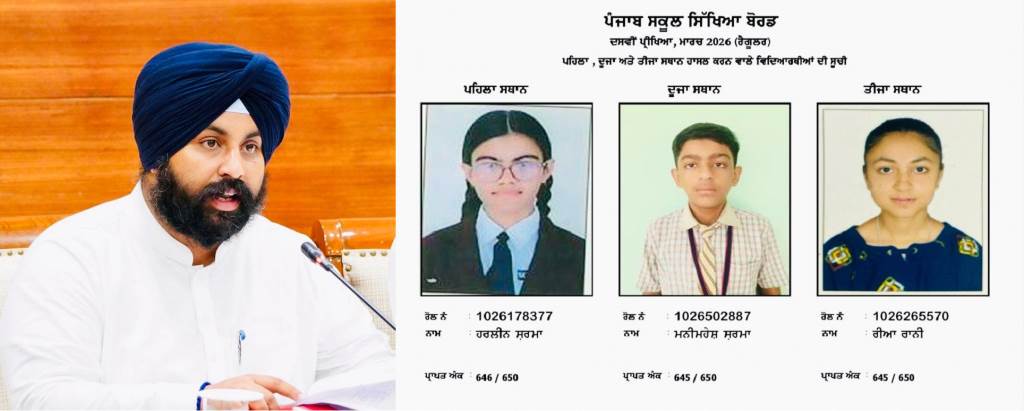
Harleen Sharma, a student of Saraswati Senior Secondary School, Jaito (Faridkot), secured the first position across the entire state of Punjab by obtaining 646 out of 650 marks (99.38%). In a closely contested race, Manimahesh Sharma of Government Senior Secondary School, Chanouli Bassi (Rupnagar), secured the second position with 645 out of 650 marks (99.23%). Riya Rani of Sri Guru Harkrishan Public School, Chief Khalsa Dewan, Model Town, Hoshiarpur, secured the third position with 645 out of 650 marks (99.23%).
S. Harjot Singh Bains informed that a total of 2,69,505 students appeared for the Class 10 board examinations, out of whom 2,54,744 students were declared successful. Consequently, the overall pass percentage stood at 94.52%. Rural students delivered a superior performance, surpassing their urban counterparts. From rural areas, 1,74,958 students took the examination, of whom 1,66,830 passed, resulting in a pass rate of 95.35%. Meanwhile, 94,547 students from urban areas appeared for the examination, of whom 87,914 passed, recording a pass rate of 92.98%.
Extending his heartfelt congratulations to all the successful students, S. Bains stated that the 2.3 percentage-point gap between the pass rates of rural and urban areas marks a historic shift compared to trends observed in previous years, as urban schools had historically tended to hold the lead. He attributed this transformation to the investments made in educational infrastructure and the regular training mechanisms provided to teachers.
He further remarked that this serves not merely as a report card for the students, but also as a report card for a government that believes in providing equal opportunities rather than privileging a select few.