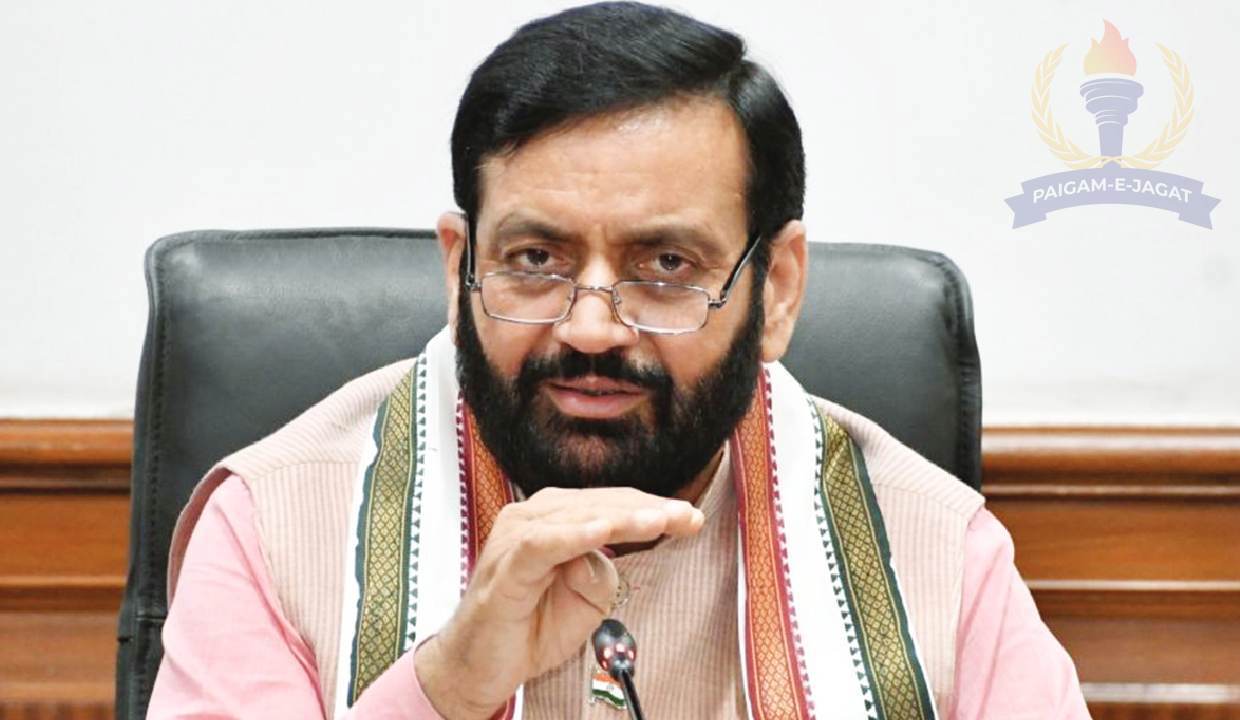
Chandigarh, October 30:- Haryana Chief Minister Nayab Singh Saini said that Prime Minister Narendra Modi launched a scheme that gave a new definition to the relationship between farmers and the government. It was the PM-Kisan Samman Nidhi scheme, under which, for the first time at the national level, provision was made to transfer financial assistance directly into farmers’ bank accounts from the very first day.
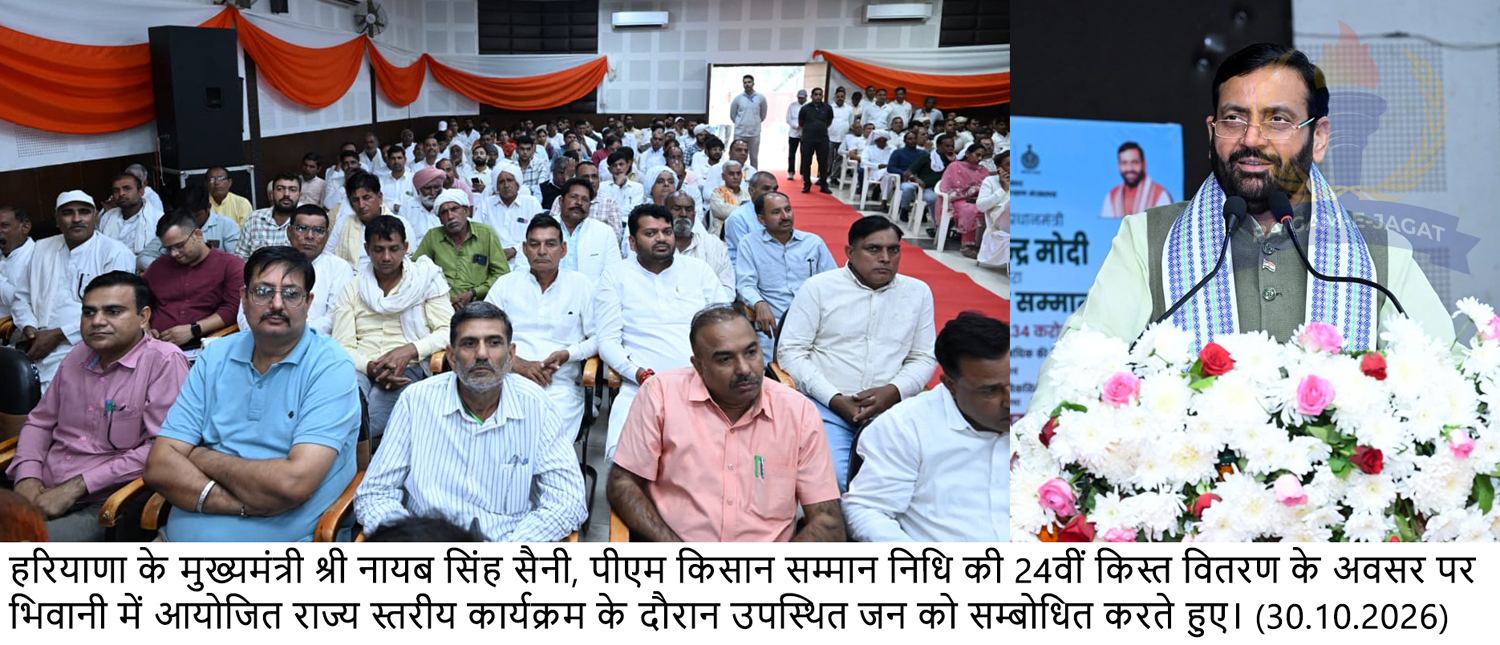
Chief Minister Nayab Singh Saini was addressing a programme organised in Bhiwani on Friday to release the 24th instalment for farmers of the state. Agriculture and Farmers Welfare Minister Shyam Singh Rana, MP Dharambir Singh, Bhiwani MLA Ghanshyam Saraf, Bawani Khera MLA Kapoor Valmiki, Badhra MLA Umed Patuwas, Women’s Commission Vice-Chairperson Meena Parmar, along with several senior officials and office-bearers, were present on the occasion.
The Chief Minister said that more than 86 per cent of the country’s farmers are small and marginal farmers. Small farmers need money for seeds, fertilisers and ploughing at the time of sowing. Out of compulsion, they had to borrow money from moneylenders at high interest rates, and even before the crop was harvested, a major portion of their earnings would go towards repaying loans.
The Prime Minister understood the hardships faced by farmers and resolved that they should not have to depend on anyone for essential agricultural expenses. The scheme initially began with small and marginal farmers, but within a few months it was extended to all landholding farmer families across the country. The Prime Minister’s vision was to make farmers prosperous and strong and increase their income. The PM-Kisan Samman Nidhi has worked towards empowering farmers.
The Chief Minister said that today it is one of the world’s largest Direct Benefit Transfer (DBT) schemes. What began with small instalments has now grown into a vast pool of more than Rs 4.47 lakh crore. Even when the COVID-19 pandemic brought the entire world to a standstill, more than Rs 1.71 lakh crore was transferred to farmers through this scheme, keeping the wheels of the rural economy moving.
Prime Minister Releases 24th Instalment from Banaskantha, Gujarat; More Than 9.34 Crore Farmers Become Beneficiaries
Every Fourth Woman Beneficiary of the Scheme Is a Farmer
The Chief Minister said that today, nearly every fourth beneficiary of the scheme is a woman farmer, with more than Rs 1.06 lakh crore having been transferred into their accounts. All this has been achieved without any middlemen, commission or recommendation. As part of this initiative, the Prime Minister released the 24th instalment from Banaskantha in Gujarat.
With the press of a button, more than Rs 18,680 crore was transferred directly into the accounts of over 9.34 crore farmer families across the country. With this, the total amount disbursed under the scheme has crossed Rs 4.65 lakh crore.
Centre Approves Rs 3.15 Lakh Crore for the Scheme up to 2030-31
The Chief Minister said that 16.23 lakh farmer families in Haryana are also beneficiaries of this scheme, with Rs 324.75 crore transferred into their accounts. Of these, 1.21 lakh farmer families in Bhiwani have received Rs 24.20 crore. Through 24 instalments, a total of Rs 8,206.36 crore has so far been transferred to farmers in Haryana, and this assurance has also been secured for the coming years. The Central Government has approved Rs 3.15 lakh crore for the scheme up to 2030-31. This is the guarantee given to farmers by Prime Minister Modi.
He said that Bhiwani is known across the country as Chhoti Kashi and Mini Cuba, and is famous as the land of boxers. It is also the land of great personalities such as Haryana Kesari Pandit Neki Ram Sharma and Vikas Purush Chaudhary Bansi Lal. Despite limited water and sandy soil, farmers here have worked hard to keep their fields green, while the youth of the region have served the nation by protecting its borders.
The Chief Minister said that along with financial assistance, farmers should also receive quality fertilisers, seeds, water, electricity, insurance, fair prices, better markets and modern technology. With this vision, the double-engine government stands with farmers at every step, from seed to market. Haryana is the first state in the country where all 24 crops are being procured at the Minimum Support Price (MSP). During the last 13 seasons, Rs 1.90 lakh crore has been transferred to the accounts of 12 lakh farmers for the procurement of their crops.
Strict Law Enacted Against Those Selling Fake Seeds and Pesticides
He said that to ensure that farmers growing vegetables and fruits are not left behind, protected prices have been fixed for 21 horticultural crops under the Bhavantar Bharpai Yojana. Under this scheme, 49,000 farmers have received Rs 282 crore. Over the last 12 years, Rs 16,160 crore has been paid as crop insurance and compensation for crop damage. To ensure that no one cheats farmers out of the fruits of their hard work, a strict law has been enacted against those selling fake seeds and pesticides. The Prime Minister’s schemes, such as crop insurance, the Kisan Credit Card and the Soil Health Card, have become a protective shield for farmers.
The Chief Minister said that the government has also taken a major decision for sugarcane farmers. The sugarcane price has been increased from Rs 415 to Rs 430 per quintal for the current crushing season and will be raised to Rs 450 per quintal in the next season. This will increase sugarcane farmers’ income by approximately Rs 10,000 to Rs 11,300 per acre in the next season.
Prime Minister Turns National Mission on Natural Farming into a Mass Movement
He said that our ancestors considered the earth as a mother and took care of its health. Through the National Mission on Natural Farming, the Prime Minister has transformed this tradition into a mass movement, and farmers in Haryana are participating enthusiastically. Nearly 2 lakh farmers have registered for natural farming on 3 lakh acres of land, of whom 23,930 farmers have adopted it on 44,000 acres. More than 12,000 farmers have learned this method through training centres in Kurukshetra, Jind, Sirsa and Karnal.
He said that farmers in Bhiwani have well understood the value of water. Under the PM-KUSUM scheme, 1,95,653 solar pumps have been installed with a 75 per cent subsidy, and fields are being irrigated using solar energy. Farmers have also extended active cooperation in stubble management to ensure clean air. A subsidy of Rs 1,017 crore has been provided for 1.11 lakh agricultural implements and 6,794 Custom Hiring Centres, while 10 lakh farmers have received an incentive amount of Rs 909 crore.
Government Develops Integrated Value Chain Partnership Model
The Chief Minister said that agriculture will become profitable only when farmers receive market assurance along with production. For this reason, the government has developed an Integrated Value Chain Partnership Model, under which a complete value chain is being created, from seeds to processing, packaging, branding and marketing. Farmers in Haryana should not remain merely producers but should also build brands for their produce. The government is working to turn this vision into reality.
The Chief Minister said that the farmer of the future will be equipped with knowledge, science and technology. Today, drones are being used to spray fertilisers and pesticides, while information about weather and market prices is available on mobile phones. In the coming times, artificial intelligence will provide farmers with direct information about crop diseases, soil requirements and the right time for irrigation. AI is not meant only for industries and cities; farmers and fields will benefit the most from it.
He said that on November 1, Haryana will complete 60 years since its formation. During these 60 years, Haryana has emerged as the food grain storehouse of the country, and this achievement is the result of farmers’ hard work. We should therefore take pride in resolving to save every drop of water, improve the health of Mother Earth and adopt new technology.
Natural Farming Has Been Our Tradition: Agriculture Minister Shyam Singh Rana
Addressing the programme, Agriculture and Farmers Welfare Minister Shyam Singh Rana said that under the PM-Kisan Samman Nidhi scheme, farmers receive Rs 2,000 directly in their bank accounts three times a year. Small farmers understand its importance very well. The government is also providing subsidies to farmers for stubble management, purchase of machinery and fertilisers.
The Agriculture Minister said that natural farming has been our tradition and cattle have played a special role in it. Therefore, farmers should be encouraged to adopt natural farming. This should begin by stopping the use of chemical fertilisers in fodder grown for cattle and cultivating it through natural methods. This will help ensure that the milk produced by animals remains pure and tasty.