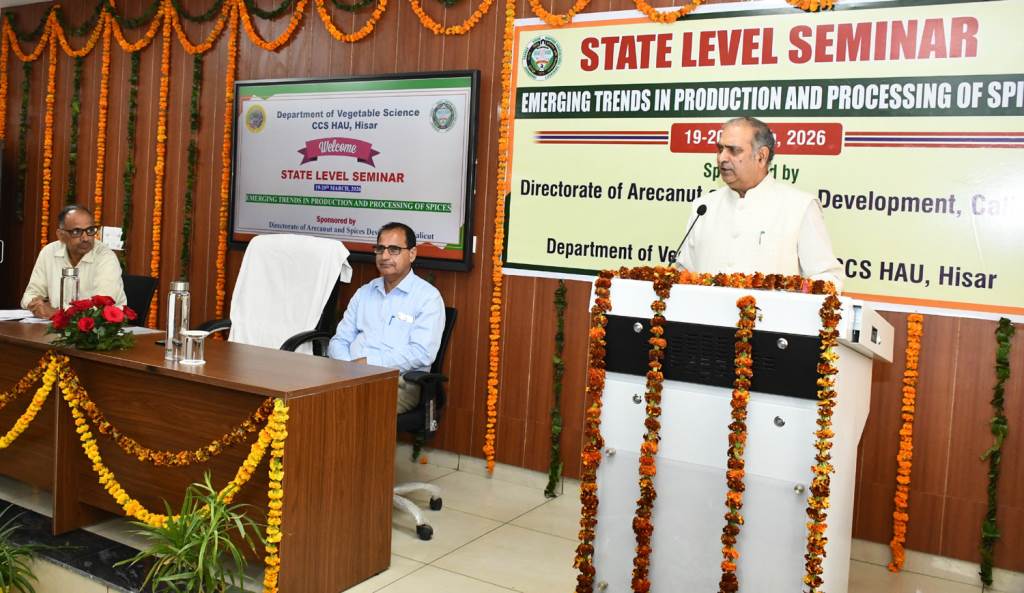
Hisar, March 20: A two-day state-level workshop on the theme "Emerging Trends in Spice Production and Processing" was organized by the Department of Vegetable Science at Chaudhary Charan Singh Haryana Agricultural University. Held in collaboration with the Directorate of Arecanut and Spices Development, Calicut (Kerala), the workshop was graced by the presence of the University's Vice-Chancellor, Prof. Baldev Raj Kamboj, who attended as the Chief Guest.
In his address, Vice-Chancellor Prof. Kamboj stated that the country's climate, geographical diversity, and agricultural traditions are extremely conducive to spice production. This is precisely why India stands today as the world's largest producer of spices. Here, more than 60 varieties of spices—such as turmeric, chilies, cumin, coriander, cardamom, and black pepper—are produced.
India is not only a leader in production but also holds a significant position in the consumption and export of spices. The global demand for Indian spices remains consistently high due to their distinct aroma, flavor, and medicinal properties. Today, Indian spices are exported to hundreds of countries, thereby strengthening the nation's economy.
The Vice-Chancellor further noted that, from an international perspective, the global market for spices is expanding rapidly. Driven by changing lifestyles, growing health consciousness, and the rising popularity of international cuisines, the demand for spices continues to surge. India holds an extremely strong position in this sector. However, we must also acknowledge that a significant portion of our spices is currently exported in their raw form.
If we focus more intently on processing, packaging, and quality enhancement, we can generate even greater returns in the global market and further consolidate our standing. Spices do not merely enhance the flavor of our food; they constitute an integral part of our culture, traditions, and economic development. Through innovation and quality improvement in this sector, we must propel India to even greater heights.
Dr. Ramesh Kumar Yadav, Director of Extension Education, remarked that this workshop holds immense utility for the Krishi Vigyan Kendras (Agricultural Science Centers). Farmers should prioritize pulse, oilseed, and spice crops over traditional crops. By undertaking animal husbandry, horticulture, and vegetable production alongside agriculture, farmers can multiply their income manifold.
Welcoming everyone, Dr. S.K. Tehlan provided detailed information regarding the workshop. Dr. Surendra Kumar Dhankhar proposed the vote of thanks. Extension specialists, horticulture officers, and farmers participated in the workshop. The proceedings were anchored by Dr. Vijay Pal. Deans, directors, officers, heads of departments, and scientists from various colleges were present on this occasion.
Global Demand for Indian Spices Driven by Their Aroma Flavor and Medicinal Properties Prof Baldev Raj Kamboj