
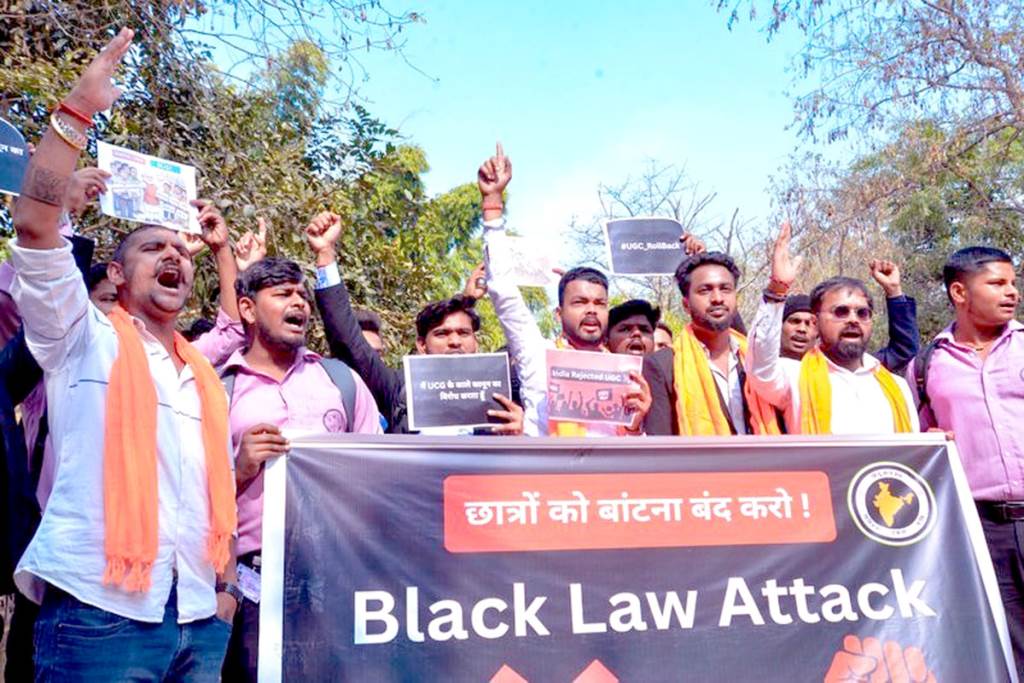
Students protest against the new Equity Rules of the University Grants Commission

New Delhi/Bareilly:- The controversy over the new rules issued by the University Grants Commission to prevent caste discrimination in higher education institutions has deepened. Despite heavy rain and barricades in Delhi on Tuesday, students protested vigorously outside the University Grants Commission headquarters.
Students say that these rules can create chaos on campuses. On the other hand, Union Education Minister Dharmendra Pradhan has assured that these rules will remain within the ambit of the Constitution and no discrimination against anyone or misuse of the rules will be allowed.
Under the ‘University Grants Commission Equity Rules 2026’ notified on January 13, it is mandatory to form an ‘Equity Committee’ in every institution, in which OBC, SC, ST, Divyang and women members are required. The committee will investigate complaints of caste-based discrimination.
While Left student organisations have welcomed the inclusion of OBCs, some student groups have demanded that representatives of the ‘general’ category also be included in it to avoid bias. The impact of this controversy was also seen at the administrative level. In Bareilly, Uttar Pradesh, City Magistrate Alankar Agnihotri resigned from his post on Republic Day, calling these rules a ‘black law’. He says these rules will spoil the academic atmosphere. The government has suspended him on charges of indiscipline, after which he has sat on a dharna outside the Collectorate office.
The matter has now reached the country’s highest court. A petition filed in the Supreme Court has challenged these rules as ‘unconstitutional’. The petitioner says that the definition of discrimination should be made 'caste-neutral'. It is noteworthy that these new rules have been prepared on the instructions of the Supreme Court after cases like Rohith Vemula and Payal Tadvi.
The University Grants Commission has assured the students that some of their demands will be considered by February 12.