
Jejo DoabaOnce a Hub of Trade During the British EraNow Lies in Ruins

Hoshiarpur: In every region, there exists a village, city, or town that has carved out a unique identity for itself in history. Although its significance may occasionally be overlooked for various reasons, its distinct identity inevitably resurfaces and manifests itself in a tangible form. Such is the case with the village of Jejo Doaba in the Hoshiarpur district; while its identity may have faded somewhat in the present day, its historical legacy remains undeniable.
Prior to British rule, the village of Jejo Doaba served as the princely estate of a local king. During that era, the ruler—a member of the Rajput dynasty named Deva Singh—and his entire family were taken captive following a skirmish that occurred during the expansion of British dominion. At the time, this village stood as the sole trading hub for the undivided Punjab and the region that now constitutes Himachal Pradesh.
Trade was conducted from this location with both domestic and international markets; merchants would arrive on camels and horses to sell their wares, and the village already boasted a thriving trade in *Khaddar* (hand-spun cotton fabric). The *Khaddar* produced here was exported as far as Tashkent (abroad). Furthermore, the very first railway station in the Hoshiarpur district was established in this village in 1914. Before the partition of the country, direct train services connected this village to Lahore and Karachi, transporting commodities such as chilies and turmeric, which were traded on a massive scale.
***Current Needs and Requirements***
The village is equipped with a 25-bed hospital, complete with eight staff quarters and two spacious bungalows (residences) for doctors; however, the hospital currently lacks both doctors and support staff. Only a single doctor visits the facility two or three times a week. Additionally, the village houses a 66 kV electrical substation. The train service—which previously ran three times a day—has been completely suspended for some time now. However, if rail services were to be resumed and this line were to be connected to Nangal, it would provide immense convenience to the people of Punjab and Himachal Pradesh. Moreover, it would greatly facilitate the pilgrims (*Sangat*) traveling to the nearby holy shrine of Sri Anandpur Sahib.
The village also features a PNB (Punjab National Bank) ATM facility. The village is equipped with modern amenities such as machinery, a post office, and a park; however, the village market—renowned for its *pedas* and other sweets—is housed within older, historic structures. While many shopkeepers have undertaken the renovation of these old buildings, others continue to conduct their business on the ground floors of these historic structures.
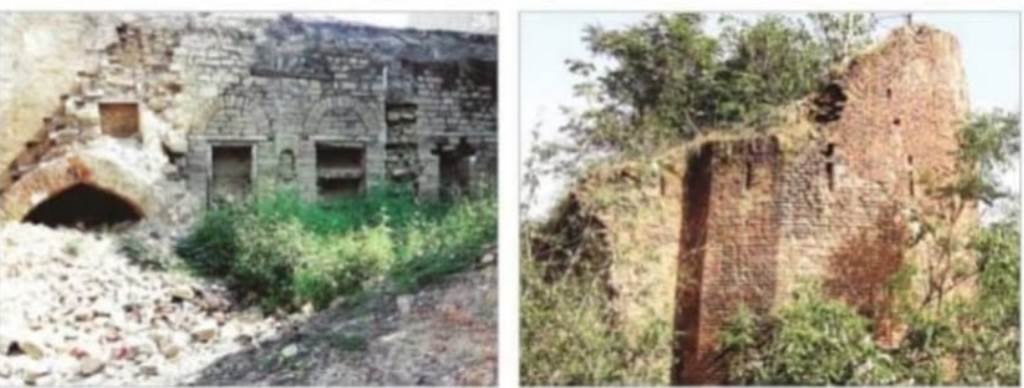
Upon venturing deeper into the village, one observes that several large buildings have fallen into ruin, posing a potential hazard to the neighboring homes situated nearby. The road leading to the main market is in disrepair in several places, marked by numerous potholes.
***What was Jejon Doaba like before the Partition of Punjab?***
Prior to the Partition of Punjab, the village was completely enclosed by a perimeter wall, and gates were installed at the entrances to its various lanes—such as Khanna Street, Jain Street, and Sood Street. Each of these lanes had a single entry point, guarded by a gate that was closed at a designated time each day. Just outside the village lay a terrain characterized by hilly features. Specifically, there stands a prominent mound (or *tilla*) right at the village's edge. In those days, if an individual committed a crime punishable by death, they would be taken to this mound and pushed off the top to carry out their sentence.
***By what names was the village known, and why?***
Home to a population of 1,500 residents, the village is inhabited by people belonging to 27 different castes. In the past, the village was also known by the name *Phalewali* (meaning "the place of fruits"), owing to the abundance of dense fruit-bearing trees that once grew there. Furthermore, the village has long been referred to as *Panj Peeron Ki Nagri* (the "City of Five Saints"). While the village is home to numerous religious sites—all of which are revered—the five principal saints (*Peers*) associated with this title are Baba Aughadnath Ji, Baba Jiju Shah Ji (after whom the village is named), Baba Manohar Das, Darbar Baba Khaki Shah Ji, and Jwala Puri Ji.
In addition to these figures, the Jama Masjid, Jain Muni Temple, the ancient Shiva Temple, Dera Ratanpuri, and the Mata Rani Temple serve as significant centers of faith and devotion within the village; there is also a shrine known as *Mahilawali* located in another part of the village. According to local accounts, the palace of Raja Man Singh once stood here, situated atop a hill-like elevation.
***There is scarcely a metropolitan city or town in the country that does not host merchants from Jejon***
When trade within the village of Jejon Doaba began to decline, the local Khanna, Jain, Sood, and Brahmin families migrated to other cities to establish and conduct their businesses. Today, no matter which corner of the country you visit, you are bound to encounter someone hailing from the village of Jejon Doaba. During the British Raj, only five individuals across the entire district paid taxes to the government—three of whom were from Jejon Doaba—despite the fact that the Hoshiarpur district encompassed a vast territory at the time, much of which has since been incorporated into the states of Himachal Pradesh and Rupnagar.
It is noteworthy that, in order to preserve the unique identity of this village, the government should periodically focus its attention on undertaking necessary repairs and maintenance, thereby ensuring that the distinct character of this historic settlement remains intact.