
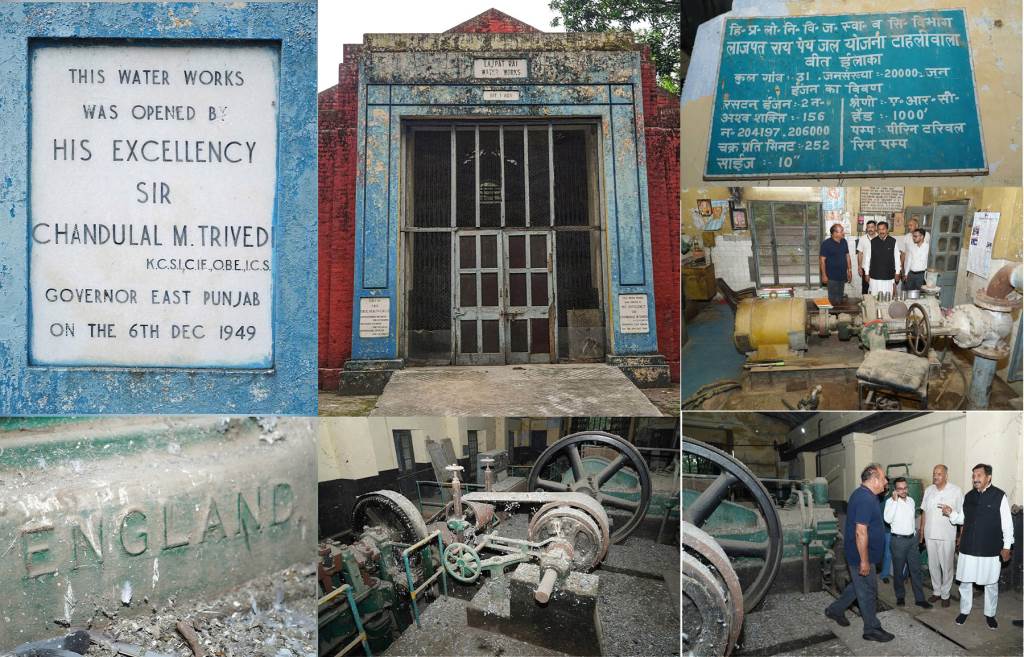
Haroli/Una, July 20:- Deputy Chief Minister Mukesh Agnihotri announced that the historic ‘Lajpat Rai Water Works’ (Tahliwal Water Supply Scheme), established in 1949 in the Beet region, will be developed into a ‘Water Supply Heritage Museum.’ The scheme’s historic pump house, the vintage pumping machinery installed within it, technical records, and other heritage elements associated with the water supply system will be restored and preserved. He issued necessary instructions to the Jal Shakti Department to this effect after inspecting the site on Saturday.
He noted that the massive vintage pumping machines, flywheel-operated equipment, and the original structure from that era remain intact in this historic pump house, serving as an excellent example of the engineering prowess of that time. All these heritage assets will be preserved in their original form. Additionally, old and historic water supply machinery from various parts of the state will be brought here for display, allowing the historic journey of the state's drinking water system development to be showcased in one place.
**Scheme Inaugurated in 1949**
Mukesh Agnihotri stated that this historic scheme was inaugurated on December 6, 1949, by Sir Chandulal M. Trivedi, the then Governor of East Punjab. At that time, the scheme was named ‘Lajpat Rai Water Works.’ It was constructed by the then Public Works and Public Health Department, and the machinery installed there was specially imported from England.
**Designed for a Population of 20,000 Across 31 Villages**
He mentioned that the scheme was originally designed to provide drinking water to a population of approximately 20,000 people across 31 villages in the Beet region. Two 156-horsepower Ruston diesel engines were installed as part of the project, facilitating drinking water supply until 1974. Later, a modern, electricity-driven pumping system was introduced, while the historic pump house and the machinery from that era remain preserved to this day.
**A Living Example of Post-Independence Technical Heritage**
The Deputy Chief Minister stated that this scheme offers insight into the conditions prevailing at the time of the country's independence. Developed with limited resources, this project stands as an excellent example of the technical proficiency and foresight of that era. He noted that while modern drinking water schemes are currently operational in the state, this historic project served as a lifeline for the local population for decades and played a pivotal role in laying a strong foundation for the state's water supply system.
**An Opportunity for the New Generation to Connect with History**
Mukesh Agnihotri stated that once developed into a heritage museum, the complex would become a significant center of knowledge for students, engineers, researchers, and the general public. The historic pump house, vintage machinery, technical records, and documents related to the evolution of the state's water supply system will be preserved and displayed here. He added that this would enable future generations to gain a close understanding of the history of public health engineering in the state and the contributions made by the engineers and officials of that time.