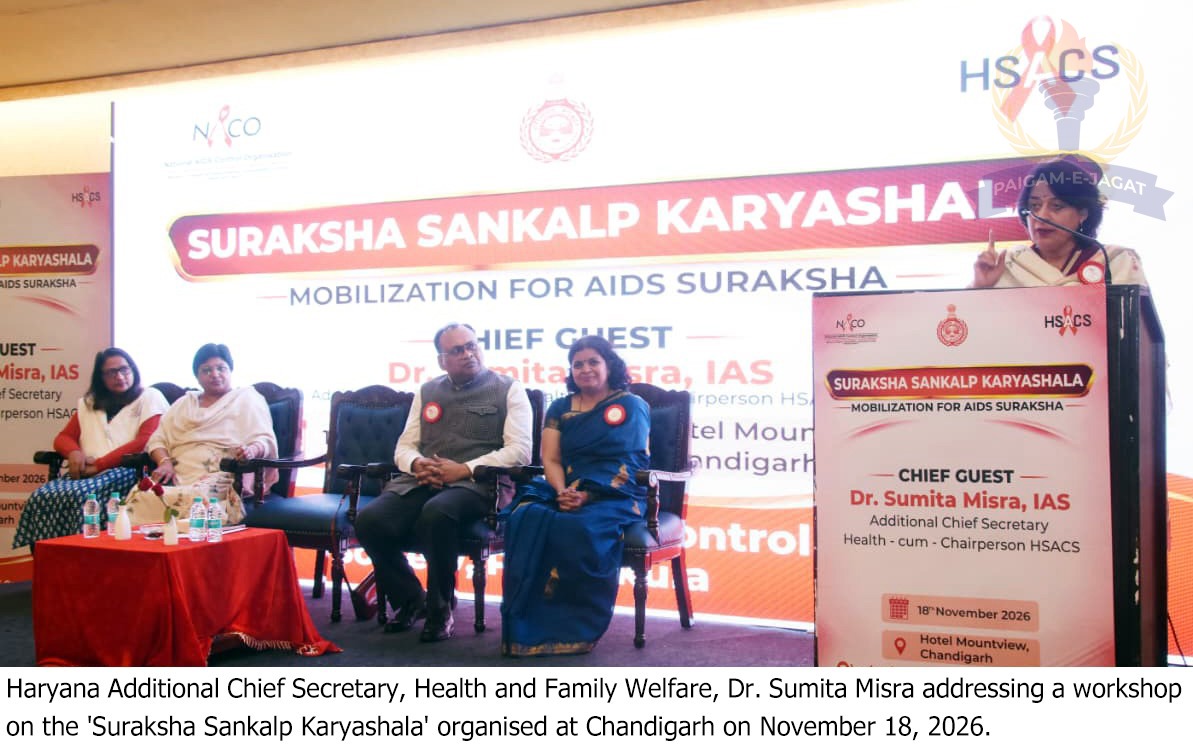
Chandigarh, 18 November:- Haryana has set a target of bringing all 23 districts of the state under the ‘Safe District’ framework for HIV/AIDS control by December 31. Additional Chief Secretary, Health and Family Welfare Department, Dr Sumita Misra, has directed district administrations and programme officers to accelerate efforts related to testing, treatment and patient follow-up.
Dr Sumita Misra was addressing a workshop organised under the ‘Suraksha Sankalp Workshop’ initiative in Chandigarh today as the chief guest. She said that Haryana had made commendable progress under the HIV/AIDS control programme. HIV testing coverage, which stood at 85.2 per cent in July 2026, increased to 94.7 per cent in October 2026. Similarly, the proportion of people diagnosed with HIV who are receiving antiretroviral therapy (ART) rose from 83.7 per cent to 91.1 per cent, while the level of viral suppression reached 95.8 per cent.
She informed that since January 2026, a total of 6,052 people who had fallen out of regular contact with treatment and healthcare services had been traced and reconnected with treatment. This is a significant achievement towards ensuring patient follow-up and continuity of treatment.
Dr Misra said that seven districts, including Ambala, Jind, Kaithal, Kurukshetra, Panchkula, Rohtak and Sonipat, had already achieved ‘Safe District’ status. The priority now is to extend this achievement to all districts of the state. She congratulated the Deputy Commissioners, Civil Surgeons, District AIDS Control Officers, healthcare workers and programme teams of these districts and urged the remaining districts to make similar efforts. She said that district administrations must work in mission mode, in coordination with one another, to address the remaining gaps within the stipulated deadline.
Referring to changes in HIV/AIDS treatment, Dr Misra said that, with advances in medical science, HIV is now regarded as a manageable health condition. People living with HIV can also lead healthy and active lives. For this, timely testing, uninterrupted regular treatment and continuous health monitoring are essential.
She also laid special emphasis on protecting the rights and dignity of people living with HIV. She said that the HIV/AIDS Ombudsman is a statutory mechanism for safeguarding their rights and addressing their grievances. Awareness about this provision should be increased so that people living with HIV can access appropriate grievance redressal without fear of discrimination or concerns about disclosure of their confidential information.
Under the HIV/AIDS control programme in Haryana, 105 Integrated Counselling and Testing Centres (ICTCs), 24 ART centres and 39 Targeted Intervention Projects are operational. In addition, 15 Opioid Substitution Therapy centres and 31 Suraksha Clinics for the treatment of sexually transmitted infections are functioning in the state. Dr Misra said that these facilities must now be used to ensure that testing, timely treatment and regular patient monitoring services reach the maximum number of people.
Emphasising the prevention of mother-to-child transmission, she said that eliminating the transmission of HIV, syphilis and hepatitis B from mother to child must be a priority for every district. Timely testing of all pregnant women should be ensured. Women found infected during screening should be provided appropriate treatment, counselling and medical supervision. Newborn babies should also receive infection-prevention care and follow-up testing in accordance with the prescribed protocols.
Dr Misra directed district administrations to ensure that every person diagnosed with HIV is immediately linked to ART services. Uninterrupted availability of medicines and timely viral load testing must be ensured. Patients who fail to report for treatment at the scheduled time should be identified promptly and contacted through healthcare workers, counsellors and field-level teams. She said that a responsible officer must be assigned to address every identified gap, along with a specific timeline for its resolution.
She said that district-level reviews to achieve the prescribed HIV control targets should not remain limited to figures and statistics. Instead, they must also identify people who are still outside the healthcare system. These include people who have not yet been tested, those who tested positive but have not been linked to treatment, and patients who discontinued their medication midway.
She reiterated that the government's objective is not merely to achieve district-level targets but to ensure timely treatment, confidentiality and dignified healthcare services for every person living with HIV. She urged Deputy Commissioners, Civil Surgeons, District AIDS Control Officers and all officials and employees associated with the programme to work in coordination so that the target of bringing all 23 districts of the state under the ‘Safe District’ framework by the end of the year can be achieved through collective efforts.
On the occasion, Dr Mukta, Project Director of the Haryana State AIDS Control Society (HSACS), also shared her views on the implementation of the HIV/AIDS control programme. She emphasised coordinated efforts at the district level, widespread public awareness, timely testing, treatment and regular patient follow-up. She said that field-level teams should work with a focused approach so that no person remains outside the ambit of testing and treatment services and every patient receives healthcare services with confidentiality and dignity.