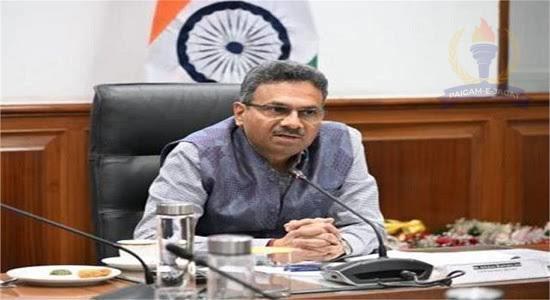
Chandigarh, October 23:- A total of 6,824 people were arrested in Haryana from January to September 2026 as part of the campaign against drug trafficking, while property worth Rs 19.52 crore linked to drug trafficking was attached. This information was shared at the 14th meeting of the State-Level Narcotics Coordination Centre (NCORD) Committee, chaired by Chief Secretary Anurag Rastogi, held here today.
The Chief Secretary reviewed enforcement action in drug trafficking cases, measures to strengthen prosecution, financial investigations, and initiatives related to de-addiction and rehabilitation. The meeting also reviewed the action being taken by various departments under the National Roadmap for Drug Prevention 2026–29 and the progress made on decisions taken at the previous state-level meeting.
Additional Director General of Police of the Haryana State Narcotics Control Bureau, Sanjay Kumar, said that the value of properties attached from January to September 2026 had increased to Rs 19.52 crore from Rs 5.92 crore during the corresponding period last year. This represents an increase of approximately 230 per cent. The number of persons whose properties were attached also rose from 78 to 163, an increase of 108.97 per cent.
These figures reflect the state government's growing focus on identifying financial assets linked to drug trafficking and taking targeted action against them. The state government has set a target of attaching property worth Rs 30 crore by December 2026. In addition, cases involving properties valued at Rs 15.09 crore are under consideration by the competent authority in Delhi.
Sanjay Kumar said that the number of FIRs registered under the Narcotic Drugs and Psychotropic Substances Act increased by 39.93 per cent, from 2,722 to 3,809, during January–September 2026. The number of arrests rose by 26.53 per cent, from 5,393 to 6,824. Cases involving commercial quantities also increased from 346 to 380, a rise of 9.83 per cent.
A significant increase was also recorded in the recovery of narcotic substances. Heroin seizures nearly doubled, rising from 43.176 kg to 84.695 kg, while opium seizures increased from 235.550 kg to 430.300 kg. Cocaine seizures rose by 194.47 per cent to approximately 2.96 kg, while the recovery of MD/MDMA increased by 235.51 per cent to approximately 1.76 kg.
The meeting also discussed improvements in prosecution outcomes. The conviction rate increased from 53.33 per cent to 58.34 per cent, a rise of 5.01 percentage points. In coordination with the Directorate of Prosecution, 50 cases under the NDPS Act were selected for special monitoring. In one of these cases, a conviction resulted in a sentence of 14 years of imprisonment and a fine of Rs 2 lakh.
Officials said that 12 drug trafficking gangs had been identified in Haryana and action was underway to dismantle them. In addition, 29 proclaimed offenders were identified. Two Blue Corner Notices and one Red Corner Notice were issued, and the matter was taken up with the Narcotics Control Bureau in Delhi. Districts have been directed to issue Lookout Notices and initiate the process of passport cancellation.
Since 2022, a total of 163 habitual drug offenders have been placed under preventive detention. District-wise targets have also been set to achieve the state's goal of placing 70 persons under preventive detention between January 2026 and March 2027.
To improve the quality and effectiveness of investigations, a Special Investigation and Financial Investigation Cell has been established at the headquarters of the Haryana State Narcotics Control Bureau. So far, 139 police personnel have been trained through four training courses. Emphasis was laid on conducting financial investigations in all cases involving commercial quantities.
A dedicated cell is being developed within the Haryana State Narcotics Control Bureau to monitor drug-related activities carried out through the darknet, cryptocurrency and social media. The services of a cyber expert have been engaged as a consultant since July 2026.
Police station in-charges, police post in-charges and patrolling personnel have been provided with the necessary information to identify clandestine synthetic drug laboratories. Red-flag indicators prescribed by the Narcotics Control Bureau have been displayed at police stations and the offices of Superintendents of Police to help detect such activities.
1. At a joint meeting held on October 3 involving the Haryana State Narcotics Control Bureau, the Narcotics Control Bureau and the Excise and Taxation Department, it was agreed that a Standard Operating Procedure would be prepared to monitor precursor chemicals used in the manufacture of narcotic substances. Details of firms holding URNs have been shared and verified by the Excise and Taxation Department.
The Food and Drug Administration has prepared a draft procedure to inspect CCTV systems at chemist shops and check arrangements for retrieving recorded footage. With the objective of encouraging informers and enforcement personnel, the draft Haryana Anti-Narcotics Award Policy 2026 has been sent to the Director General of Police for approval.
The meeting also reviewed proposals to strengthen de-addiction and rehabilitation facilities. A proposal to bring all 127 de-addiction centres in Haryana within the prescribed registration system under the Mental Healthcare Act, 2017, was also considered.
In addition, proposals to appoint additional scientific personnel to enhance the capacity of the NDPS Division of forensic science laboratories and to notify the service rules for Group-C employees were discussed, so that reports on the analysis of narcotic substances could be prepared and submitted to courts in a timely manner.
Additional Chief Secretary Sudhir Rajpal, Dr G. Anupama, A.K. Singh and other senior officials attended the meeting.