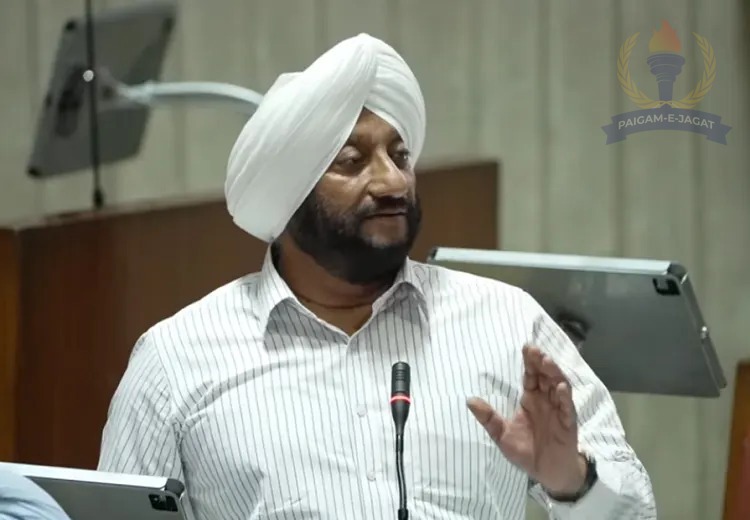
Nawanshahr (Des Raj Bali):- Bahujan Samaj Party MLA Dr. Nachhatar Pal said in the Punjab Legislative Assembly that he was presenting the BSP’s position on the resolution moved by Cabinet Minister Sardar Harpal Singh Cheema and had stood up to speak in its support. He said that his party’s national president, Behen Kumari Mayawati, former Chief Minister of Uttar Pradesh, had recently raised concerns about the hacking of EVMs, the matching of VVPAT slips and the Special Intensive Revision (SIR) process. He said that millions of people were allegedly being deprived of their rights through the deletion of millions of voters’ names from electoral rolls, resulting in growing public distrust of the Election Commission. People, he said, felt that they had been cheated. He attributed these concerns to Behen Kumari Mayawati.
Dr. Nachhatar Pal said that the constitutional right to vote holds great importance in Indian democracy. Articles 314, 325 and 326 of the Indian Constitution, he said, provide protection to these rights. The Election Commission is responsible for overseeing elections and ensuring that every eligible adult citizen is included in the electoral rolls without discrimination on the basis of caste, religion or gender. India is the world’s largest democracy, where citizens enjoy various freedoms. He added that in several countries, including Saudi Arabia, Dubai, Qatar, China and Libya, ordinary citizens do not have the opportunity to participate in national-level elections.
Revisiting history, Dr. Nachhatar Pal said that in 1902, Chhatrapati Shahu Maharaj of the Kolhapur princely state provided 50 per cent representation to OBCs and other backward classes in his state. The Minto-Morley Reforms of 1909 provided for five elected members, while the remaining members were to be nominated. Ordinary people did not have the right to vote under that system. In 1919, the Montagu–Chelmsford Reforms were introduced, under which 71 members were to be elected and 22 nominated. Even then, voting rights were restricted to people who met certain property, tax-paying, educational or government-related eligibility criteria. Ordinary citizens, particularly women, did not enjoy voting rights at that time. Under the 1919 reforms, only 12 seats were reserved for Sikhs.
He said that under the Government of India Acts of 1935 and the elections of 1937, Punjab had 175 seats, while the number of voters increased from five lakh to 27 lakh. At that time, there were approximately eight constituencies where representatives were elected through a system of double voting, providing Scheduled Caste communities in those constituencies an opportunity to elect their representatives separately. Dr. Nachhatar Pal recalled the contribution of Dr. Bhim Rao Ambedkar, who participated in the Round Table Conference held in London on August 18, 1931, where important rights were discussed. He said that the subsequent Poona Pact between Dr. Ambedkar and Mahatma Gandhi also played a role in the voting rights secured for the people.
He also referred to Babu Mangu Ram, founder of the Ad Dharm movement, whose role was discussed in the Assembly. He said that from 1932 to 1937, Babu Mangu Ram helped elect representatives from reserved constituencies. Between 1947 and 1950, the Constituent Assembly comprised 299 members, with Dr. Rajendra Prasad as its president and Dr. B. R. Ambedkar as chairman of the Drafting Committee. Dr. Ambedkar spent two years, 11 months and 18 days preparing the Constitution of India, which granted voting rights to citizens across all sections of society, irrespective of caste, religion, wealth, poverty or gender. At that time, the number of voters in India stood at 17 crore, while Punjab had approximately 67 lakh voters.
Explaining why he had referred to history during his Assembly speech, Dr. Nachhatar Pal said that their ancestors and social leaders had struggled immensely to secure the right to vote for the people. He alleged that the Election Commission of India, a constitutional body, was functioning like a political institution under the BJP-led central government. He said public confidence in the impartiality of the Election Commission was extremely important in a democratic country like India. If 13 crore people were deprived of their right to vote, he warned, it could increase unrest and distrust among the public. He said the Assembly should raise its voice on behalf of those affected and expressed his support for the resolution.