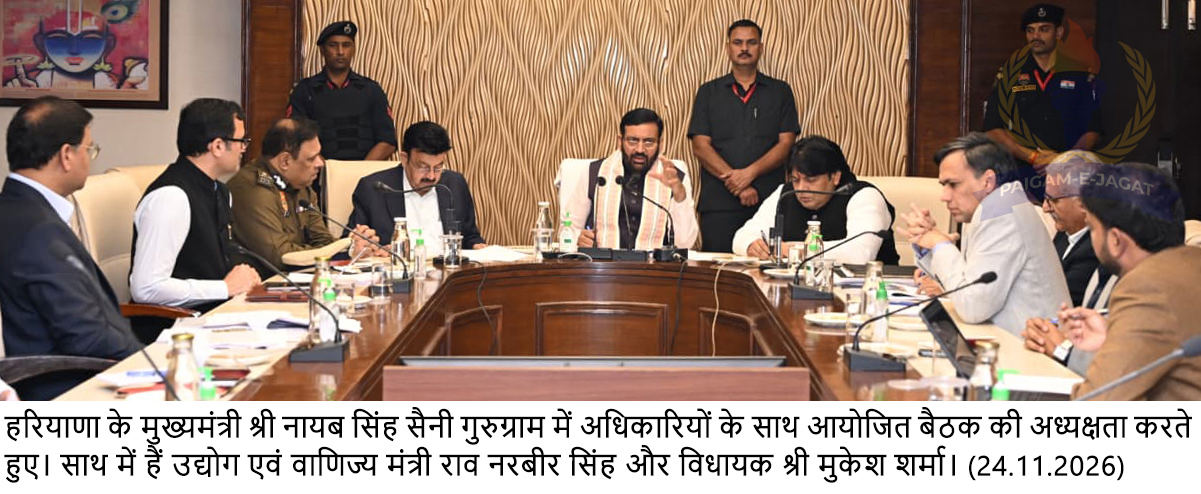
Chandigarh, 24 November (Paigam-E-Jagat):- Haryana Chief Minister Nayab Singh Saini said that capable panchayats and accountable municipalities are the strong foundation of a developed Haryana. The government's aim is not to limit local bodies merely to administrative units, but to develop them as effective local governments equipped with powers, capabilities and their own financial resources.
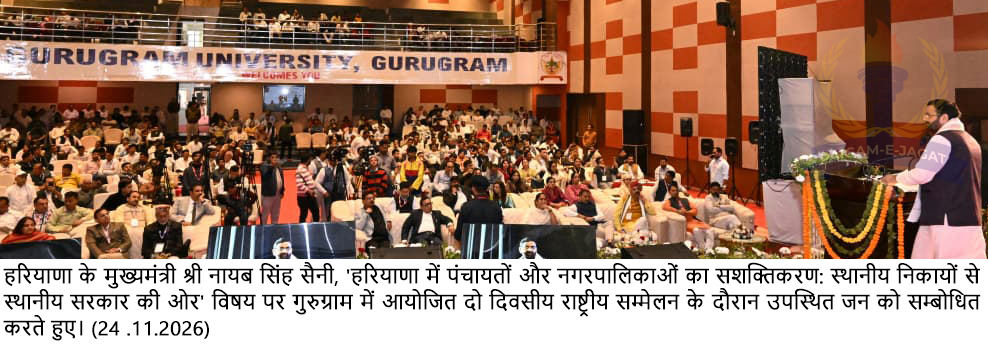
Chief Minister Nayab Singh Saini was addressing the concluding ceremony of a two-day national conference on the theme of strengthening panchayats and municipalities in Gurugram on Tuesday. Development and Panchayats Minister Krishan Lal Panwar and Industries and Commerce Minister Rao Narbir Singh were also present on the occasion.
The Chief Minister said that public representatives, experts and policymakers from different states of the country had shared their experiences, innovations and successful initiatives at the conference. The extensive deliberations over two days had resulted in the preparation of a practical roadmap to strengthen local self-governance. This conference would prove to be a milestone in strengthening the foundation of local self-governance.
The Chief Minister said that the real strength of democracy does not lie in the files of secretariats, but in the streets of villages and neighbourhoods of cities. Father of the Nation Mahatma Gandhi had envisioned Gram Swaraj, while Prime Minister Narendra Modi had placed the ambitious goal of Viksit Bharat-2047 before the country. The path to achieving both these goals passes through the village chaupal and the city ward. The magnificent structure of a developed India will have its foundation in panchayats and wards. In the past 12 years, Prime Minister Narendra Modi has brought 50 crore people in the country out of poverty through welfare schemes, which is a record at the global level.
**Financial Self-Reliance of Local Bodies Is Essential**
The Chief Minister said that three important subjects were discussed in detail at the conference: revenue generation and financial self-reliance, autonomy and accountability, and effective service delivery and inclusive participation. In this regard, any government can take independent and effective decisions only when its financial foundation is strong.
He said that the Haryana Government had established a transparent system for directly transferring financial resources to panchayats. In addition, regular income for panchayats had been ensured through a share of stamp duty and electricity consumption. To strengthen urban local bodies financially, a property tax system based on capital value had been implemented.
The Chief Minister appealed to panchayat representatives to develop their common lands, ponds and community assets as permanent sources of income. Municipalities, meanwhile, should enhance their financial capacity by adopting a simple and effective tax collection system. He said that grants help keep things running, but one's own income builds the future.
**Announcement of an Additional 2 Per Cent Matching Grant for Local Bodies**
The Chief Minister announced an additional fund equivalent to 2 per cent of the State's Own Tax Revenue (SOTR) as a matching grant to further strengthen local bodies financially. He said that urban local bodies and Panchayati Raj institutions would be able to avail themselves of this additional amount through a competitive process on the basis of their project proposals. At present, the state government is allocating 7 per cent of its tax revenue to local bodies.
He said that developing their own revenue sources was essential to make local bodies self-reliant. To encourage their efforts in this direction, the government had also decided to provide a matching grant. Under this arrangement, the state government would provide an equal amount as a matching grant to any local body that mobilises additional financial resources at its own level. This would mean that every additional rupee raised by local bodies would be matched by government support, potentially doubling the resources available for the development of the area.
The Chief Minister also announced that the local body whose leadership succeeds in collecting the highest amount of its own revenue in its area would be specially honoured and rewarded at the state level. He said that this award would encourage healthy competition, transparent governance and better financial management among local bodies.
**Local Bodies to Be Entrusted with Responsibilities for Public Services**
The Chief Minister said that the government was going to take a major policy step towards providing genuine authority and powers to local bodies. Under this initiative, important responsibilities such as public health engineering, drinking water supply and fire services would be transferred to local bodies in a phased manner in the coming period. He said that this would enhance the decision-making capacity of local bodies and enable them to manage public services more effectively according to the needs of their respective areas.
**Accountability Is Equally Essential Along with Autonomy**
The Chief Minister said that while granting greater financial and administrative powers to local bodies, it was equally important to ensure their accountability. Autonomy and accountability are two sides of the same coin. Therefore, transparency, proper mapping of properties, timely audits and a robust accounting system are essential. Technology and digitalisation can play an important role in this direction.
He said that the objective of e-Gram Swaraj, digital property records and online grievance redressal systems was to reduce paperwork and bring governance closer to ordinary citizens. Only when every rupee of panchayats and municipalities is spent honestly and transparently on development works will true good governance be established.
**The Measure of Development Is Positive Change in the Lives of Ordinary People**
The Chief Minister said that development figures are meaningful only when they bring positive changes in the standard of living of ordinary people. Clean drinking water, solid waste management, accessible roads, modern libraries and a clean environment are the basic needs and rights of every citizen.
Nayab Singh Saini said that it was a matter of pride that initiatives such as four major cluster projects for generating energy from waste and 350 e-Atal Libraries in Haryana had been appreciated at the conference. These initiatives would not only enable the use of waste for energy production but also open new doors of digital knowledge in rural areas.
The Chief Minister said that the government had provided representation to Backward Class-B in Panchayati Raj institutions through reservation. In addition, a minimum 50 per cent participation of women had been ensured in village water and sewerage committees. This had increased the participation of all sections of society in local governance.
**Haryana-Specific Reform Roadmap to Form the Basis of the Action Plan**
The Chief Minister said that the success of any conference is assessed by the changes it brings at the grassroots level afterwards. He appealed to public representatives to select at least one idea from the hundred good ideas shared at the conference, adapt it to their local needs and implement it at the grassroots level. He said that the Haryana-specific reform roadmap presented under the leadership of Professor V.N. Alok, along with senior officers of the two concerned departments, was not merely a document but a commitment to action for the coming years. Instead of becoming a showpiece on a shelf, this roadmap would form the basis of the government's action plan.
The Chief Minister directed officials to seriously compile the concrete recommendations received at the conference and feedback from public representatives and prepare a time-bound action plan. These should be fully aligned with Haryana Vision-2047 and the Prime Minister's Viksit Gram Swaraj Yojana. He made it clear that every suggestion must be acted upon and every piece of feedback must be accounted for.
**Public Representatives Must Live Up to People's Trust Through Their Work**
The Chief Minister told sarpanches, panches, councillors, mayors and municipal corporation presidents that they were the true flag-bearers of the democratic system. The people had elected them and entrusted them with responsibility, and now they had to prove through their work that the people's decision was right.
He said that the government could provide resources and policies, but setting priorities, ensuring that the right work was undertaken at the right place and completing it on time were the responsibilities of public representatives. They also had an important role in ensuring that the benefits of government schemes reached every eligible person. Calling for Gram Sabhas and ward committees to be made active, he said that when a Gram Sabha is vibrant, a plan becomes the people's plan rather than the government's. Empowering panchayats and municipalities is one of the greatest needs of the present time. People remember those who take such initiatives for a long time.
The Chief Minister thanked the Swarna Jayanti Haryana Institute for Fiscal Management, Gurugram University, the concerned departments, subject experts and researchers for the successful and well-organised conduct of the conference. He especially thanked Union Minister Manohar Lal, whose guidance and experience had given the conference the stature of a national-level event.
The Chief Minister said that the government's resolve was to build an empowered Haryana where villages have modern facilities like cities and cities have the sense of belonging found in villages. Only when every panchayat and municipality in Haryana becomes self-reliant and responsive will the state emerge as a leading state in the country and the goal of making India a developed nation by 2047 be realised.
On this occasion, Pataudi MLA Bimla Chaudhary, Gurugram MLA Mukesh Sharma, Sohna MLA Tejpal Tanwar, Additional Chief Secretary of the Development and Panchayats Department Vijendra Kumar, Commissioner of the Urban Local Bodies Department Ashok Kumar Meena, OSD to the Chief Minister and Director General of the Swarna Jayanti Haryana State Fiscal Management Institute Dr Raj Nehru, Professor V.N. Alok of the Indian Institute of Public Administration, and Gurugram University Vice-Chancellor Sanjay Kaushik, among several other dignitaries, were present.