
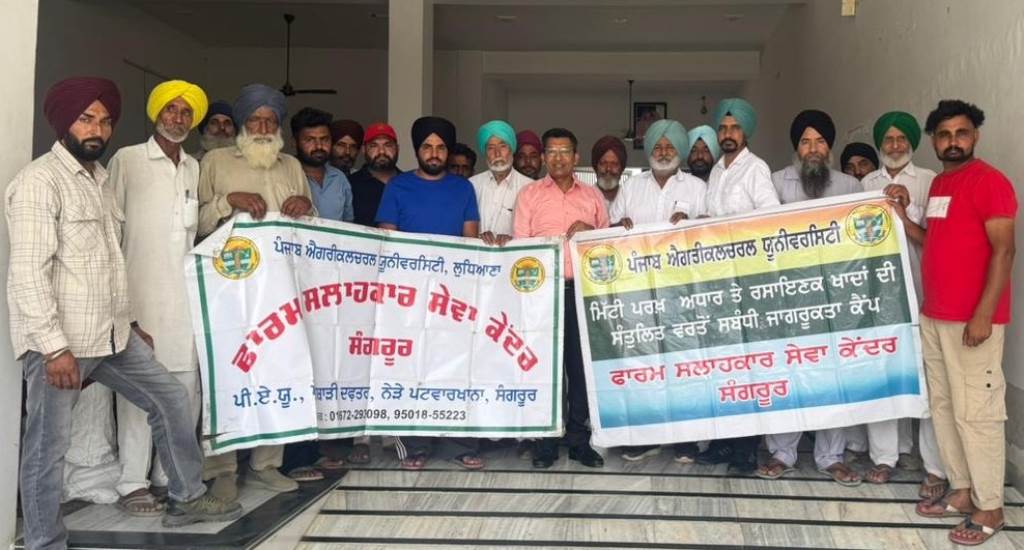
PAUFASC Sangrur organised farmers training camp at Bhutal Kalan

Lehragaga/Sangrur, June 22:- Under the guidance of Punjab Agricultural University, Ludhiana, the Farm Advisory Service Centre (FASC), Sangrur organized a farmers’ training camp at village Bhutal Kalan (Near Lehragaga) to promote the scientific management of poor-quality irrigation water, soil test-based fertilizer use, and cost-effective crop production practices. Around 30 farmers participated enthusiastically in the programme.
Addressing the gathering, Dr. Ashok Kumar Garg, Senior Extension Scientist, highlighted the importance of soil testing for balanced nutrient management and advised farmers to avoid the unnecessary use of DAP and excessive application of urea in paddy and basmati cultivation. He emphasized that fertilizer application based on soil test recommendations helps reduce cultivation costs, improves crop productivity, and maintains soil health.
Dr. Garg also provided detailed information on the management of poor-quality irrigation water. He explained that continuous use of saline water can adversely affect soil productivity and recommended its use after mixing with canal water wherever possible. For sodic water containing excessive sodium carbonate or bicarbonate, he advised the application of gypsum before use. He encouraged farmers to get their tube-well water tested through soil and water testing laboratories to determine the nature and extent of water quality problems.
Discussing sustainable nutrient management, Dr. Garg elaborated on the importance of Azospirillum inoculation for paddy and basmati nurseries. He stated that the biofertilizer not only contributes to higher crop productivity but also improves the biological health of the soil. He also shared recommendations regarding paddy nursery management and explained the identification and management of dwarfing symptoms in paddy seedlings. During the camp, he demonstrated the correct method of collecting soil samples for laboratory testing.
Harsant Singh played a significant role in the successful organization of the programme. At the conclusion of the camp, Azospirillum inoculants were distributed to farmers for demonstration purposes, and agricultural literature was made available. Farmers’ queries on various agricultural issues were addressed scientifically and in an interactive manner.