

Harolis Ponds Emerging as a New Model for Water Conservation in Himachal

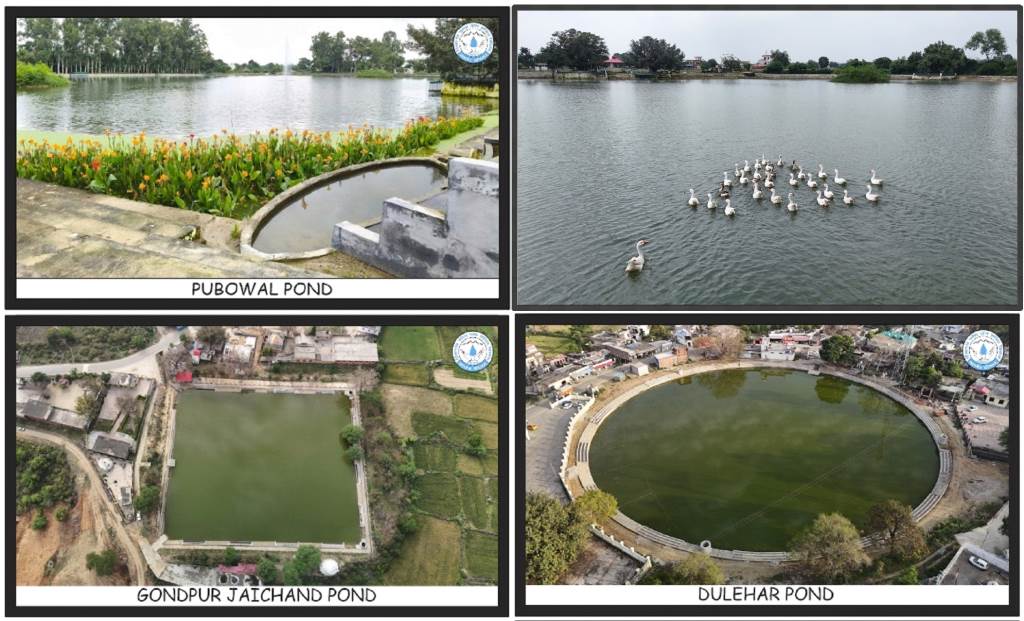
Una, June 28: Haroli is setting a new example in the conservation of traditional water sources in Himachal Pradesh. Ponds that had lost their utility over the years due to siltation, rainwater runoff, and changing conditions are now being revitalized using modern scientific techniques. Under an ?11.75 crore project, the Jal Shakti Department is scientifically rejuvenating various ponds, including those in Pubowal, Dulehar, and Gondpur Jaichand. The objectives include rainwater harvesting, groundwater recharge, improving water quality, developing sustainable water management systems for future needs, and beautifying the ponds.
The project involves desilting the ponds, strengthening embankments, and developing groundwater recharge structures. Additionally, catchment areas—the zones from which rainwater flows into the ponds—are being improved. Where necessary, water quality is being enhanced through the use of constructed wetlands (systems that purify water using plants and natural processes), in-situ treatment systems (techniques to purify water within the pond itself), and aeration systems (mechanisms to increase oxygen levels in the water). Simultaneously, the natural capacity of the ponds is being boosted through cascade structures—stepped systems designed to trap silt and solid waste carried by rainwater runoff.
**A Unique Scientific Plan for Each Pond**
According to Naresh Dhiman, Superintending Engineer of the Jal Shakti Department in Una, the project's standout feature is that a "one-size-fits-all" plan was not adopted. Technical solutions were tailored to each pond after individually studying its geographical location, catchment area, water source, pollution status, and local requirements. It is this scientific approach that distinguishes this project from other schemes. **Groundwater Recharge Capacity to Increase by 5.8 Million Cubic Meters**
Puneet Sharma, Executive Engineer of the Jal Shakti Department in Haroli, stated that work is currently underway on major ponds, including those at Pubowal, Dulaihar, and Gondpur Jaichand. Restoration projects are being executed at a cost of approximately ?2 crore for the Pubowal pond and around ?1.26 crore for the Dulaihar pond. While 90 to 100 percent of the work on several components has already been completed, the remaining tasks are progressing through various stages.
According to the feasibility report prepared in February 2025, the project—once completed—will generate an annual groundwater recharge capacity of approximately 5.8 million cubic meters through the selected ponds. Additionally, an extra 0.90 MLD (million liters per day) of water is expected to become available in the region. The report estimates the annual recharge capacity of the Pubowal pond at approximately 3.2 million cubic meters, with the combined capacity of six smaller ponds estimated at around 2.6 million cubic meters.
**Preparing for Future Water Security**
Officials note that the Haroli region receives rainfall only during a limited period each year; consequently, conserving every drop of rainwater is a primary objective of this project. According to the Central Ground Water Board, the region currently falls under the 'Safe' category with a groundwater extraction rate of 62 percent. However, given the challenges posed by a growing population, rising water demand, and climate change, this initiative is viewed as a long-term measure to meet future needs.
Experts believe that this model—which integrates the conservation of traditional water sources with modern scientific techniques—could prove beneficial for other regions of Himachal Pradesh in the future. Beyond water conservation, the restoration of these ponds is expected to foster environmental protection, aquatic biodiversity, natural beauty, and local eco-tourism opportunities. Rohit Dubey, Chief Engineer of the Jal Shakti Department (Hamirpur Zone), states that the conservation of traditional water sources is not only a current necessity but also the foundation for the water security of future generations. With this vision, a model is being developed in Haroli that strikes a balance between development and the conservation of natural resources, simultaneously strengthening rainwater harvesting, groundwater recharge, and environmental protection. This model will serve as a guide for other districts in the state in the future.
**At a Glance**
• Total project cost: ?11.75 crore
• Estimated annual groundwater recharge capacity: 5.8 million cubic meters
• Recharge capacity of Pubowal Pond: 3.2 million cubic meters per annum
• Combined capacity of six smaller ponds: 2.6 million cubic meters per annum
• Current groundwater extraction: 62% ('Safe' category)
**Key Highlights**
• Distinct scientific and technical plans for each pond
• Improvement of water quality using modern scientific techniques
• Use of techniques such as constructed wetlands, aeration systems, and in-situ treatment as required
• Scientific treatment of groundwater recharge and catchment areas
• Focus on rainwater harvesting and future water security
• Promotion of aquatic biodiversity and environmental conservation
• Boosting local natural beauty and eco-tourism potential