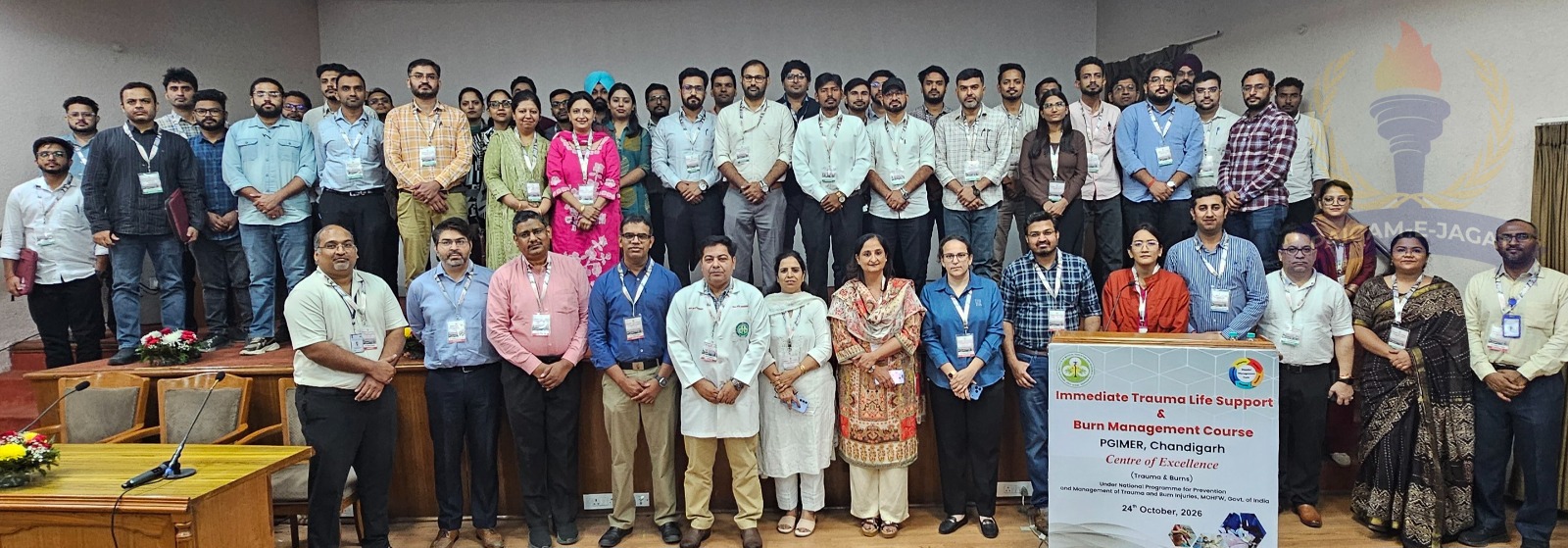
Chandigarh:- The Centre of Excellence (Trauma and Burns) at the Postgraduate Institute of Medical Education and Research (PGIMER), Chandigarh, organised an Immediate Trauma Life Support and Burn Management (ITLS & BM) training course for 57 doctors from Haryana, Punjab and Chandigarh on October 24, 2026. The course was conducted under the National Programme for Prevention and Management of Trauma and Burn Injuries (NPPMTBI) of the Ministry of Health and Family Welfare, Government of India.
The programme aimed to reduce preventable deaths and complications resulting from trauma and burn injuries, strengthen the capacity of healthcare professionals, standardise treatment protocols and improve systems for providing better patient care in hospitals.
The course was led by Dr. Atul Parashar, Course Director, Head of the Department of Plastic Surgery at PGIMER, Chandigarh, and Nodal Officer of the Centre of Excellence (Trauma and Burns). Dr. Nidhi Bhatia from the Department of Anaesthesia served as Co-Director, while Dr. Ankit Dadra was the Course Coordinator. The training particularly focused on a systematic approach to the initial assessment and management of patients with traumatic and burn injuries.
Dr. Atul Parashar stated that, according to data from the Ministry of Road Transport and Highways (MoRTH), more than five lakh people were involved in serious road accidents in 2025, and 1.87 lakh people lost their lives. This translates into an average of 512 deaths every day and approximately 21 deaths every hour. He also stated that around one lakh people were hospitalised due to burn injuries, with the mortality rate exceeding 30 per cent.
The Immediate Trauma Life Support and Burn Management course covered key topics such as patient triage, disaster preparedness, traumatic brain injuries, musculoskeletal trauma and the management of burn injuries. Along with theoretical sessions, participants received practical training in emergency medical procedures, including airway management, intercostal drain insertion, establishing intraosseous access and controlling bleeding.
Through special lectures, interactive learning and practical skills sessions, efforts were made to strengthen participants’ clinical competence and preparedness to respond effectively to trauma- and burn-related emergencies. The broader objective of this initiative is to reduce preventable illness, complications and deaths resulting from such injuries.
Through this programme, PGIMER’s Centre of Excellence (Trauma and Burns) reiterated its commitment to national efforts to improve the quality of trauma and burn care in the country through capacity building and training of healthcare professionals.