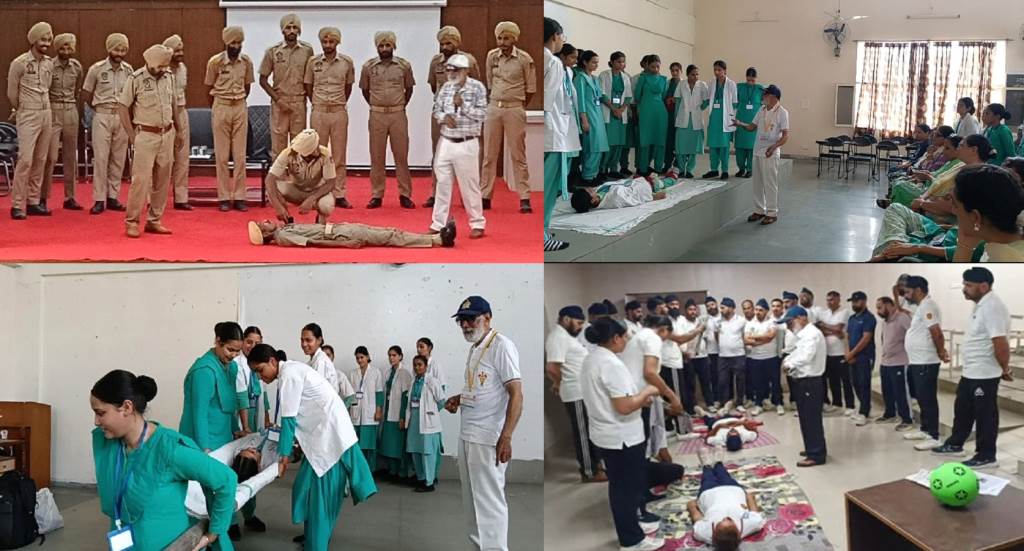
Patiala, August 28:- 189 glacier lakes in the country are on the verge of bursting, due to which terrible destructive threats are looming in the Himalayan and plains. Giving this information, Chief Trainer of First Aid Safety Health Awareness Mission, Patiala said that students, teachers, police, factory workers, NSS. Volunteers and NCC. Cadets are being trained to avoid and save from disasters caused by natural, seasonal and human disasters all over the world.
He said that in India, students are trained and practiced to make reels through dancing, fun and fashion. The glacial lakes that are being formed as a result of rapid melting of snow due to global warming, pollution, warming and heat waves caused by human activities on the mountains have now become a serious and major threat.
The latest data from ISRO and the National Disaster Management Authority (NDMA) has presented a terrifying picture. According to the news, according to the ISRO report, there are a total of more than 7,500 glacial lakes in the Indian Himalayan region, out of which 189 lakes are in the ‘red zone’ (high risk category) and can break at any time and cause major devastation.
According to the study, thousands of small and large lakes are spread on the peaks of the Indus, Ganges and Brahmaputra river basins. 3,219 lakes have been identified in the Ladakh region alone. There are 2,431 lakes in the entire Indian Himalayas, which are larger than 10 hectares in size.
Talking about Uttarakhand, out of the 426 large glacial lakes identified here, 25 are sensitive, out of which 13 fall in the highly sensitive category. The size of Masar Tal located in the Bhilangana valley was 2,44,613 square meters in 2013, which increased to 3,66,871 square meters in 2023. That is, it has registered a huge increase of 50 percent in the last 10 years.
The sudden floods (GLOF) caused by the bursting of these lakes have become a major threat to humanity as destructive as nuclear atomic water bombs. According to Dr. Manish Mehta, a scientist at the Wadia Institute of Himalayan Geology, the natural walls (moraines) of these lakes are quite weak and rough. In the Himalayan region, a mild earthquake, heavy rain or an avalanche (snowstorm) can break these walls.
The most dangerous are the ‘proglacial lakes’ that form in front of glaciers. The recent floods in Lohnak Lake in Sikkim and Chamoli in Uttarakhand are recent examples of this danger.
Due to climate change, excessive tourist and vehicle traffic and rising temperatures, these lakes forming on the mountains can cause major disasters for millions of people living in the lower regions.
Alarming Water is becoming a missilenuclear atomic bomb Destruction of natural forests rivers and mountains Development for humanity but the path that nature has taken is destruction