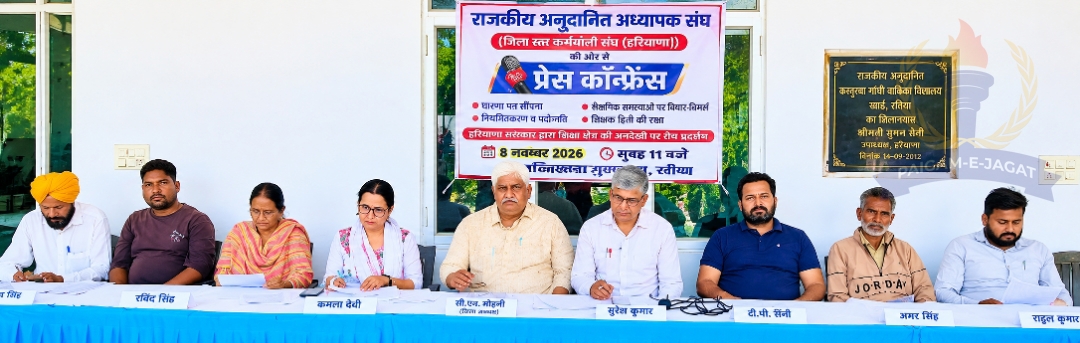
Ratia, November 7 (Advocate Gurpreet Singh Mander):- The protest being held in front of the Kurukshetra Mini Secretariat, under the call of the Government Contractual Teachers' Association, demanding regularisation under the three-year regularisation policy of 2014 in accordance with court orders, continued for the 136th day today. As part of this movement, the next phase of the agitation was announced at a press conference held at Kamboj Dharamshala, Block Ratia, District Fatehabad. Guest teachers will observe a Black Diwali on November 8 and, on November 15, organise a Mock Parliament in front of the Kurukshetra Mini Secretariat, followed by a protest march and gherao of the Chief Minister's Camp Office. During the protest, copies of the negative speaking orders issued by the Education Department will be burnt to register opposition to the government's stubborn attitude.
Addressing the press conference, C. N. Bharti said that guest teachers had been managing the education system by teaching in government schools for the past 21 years, but instead of regularising their services, the government continued to keep them in a temporary arrangement. He said that on November 8, guest teachers across the state would observe a Black Diwali to register their protest against the government's unjust attitude. On November 15, the Mock Parliament would raise questions concerning the regularisation of guest teachers, judicial decisions and government accountability on a public platform. This would be followed by a gherao of the Chief Minister's Camp Office.
Educationists, intellectuals, employee leaders from various departments, parents' organisations, School Management Committees (SMCs), the Samyukta Kisan Morcha, student and youth organisations, Haryana Gyan Vigyan Samiti, advocates' unions, writers' associations, university professors, Jan Sangharsh Manch Kurukshetra and social activists will be invited to the Mock Parliament.
Krishna Nain, General Secretary of Sarv Karamchari Sangh Haryana, said that the negative speaking orders issued by Education Department officials were entirely wrong, arbitrary and contrary to the spirit of judicial directions. The service conditions of the three-year regularisation policy dated June 16 and 18, 2014, contain no mention of the conditions cited by the department in its speaking orders. The Haryana Government itself had issued notifications on June 16 and 18, 2014, framing the regularisation policy, and guest teachers working in government schools fulfil all the conditions of that policy.
He said that guest professors working in the college cadre had already been regularised in June 2014, whereas guest teachers working under the school cadre in similar circumstances were being denied regularisation. Despite the Supreme Court upholding the validity of the 2014 policy and the High Court directing the government to consider regularisation, the Education Department issued negative speaking orders and rejected the claims of guest teachers. This, he said, was an example of the government's anti-employee policy and administrative stubbornness.
Krishna Nain said that following the Supreme Court's judgment in the Madan Singh case and the High Court's order in the Sukhwinder Singh case concerning the regularisation of guest teachers, the path to regularisation had become clear. The High Court had considered the appointments of guest teachers, their merit and nearly two decades of continuous service to be important factors. Despite this, instead of regularising them, the government was attempting to deprive them of their rights on technical grounds.
He said that the principles laid down in the Uma Devi case could not be selectively applied to deny regularisation to employees who had been serving for a long time. In the Jaggo case, the Supreme Court had also emphasised the rights of employees working continuously over a long period and the actual nature of their service. Making guest teachers perform regular and permanent work such as teaching for 21 years and then depriving them of their rights merely by calling them “guest” teachers was unjust.
Krishna Nain said that guest teachers teach the same syllabus as regular teachers, perform examination- and result-related duties, and share similar responsibilities in the academic activities of schools. Despite this, they are being denied rights such as regular pay scales, pension, gratuity, leave, transfers and promotions. This is contrary to the principle of equal pay for equal work, social justice, employee dignity and the spirit of Articles 14 and 16 of the Constitution.
He said that the government's approach was not limited to guest teachers but was part of a broader policy of promoting temporary, contractual, HKRN and outsourced employment in place of permanent jobs. Eliminating permanent posts in public education and promoting low-paid employment without adequate rights was harmful to the quality of education, the dignity of teachers and the future of students.
Krishna Nain said that regularisation of guest teachers was not merely an employment issue but was linked to quality education, social justice and the future of government schools. The government should regularise guest teachers under the three-year policy of 2014, consider their seniority and pending financial benefits, and end the practice of keeping teachers in guest and contractual arrangements for long periods in the future.
He urged guest teachers to honestly review the weaknesses of their movement over the past two decades, including internal differences, personal ambitions, monopolistic leadership, financial irregularities and the tendency to pursue separate struggles. He said that a movement could not be the personal property of any one individual. Broad unity, democratic leadership, transparency, collective decision-making and a united struggle were essential to taking the fight for regularisation to a decisive stage. If guest teachers overcome these weaknesses and fight together, they can compel the government to accept their demands.
Mrs. Poonam Kumari, President of the Women's Wing of the Government Contractual Teachers' Association, said that women teachers organise a 24-hour *baithak* at the ongoing protest site in Kurukshetra on the second Saturday of every month. Under this programme, women employees from across the state gather in Kurukshetra and protest against the government's anti-people policies. As part of this initiative, women teachers will also reach the Kurukshetra Mini Secretariat on November 15 and participate in the struggle for their rights.
At the press conference, leaders of various departments affiliated with Sarv Karamchari Sangh Haryana, including the Electricity Board, Fire Department, Municipalities, Mid-Day Meal workers, Building and Construction Workers' Union and student organisations, supported the protest being held by guest teachers in Kurukshetra since June 23. They demanded that the government regularise guest teachers at the earliest under the three-year policy of 2014. Employee leaders warned that if the government failed to regularise guest teachers in time, organisations from various departments would jointly call for a widespread movement against the government's anti-people policies.
Those present on the occasion included Sarv Karamchari Sangh Haryana Fatehabad District Secretary Devi Lal, Harjinder Kamboj, Surjit Sachdeva, Bhudev, Pradesh Kamboj, Reena Rani, Shweta, Rajendra Batu, Bhup Singh, Malkit Singh, Raghubir Singh, Pushpa Kumari and Kiran Pal Kaur, among others.