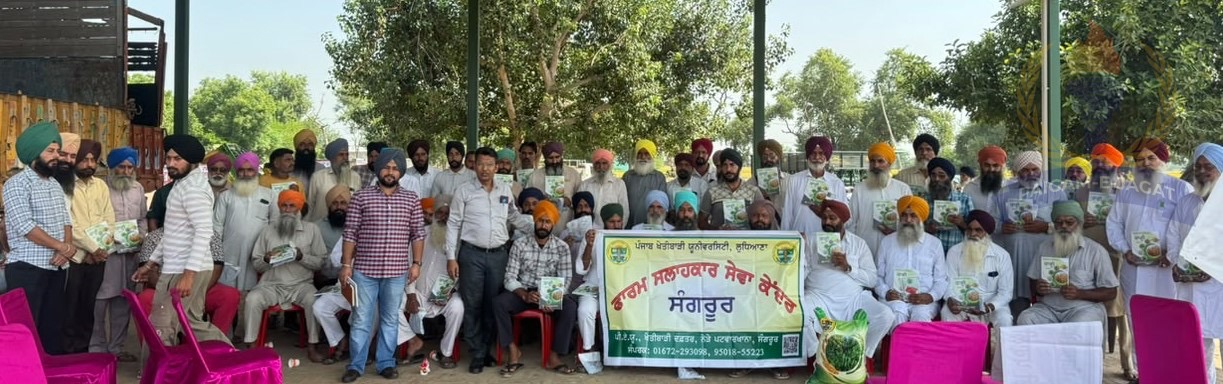
Dhuri/Sherpur, October 21:- With the aim of conserving natural resources and making agriculture more sustainable, the PAU-Farm Advisory Service Centre (FASC), Sangrur, organised a farmers’ awareness camp at Fatehgarh Panjgraian village under the guidance of the Director of Extension Education, Punjab Agricultural University (PAU), Ludhiana. During the camp, farmers were provided practical information on the scientific management of paddy straw in fields, balanced fertiliser management, alternative sources of phosphorus, improved wheat varieties and diversification of rabi crops. More than 70 farmers from Fatehgarh Panjgraian and nearby villages participated in the camp.
Addressing the gathering, Dr. Ashok Kumar Garg, Senior Extension Scientist (Soil Science), PAU-FASC Sangrur, urged farmers to manage paddy straw properly in their fields instead of burning it. He said crop residue is an important source of organic carbon and several essential plant nutrients. Retaining straw in the field helps improve soil health, organic matter and long-term productivity.
Explaining the loss of nutrients caused by straw burning, Dr. Garg said that burning one tonne of paddy straw results in the loss of approximately 400 kg of organic carbon, 5.5 kg of nitrogen, 2.3 kg of phosphorus, 25 kg of potassium and 1.2 kg of sulphur.
Dr. Garg encouraged farmers to adopt recommended machinery and techniques for straw management, such as the Happy Seeder, Super Seeder, PAU Smart Seeder and surface seeding-cum-mulching, so that wheat can be sown on time without burning paddy straw.
Use Fertilisers According to Soil Testing
Regarding fertiliser management, Dr. Garg said farmers should use fertilisers based on soil testing, crop requirements and balanced nutrient supply. He clarified that DAP is not the only source of phosphorus. Depending on soil conditions and crop requirements, fertilisers such as Single Super Phosphate (SSP), Triple Super Phosphate (TSP) and NPK 12:32:16 can also be used appropriately.
Emphasising integrated nutrient management, he said it helps improve fertiliser-use efficiency while maintaining soil fertility and sustainable crop production.
During the camp, Dr. Garg also explained in detail the biofertiliser inoculant recommended by PAU for wheat seed, the beneficial microorganisms it contains and its advantages for the crop. He encouraged farmers to treat wheat seed with the recommended biofertiliser before sowing.
After the camp, biofertiliser inoculants were also distributed to some farmers for demonstration and adoption so that they could use the technology in their fields. Keeping the upcoming rabi season in view, farmers were also informed about improved wheat varieties recommended by PAU.
Explaining the features of PBW 887, Dr. Garg said that the variety matures in approximately 155 days and has an average yield potential of around 24.60 quintals per acre.
Information was also shared with farmers about other varieties with specialised traits, including PBW 872, PBW 826, PBW Zinc 2, PBW 1 Chapati, PBW RS 1 and PBW 1 Biscuit.
Promoting crop diversification, Dr. Garg urged farmers to prioritise the cultivation of pulses and oilseeds alongside wheat wherever conditions are suitable. He provided information about crops such as gobhi sarson GSC 7, chickpea PBG 10 and pea PB 90 for domestic and commercial requirements.
He said that including pulses and oilseeds in crop rotations promotes diversification and also strengthens food and nutritional security.
Dr. Harpreet Singh, Agriculture Development Officer, Sangrur, informed farmers about various schemes run by the Agriculture Department, machinery available for straw management, and mustard and chickpea seeds. He also provided farmers with mustard and chickpea seeds available under subsidy schemes.
During the camp, farmers raised various questions about straw management, fertiliser selection and application, wheat varieties, biofertilisers and planning for rabi crops. Dr. Garg answered their questions with appropriate scientific explanations. To encourage farmers to adopt PAU recommendations, gobhi sarson seeds, biofertiliser for wheat and PAU agricultural literature were distributed.
Shri Harminder Singh, Agriculture Sub-Inspector; Shri Gurkirpal Singh, Secretary of the Cooperative Society; and other farmers of Fatehgarh Panjgraian village provided valuable support in organising the programme.