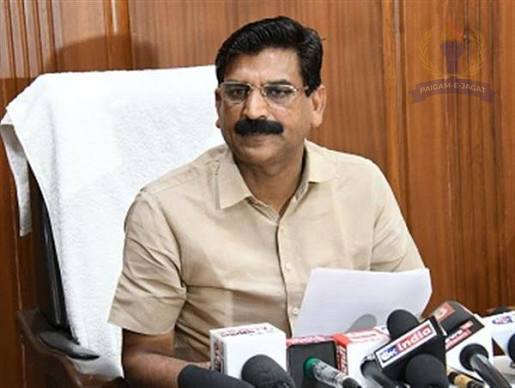
Hoshiarpur (Daljit Ajnoha):- On the occasion of Constitution Day, Avinash Rai Khanna, Chairman of the Punjab BJP Election Manifesto Committee, former Member of Parliament and former BJP State President, said that the Indian Constitution is the cornerstone of the country's democratic system, citizens' rights and national unity. Under the leadership of Prime Minister Narendra Modi, the Central Government is continuously taking historic steps to strengthen the basic spirit of the Constitution, protect citizens' rights and free the country from a colonial mindset.
Khanna said that India adopted its Constitution in 1950, but despite this, the penal code introduced during British rule continued to remain in force in the country for decades. Through the Bharatiya Nyaya Sanhita, the Modi Government has brought extensive changes to the criminal justice system and taken an important initiative towards moving away from colonial thinking and giving priority to justice over punishment. This change reflects the vision of a self-reliant, modern and citizen-centric India.
He said that Indian culture places special importance on duties along with rights. Under the leadership of Prime Minister Narendra Modi, several campaigns related to the Swachh Bharat Mission, water conservation, environmental protection and public participation have created a new awareness among citizens about their social responsibilities. A strong nation can be built only when every citizen fulfils their duties along with exercising their rights.
Khanna said that those who speak about protecting the Constitution and strengthening democratic institutions should also study the country's history impartially. From the first Constitutional Amendment after Independence to the 42nd Constitutional Amendment during the Emergency, there have been several instances when decisions taken by the then Congress governments affected civil liberties and the autonomy of democratic institutions. The restrictions imposed on fundamental rights through the first Constitutional Amendment and the changes made to the constitutional framework during the Emergency remind us that the Constitution and democratic norms must remain above those in power.
He said that the repeated use of Article 356 to dismiss elected state governments has also been a troubling aspect of the history of Indian democracy. During Congress rule, this constitutional provision was used on numerous occasions for political purposes. In contrast, the BJP believes that respecting the people's mandate should be paramount in a democracy and constitutional institutions should not be used to serve political interests.
Khanna said that due to Articles 370 and 35-A in Jammu and Kashmir, the entire Indian Constitution and several rights available to citizens could not be fully implemented there. Scheduled Castes, Scheduled Tribes, backward classes and women also faced obstacles in receiving the benefits of equal rights. Under the leadership of Prime Minister Narendra Modi, the removal of Article 370 in 2019 was a decisive step towards ending this historic inequality. Jammu and Kashmir now comes within the ambit of the provisions and rights of the Indian Constitution, just like other states of the country. This is a historic achievement in the direction of national unity, equality and constitutional harmony.
He said that for decades, Naxalism had created obstacles to development, education, security and constitutional rights in the country's tribal and backward regions. The Modi Government has launched a decisive campaign against Naxalism, giving priority to development and public welfare along with security. This has paved the way for strengthening peace, development and the democratic system in the affected areas.
Congratulating the people on Constitution Day, Khanna said that the day is not merely a formal observance but an opportunity to reaffirm our commitment to the Constitution. Under the leadership of Prime Minister Narendra Modi, the Central Government has taken several important steps to strengthen constitutional values, national unity, social justice, good governance and citizens' duties. There is a need for the younger generation to study the history of the Constitution, its making and the amendments made to it from time to time, and play an active role in strengthening democracy.
He said that the Constitution is the guiding force of the country, and the BJP Government is committed to ensuring that every citizen gets equal rights, justice and opportunities for development, and that India further strengthens its identity on the world stage as a strong, harmonious and developed nation.