Ambala, 18 November (R. Singh):- District Bar Association Ambala President Rohit Jain has written a detailed letter to the Chief Minister of Haryana, demanding that the 175-year-old Central Jail in Ambala be developed as a Freedom Struggle Museum and Heritage Centre. In his letter, Advocate Rohit Jain has presented facts, arguments and historical references that, he believes, strongly support the conversion of the jail into a heritage centre.
In his letter, Advocate Jain writes that Ambala Central Jail is not merely a prison but an extremely important and glorious chapter in the history of India's freedom struggle. The air here still echoes with extraordinary stories of the courage and sacrifices of immortal martyrs and freedom fighters, in whose memory every head bows in reverence. The soil of this 175-year-old historic complex preserves indelible memories of the sacrifices and struggles of numerous revolutionaries, freedom fighters and patriots who fought for the country's independence.
According to him, a review of historical records reveals that the British government initially established this facility as a sub-jail. In 1930, it was converted into a district jail, and in 1947, it was granted the status of a Central Jail. At that time, the prison had seven blocks and two floors, with hundreds of rooms. Spread over approximately 12 acres, the complex also had a women's ward, hospital, factory, warehouses, security ward and other facilities.
In 2022, a detailed memorandum was submitted seeking the preservation of this historic heritage and the declaration of Ambala Central Jail as a national monument. At that time, concerns were raised that the process of shifting the jail could compromise its historical character and significance.
It is a matter of great happiness and pride that a magnificent memorial has been built and inaugurated in Ambala in memory of freedom fighters. This is a commendable initiative by the Haryana Government and an expression of respect and gratitude towards the freedom fighters of the country. However, it is important to emphasise that the newly constructed memorial dedicated to freedom fighters and Ambala Central Jail are two separate historical heritage sites. The construction of one cannot diminish the historical significance of the other.
The importance of Ambala Central Jail lies not only in the fact that many freedom fighters were imprisoned there or revolutionaries were executed there. The entire complex itself is a historical witness to the oppressive system of British rule and the indomitable struggle of Indians against it.
Highlighting the historical significance of the Central Jail, he writes that Basant Kumar Biswas, one of the four brave revolutionaries who threw a bomb at the then Viceroy of India, Lord Hardinge, during a procession in Delhi's Chandni Chowk in 1912, was hanged at Ambala Central Jail at the age of 20.
On September 3, 1915, the British government hanged 12 people in Ambala Jail for the offence of military rebellion. Eighteen people had been sentenced to death by the British Indian Army in connection with the case, but the sentences of six were later commuted to life imprisonment. This incident remains an important and tragic chapter in the history of India's freedom struggle.
Freedom fighter Sucheta Kripalani, who later became the first Chief Minister of Uttar Pradesh, also spent time in this jail. She was born in Ambala and became the first Chief Minister of Uttar Pradesh after independence. Following her participation in the Jungle Satyagraha of 1931, she was first imprisoned in Tihar Jail in 1932. Later, she was transferred to Ambala Jail to undergo solitary confinement.
Prominent national leader Maulana Sabri also spent time in Ambala Jail during the freedom struggle. He wrote his first book, "A History of Crime and Punishment", here, based on his life in prison.
Revolutionary Bibi Amar Kaur, sister of immortal martyr Bhagat Singh, had hoisted the Tricolour in Lahore Jail during the Quit India Movement of 1942. She was imprisoned in Ambala Jail in October 1942.
Jasleshwar Singh, a fighter of the Indian National Army, was also hanged in Ambala Jail. Information about other martyrs remains hidden in historical records.
Rajkumari Amrit Kaur, independent India's first Health Minister, also faced severe atrocities at the hands of the British government during the Quit India Movement. She was imprisoned in Ambala Jail as well. There, she was kept in solitary confinement in an extremely narrow, dirty and dark cell and was not even informed about the death of her brother.
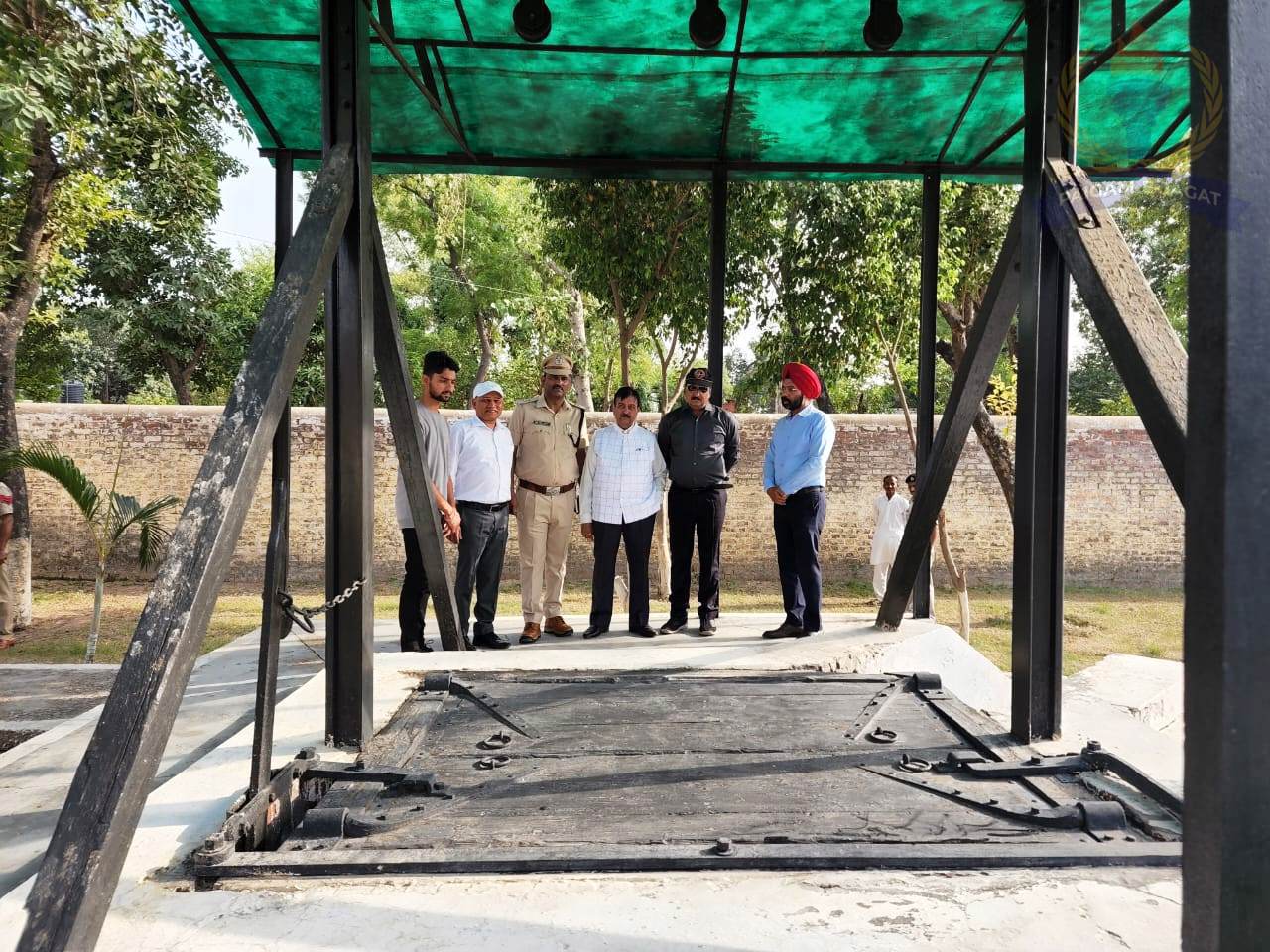
The trial of Nathuram Godse and his associates for the assassination of Mahatma Gandhi was held at the East Punjab Court in Peterhoff, near Shimla. The verdict was delivered on November 8, 1949, and within a week, on Tuesday, November 15, 1949, Nathuram Godse and Narayan Apte were hanged at Ambala Central Jail. It is said that they were executed at sunrise and that a jeep secretly transported their bodies from the jail to an undisclosed location, where they were cremated. The gallows where Godse and Apte were executed still stand inside Ambala Jail. Other accused in the case, Gopal Rao Godse and Karkare, were transferred from Ambala Jail to Nashik Jail on May 19, 1950.
Sucha Singh and Baldev Singh, who assassinated Pratap Singh Kairon, the third Chief Minister of Punjab, were also hanged at Ambala Jail in 1972.
Although 29 people have been executed at Ambala Central Jail since independence, the last execution took place on June 21, 1989, when Gulab Singh of Karnal was hanged. No execution has taken place there since then.
According to Rohit Jain, all these incidents establish that the historical significance of Ambala Central Jail is not limited to any one event or individual. It is connected with different phases of the freedom movement, revolutionary activities, repression under British rule and the sacrifices of freedom fighters.
In this context, the example of the historic Cellular Jail, also known as Kala Pani, in the Andaman and Nicobar Islands is particularly relevant and inspiring. Recognising its historical importance after independence, the Government of India decided to preserve the Cellular Jail and declared it a national memorial dedicated to the nation on February 11, 1979. Today, it is an important centre for understanding the history of the freedom struggle and paying tribute to the martyrs.
Jain says that if the historic buildings, barracks, cells, gallows and other important structures of Ambala Central Jail are not preserved, future generations will be deprived of the opportunity to see and understand this significant chapter of the freedom struggle for themselves. He has demanded that, considering the historical importance of the Central Jail, the necessary process to declare it a national monument should be initiated and coordination established with the concerned Union Ministries in this regard.