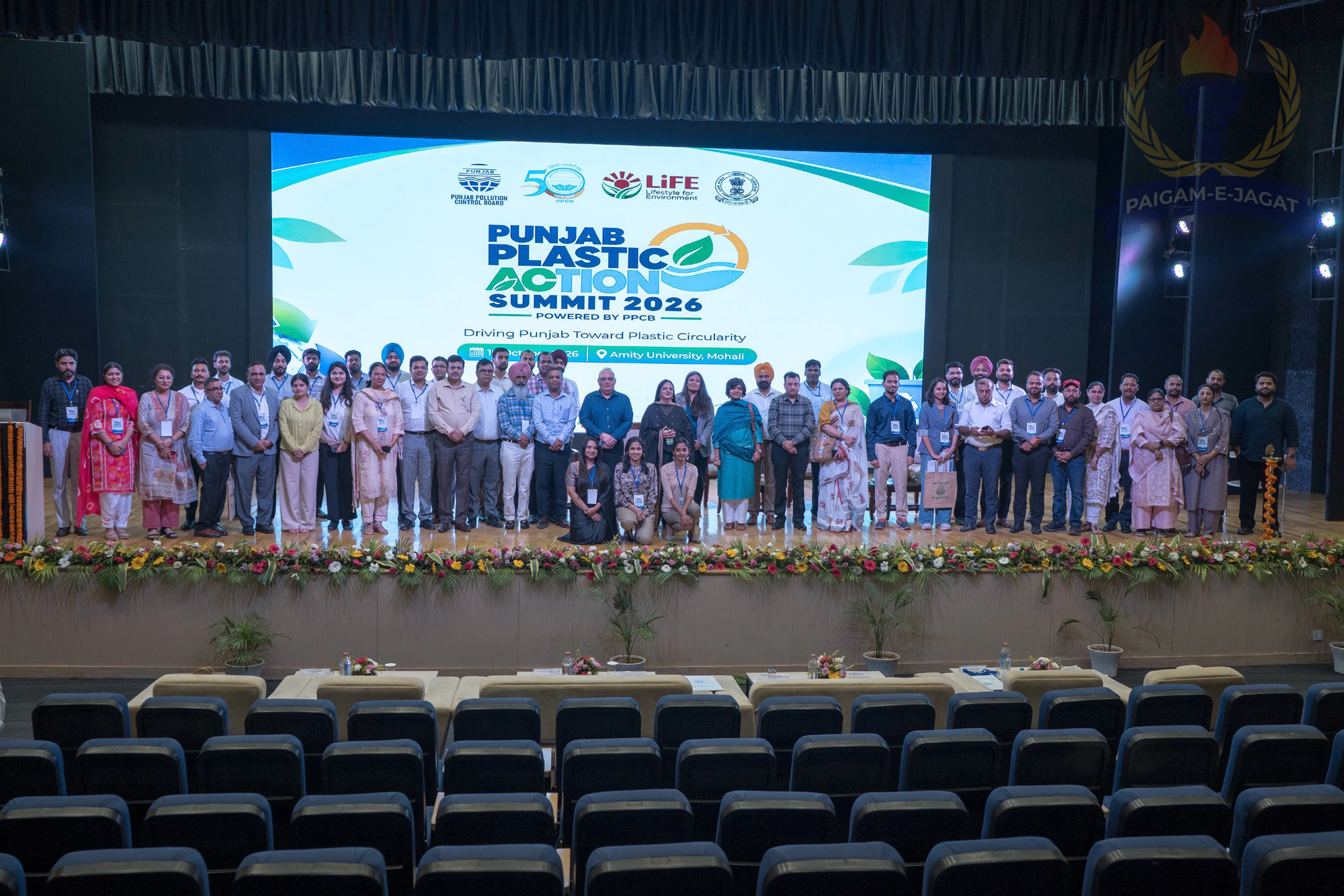
Sahibzada Ajit Singh Nagar, October 11:- The Punjab Pollution Control Board (PPCB) organised the International Punjab Plastic Action Summit-2026 at Amity University, Mohali. Policymakers, industry representatives, civil society members, environmental experts and representatives of international organisations participated in the summit and deliberated on practical solutions and measures to tackle plastic pollution. The summit aimed to promote the exchange of global experiences and information, technology-driven initiatives, and stronger accountability across the entire plastic value chain, taking steps towards realising the vision of ‘Rangla Punjab’.
Punjab Chief Secretary K.A.P. Sinha, Vice Chairperson of the Punjab Development Commission Seema Bansal, Punjab Pollution Control Board Chairperson Reena Gupta, Director of the Department of Environment and Climate Change Dr. Shailendra Kaur, IFS, senior representatives of the Alliance to End Plastic Waste and the World Bank, along with representatives of other relevant stakeholders, attended the summit.
During the summit, participants discussed the growing problem of plastic waste and measures to manage it, including advanced waste-processing technologies, circular economy models, environmentally friendly alternatives, effective implementation of Extended Producer Responsibility (EPR), and initiatives involving public participation.
On the occasion, the results of a plastic waste brand audit conducted by the Punjab Pollution Control Board in six major cities of Punjab were also shared. During the exercise, approximately 7,000 kilograms of sampled waste were examined, and around 12,000 packets were linked to 231 companies. The findings highlighted the scale of branded plastic waste and the need to establish clear standards and ensure accountability among producers and manufacturers.
Addressing the gathering, Chief Secretary K.A.P. Sinha spoke about plastic consumption and the economic value of plastic waste. He said that multilayer plastic packaging used for wafers, biscuits and other consumer goods had little or no market value for waste pickers. As a result, such packaging often remained scattered on roads and in public places. He also stressed the importance of public responsibility and said that religious teachings could traditionally help encourage restraint, simplicity and thoughtful consumption of plastic.
The summit also discussed a key issue emerging from the brand audit findings: the gap between compliance reported under national EPR systems and the branded plastic waste found on the ground. Under the existing system, producers can fulfil their recycling obligations through geographically neutral EPR certificates based on plastic waste processed in another part of the country. This does not necessarily ensure that an equivalent quantity of waste is recovered in the states where their products are consumed.
In this context, participants emphasised the need to strengthen transparency, monitoring and accountability mechanisms to link producers’ responsibilities to the waste burden generated at the local level.
The summit also highlighted that plastic waste is not merely a problem of litter and appearance. If not properly collected and processed, plastic waste can break down into very small particles and contribute to the contamination of soil and water. This creates the possibility of plastic and associated pollutants entering the food chain. Research findings have also reported the presence of microplastic particles in environmental and human biological samples. Therefore, the summit emphasised preventing plastic waste from entering the environment in the first place.
Participants exchanged views on improving plastic packaging, expanding the use of technology for waste collection, segregation, recycling and processing, reducing dependence on virgin raw materials, and minimising waste generation. They also stressed the need to make environmentally friendly alternatives effective, economically viable and suitable for large-scale implementation. The Alliance to End Plastic Waste expressed its commitment to exploring possibilities for providing technical and financial support for plastic waste management in Punjab.
The central objective of the summit was to promote responsible management of plastic waste throughout its entire life cycle rather than simply transferring it from one place to another. This approach includes every stage, from mindful consumption and waste segregation to recovery and recycling, followed by the proper disposal of non-recyclable materials.
On the occasion, Punjab Pollution Control Board Chairperson Reena Gupta said, “Our goal should be to ensure that plastic is safely collected after use, processed using scientific methods and disposed of responsibly. It is essential to prevent it from contaminating our soil and water, entering the food chain or posing a threat to human health. By adopting advanced technologies, strengthening producer accountability and making every citizen a participant in this campaign, we can turn the challenge of plastic waste into an opportunity to build a cleaner, healthier and more sustainable Punjab. The vision of ‘Rangla Punjab’ also calls for environmental responsibility alongside development and for protecting the health of future generations through environmental conservation.”
Ms. Gupta stressed that responsibility for plastic waste management could not be limited to sanitation workers or governments. Producers, institutions, communities and every citizen had an important role to play in ensuring that plastic remained a useful material rather than becoming an uncontrolled burden on the environment.
The Punjab Pollution Control Board also showcased initiatives to reduce plastic use at public events and institutions and promote environmentally friendly alternatives. These included plastic-free langar at Fatehgarh Sahib, plastic-free prasad at Kali Mata Temple in Patiala, and a plastic-free Hola Mohalla at Sri Anandpur Sahib. Thousands of devotees used steel and biodegradable utensils at these events.
In addition, a plastic-free lunch campaign in schools and colleges in Patiala and a campaign to collect multilayer plastic waste are being undertaken as pilot projects. These initiatives aim to encourage responsible consumption and waste segregation habits among students.