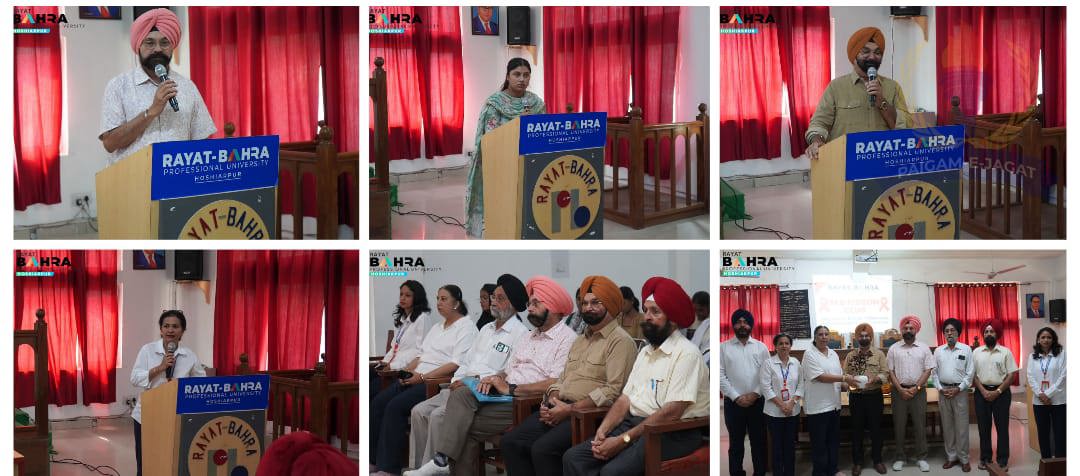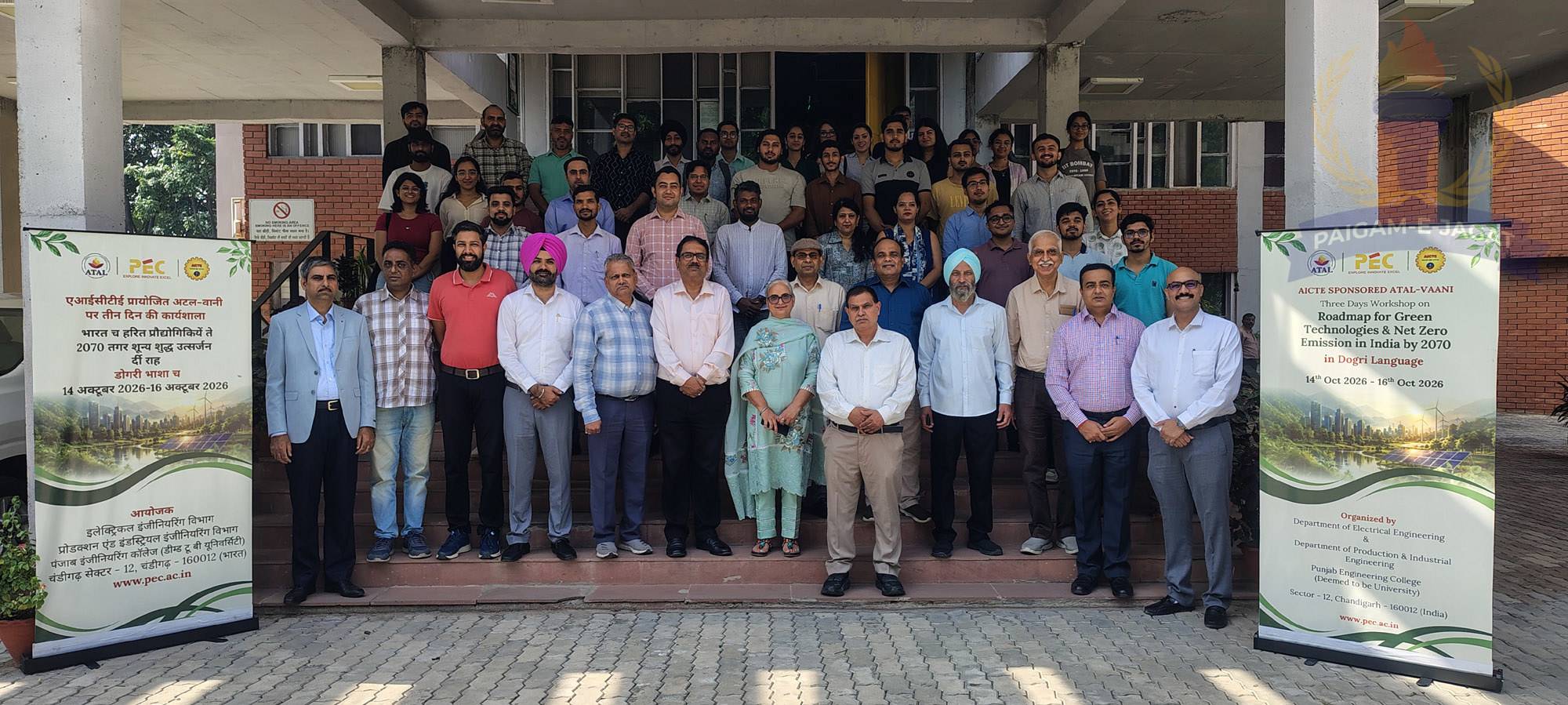
Chandigarh, October 14, 2026:- Punjab Engineering College (Deemed to be University), Chandigarh, inaugurated a three-day AICTE-sponsored ATAL–VAANI workshop titled “Roadmap for Green Technologies & Net Zero Emission in India by 2070” today. Being conducted in the Dogri language from October 14 to 16, 2026, the workshop aims to promote awareness of sustainable technologies and environmental responsibility while encouraging the use of regional languages in technical education.
The inaugural session was attended by Prof. Umesh Sharma, Dean, SRIC, along with Prof. Sandeep Kour, Head of the Electrical Engineering Department, and Prof. N. M. Suri, Head of the Production and Industrial Engineering Department. Their presence and encouragement highlighted the importance of initiatives that bring technical education, sustainability and regional languages together.
The organisers gratefully acknowledged the guidance and support of Prof. Bhola Ram Gurjar, Vice-Chancellor of Punjab Engineering College, in fostering an academic environment that encourages innovation, interdisciplinary collaboration and environmental sustainability. His support is valuable in strengthening the institution’s commitment to addressing contemporary environmental challenges through education, research and technological advancement.
The workshop is being coordinated by Dr. Manohar Singh and Dr. Jimmy Karloopia, who share their roots in Jammu and took particular pride in organising this technical workshop in Dogri. The initiative highlights the potential of regional languages to make scientific and technological knowledge more accessible and encourage wider engagement with important national priorities.
The workshop has attracted speakers, academicians, experts and participants from institutions across India, including Jammu and Kashmir, Himachal Pradesh, Punjab, Uttarakhand and Delhi. Their participation provides a valuable platform for exchanging ideas, sharing institutional experiences and developing collaborative approaches to sustainability-related challenges.
The technical programme features expert lectures by distinguished academicians and professionals from various institutions. The sessions cover a diverse range of topics, including energy security, waste-to-energy conversion, microwave hybrid heating for materials processing, smart manufacturing through the Industrial Internet of Things (IIoT), green building technologies, additive manufacturing, sustainable biomaterials, composite technology, waste management and sustainable energy infrastructure.
Supported by the All India Council for Technical Education (AICTE) under its VAANI initiative, the workshop seeks to make technical education more inclusive and accessible through Indian languages. It also emphasises the role of higher educational institutions in advancing green technologies, sustainable manufacturing and environmentally responsible innovation in support of India’s long-term vision of achieving net-zero emissions by 2070.
The organising team expressed its sincere gratitude to AICTE, the institute administration, the participating departments, invited speakers and all members of the core organising team, including faculty colleagues, staff and student volunteers, for their valuable contributions to the successful conduct of the event.
The workshop will continue until October 16, 2026, featuring further expert lectures and technical discussions aimed at fostering innovative ideas, strengthening academic collaboration and advancing the transition towards a greener and more sustainable future.