
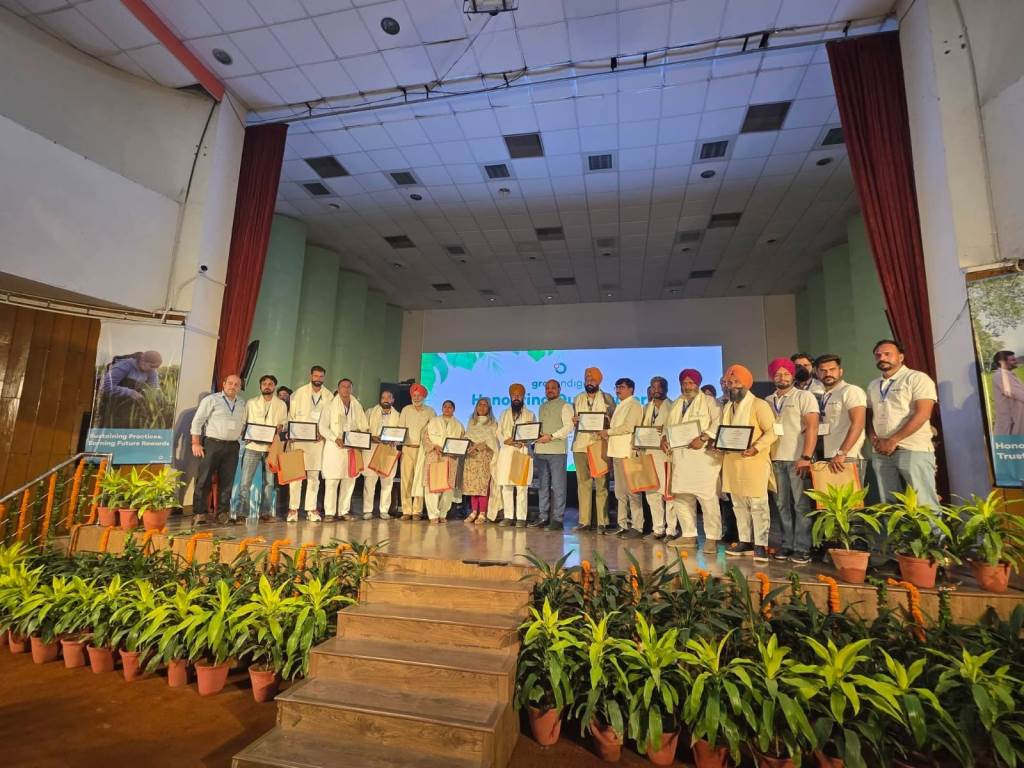
Patiala, September 16:- For the first time under a science-based, climate-friendly agriculture programme, small farmers from Punjab and Haryana have received carbon credit payments. The event was held at Punjab Agricultural University, Ludhiana, where Dr. M. L. Jat, Director General, ICAR, attended as the chief guest.
Ludhiana, September 15, 2026: For the first time in Indian agriculture, small farmers from Punjab and Haryana have received their first carbon credit payments for adopting climate-friendly agricultural practices on their own farms. The payments were digitally released during an event held on September 14, 2026, at Punjab Agricultural University (PAU), Ludhiana. Dr. M. L. Jat, Director General of the Indian Council of Agricultural Research (ICAR), was the chief guest at the event.
Those present on the stage included Dr. M. L. Jat, Director General, ICAR (Chief Guest); Dr. Rajbir Singh, Deputy Director General (Agricultural Extension), ICAR; Dr. Ajmer Dhatt, Director of Research, Punjab Agricultural University; Dr. V. K. Sehgal, Principal Scientist, ICAR-Indian Agricultural Research Institute; and Dr. Usha Barwale Zehr, Executive Director, Grow Indigo.
These payments are part of the Aadi Project, a farmer carbon programme being run by Grow Indigo. Between 2019 and 2022, farmers adopted climate-friendly agricultural practices such as direct-seeded rice, reduced tillage and crop residue management. These practices reduce greenhouse gas emissions and help store carbon in the soil. The resulting climate impact was independently measured, checked, measured and verified, and carbon credits were issued on this basis. Aadi is the first programme in India to issue carbon credits for agriculture under the Verra VM0042 methodology.
Every eligible farmer was paid on an equal and fair basis. Each farmer’s payment corresponds to their share of the carbon credits generated by their farms. To ensure that farmers did not have to wait, Grow Indigo made digital payments from its own funds before the complete sale of the carbon credits. Each farmer was given two options: receive a predetermined and guaranteed payment immediately, or wait until the credits were sold and receive 75% of the net carbon income.
First Payment—In Figures
Details - Figure
Farmers receiving payments - More than 2,500
Average payment - ?11,478
Minimum payment - ?3,000
Maximum payment - ?1,17,985
Payment received by most farmers - ?4,000 to ?15,000
In addition to additional income, these agricultural practices also provide several important benefits. Direct-seeded rice, instead of traditional rice transplantation, saves a large amount of water used for irrigation, while a reduction in crop residue burning improves air quality. During the period from 2019 to 2022, the fields participating in the programme collectively saved an estimated 45 billion litres of water, prevented more than 2 lakh tonnes of crop residue from being burned, and avoided approximately 1,000 tonnes of PM2.5 emissions.
These payments are the result of a rigorous process of measurement and independent verification carried out over several years.
Suggested statement by Dr. M. L. Jat, Director General, ICAR:
“This is a historic moment for Indian agriculture. It demonstrates that climate-friendly agricultural practices based on strong science and rigorous verification can provide real and additional increases in the incomes of our small farmers, while also saving water and improving air quality.”
Dr. Usha Barwale Zehr: “For the first time in India, a farmer is being paid for the carbon that has been stored in their soil.”
Farmer Harinderjit Gill, Noorpur Bet, Ludhiana: “Five years ago, we took a step with confidence to join Grow Indigo’s carbon programme, and today we have received the fruits of that in the form of a payment.”
Farmer Amandeep Kaur, Sangrur: “Avoiding the burning of crop residue improves soil health and also benefits people and the environment.”
About the Programme:
Aadi is Grow Indigo’s flagship farmer carbon programme in Punjab and Haryana. Grow Indigo was established by Mahyco and Indigo Ag (USA).