Chandigarh, October 22:- The Haryana government has intensified its efforts to control stubble burning, vehicular pollution, road dust, construction activities and industrial pollution.
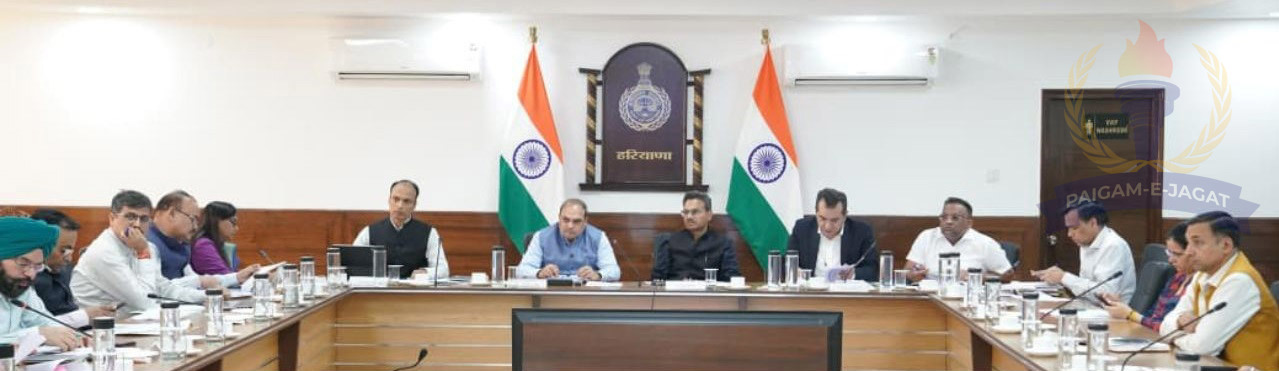
These measures were reviewed at a high-level meeting held here today under the chairmanship of Mr. Rajesh Verma, Chairman of the Commission for Air Quality Management (CAQM), and Mr. Anurag Rastogi, Chief Secretary of Haryana. The meeting assessed the progress of initiatives and actions being undertaken across the state to improve air quality.
Mr. Amit Khatri, Director of the Agriculture and Farmers’ Welfare Department, informed the meeting that against the target of distributing 9,000 crop residue management machines, 13,200 machines had already been distributed in the state, exceeding the target by 47 per cent. So far this year, 52 FIRs have been registered and 21 people arrested to prevent stubble-burning incidents. Environmental compensation of Rs. 10,000 has also been collected. Red entries have also been made in the land records of farmers involved in stubble-burning cases.
At the village level, a mobile application developed by the National Remote Sensing Centre (NRSC) is being used to verify stubble-burning incidents. It helps monitor affected areas through satellite-based data. To promote paddy residue as a useful resource, district-level agreements have been signed for the industrial use of 27.10 lakh metric tonnes of paddy residue during the current season.
The meeting was informed that, as of September 30, 7.284 lakh metric tonnes of paddy straw had been utilised in biomass-based power projects, accounting for 77.16 per cent of their annual target. In addition, 1.053 lakh metric tonnes of straw had been used in compressed biogas (CBG) plants.
CAQM Chairman Mr. Rajesh Verma praised the Haryana government for the continued decline in stubble-burning incidents in the state. He described the sustained efforts to curb the practice of burning crop residue and promote environmentally friendly alternatives as significant.
Mr. Verma also appreciated the model brick kiln developed by the Jhajjar district administration in the Badli area, where paddy straw is being effectively used as fuel. Calling it a practical example of converting agricultural waste into a useful resource, he said such innovative measures could help reduce stubble burning and air pollution. He stressed the need to adopt these sustainable measures on a wider scale and improve coordination between district administrations and industrial units.
The meeting was informed that brick kilns in eight districts outside the National Capital Region (NCR) are using pellets made from paddy straw as fuel. An average co-firing rate of 21.9 per cent has been recorded in these kilns. Of the total 708 brick kilns in these districts, 707 have been brought within the ambit of compliance with prescribed standards.
The use of biomass blended with coal is also being promoted at thermal power plants. The Indira Gandhi Super Thermal Power Station has achieved 72.89 per cent of its co-firing target.
Mr. Shekhar Vidyarthi, Chairman of the Haryana State Pollution Control Board, said that 79 PM2.5 sensors had been installed in identified red-zone villages across the state to strengthen monitoring of air pollution and stubble-burning incidents.
In the first phase of monitoring, 20 drones have been deployed, while another 30 are planned to be deployed. These measures will help monitor affected areas and identify stubble-burning incidents more effectively.
The Haryana government has approved the procurement of 600 Automatic Number Plate Recognition (ANPR) cameras at a cost of Rs. 14.50 crore. In addition, a separate tender has been issued for the procurement of another 1,500 cameras.
Under the proposed action measures, a provision is also being considered in the state’s NCR districts to ensure that vehicles without valid Pollution Under Control (PUC) certificates are not supplied fuel at petrol pumps and CNG stations.
From January to mid-October this year, the Haryana Traffic Police impounded 19,067 vehicles that had exceeded the prescribed age limit. Of these, 785 vehicles were sent for scrapping.
Under the ‘Parivartan Yojana’, 18,501 beneficiaries have registered to replace old commercial trucks and buses with cleaner BS-VI, electric or CNG vehicles.
A total of 596 diesel-powered auto-rickshaws have also been phased out in the state’s NCR districts. Registration of new diesel auto-rickshaws has been prohibited since January 2023.
To reduce traffic congestion and the resulting pollution, short-term measures have been implemented at 84 locations where immediate intervention was required. In addition, steps have been taken towards long-term solutions at 10 locations. A total of 205 ANPR cameras have been installed at these locations to make automated monitoring more effective.
To reduce pollution caused by road dust, 748.89 kilometres of roads have been redeveloped in Gurugram, Faridabad, Sonipat, Manesar, Karnal, Panipat and Rohtak. In addition, 78 mechanised sweeping machines have been deployed against a requirement of 81.
All 44 secondary collection centres for construction and demolition (C&D) waste have been established in these seven cities. GPS-enabled vehicles have also been deployed to collect the debris. To improve dust-control measures at construction sites, building plans for 56 buildings with an area of more than 500 square metres have been registered on the ‘Dust Portal’.
Urban local bodies have been directed to ensure strict compliance with dust-control measures. These include video surveillance, fortnightly self-assessments, low-cost air-quality sensors, wind barriers, dust screens, water sprinkling and covered transportation of construction materials.
Mr. Yogesh Kumar, Member Secretary of the Haryana State Pollution Control Board, said inspections of industrial units had been intensified to ensure compliance with pollution-control standards. Between January and September, the board inspected 4,129 industrial units in designated compliant areas and 462 units in non-compliant areas. Action has been taken against units violating the rules, including closure of units.
A total of 191 stone-crusher units have installed web cameras or video-surveillance systems, while 293 units have been equipped with low-cost particulate matter sensors. Of the total 708 stone-crusher units, 707 have been issued revised Consent to Operate certificates with dust-control conditions.
Action has also been taken to control pollution from diesel generator (DG) sets. Following inspections of 2,978 DG sets, 153 non-compliant units were ordered to shut down.
Speaking to the media after the meeting, Mr. Tarun Kumar Pithode, Member Secretary of the Commission for Air Quality Management, said paddy straw needed to be converted into a useful economic resource and managed more effectively. He said the Commission aimed to develop a system in Punjab and Haryana that could prevent stubble-burning incidents and ensure productive utilisation of crop residue.
He said developing a circular economy based on crop residue was the key objective of this initiative. It would create opportunities for farmers to earn additional income and help reduce the adverse effects of pollution on people living in rural and urban areas.
Mr. Ashok Kumar Meena, Commissioner and Secretary of the Urban Local Bodies Department, Mr. Prabhjot Singh, Transport Commissioner, and other senior officers were also present at the meeting.