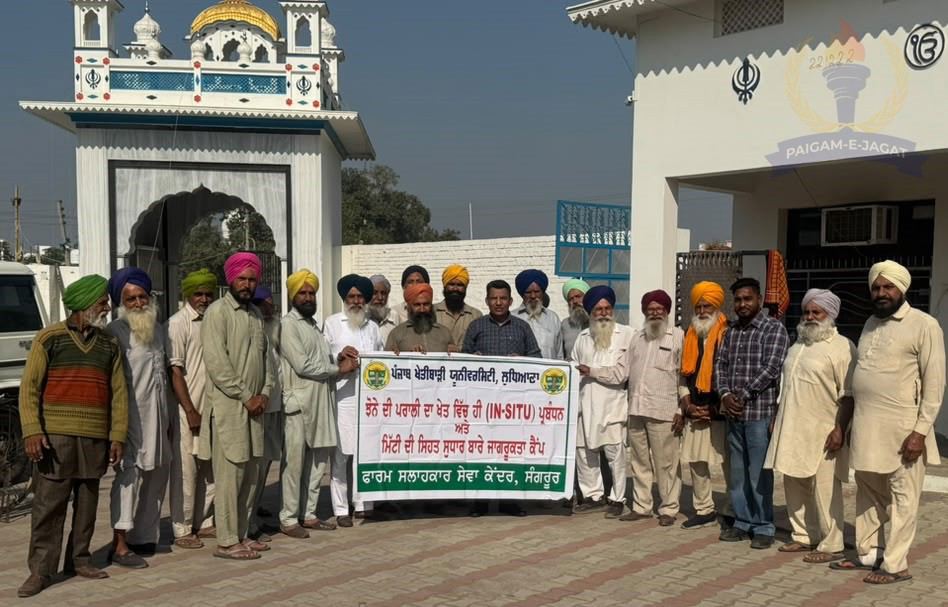
Bhawanigarh, 23 November:- The Farm Advisory Service Centre, Sangrur, of Punjab Agricultural University (PAU) organised a farmers’ awareness camp at Nadampur village near Bhawanigarh on nutrient management in wheat and other Rabi crops.
Held under the guidance of the Director of Extension Education, PAU, the camp provided information on the use of fertilisers based on soil testing, identification of manganese deficiency in wheat and methods to maintain soil health. More than 25 farmers, including village Sarpanch Baljinder Singh, participated in the camp.
Interacting with farmers, Dr Ashok Kumar Garg, Senior Extension Scientist (Soil Science) at the Farm Advisory Service Centre, said that fertilisers should be applied according to soil test results and crop requirements. He explained that excessive use of urea and other fertilisers increases cultivation costs and adversely affects soil health and the environment. He encouraged farmers to apply balanced quantities of essential nutrients, including nitrogen, phosphorus and potassium, in accordance with PAU recommendations.
Dr Garg also explained the symptoms of manganese deficiency in wheat. He said that this deficiency may particularly occur in light-textured soils. It can cause yellowing between the veins of newly emerging wheat leaves, followed by the appearance of brown spots. He advised farmers to spray a 0.5 per cent solution of manganese sulphate, as recommended by PAU, to address this deficiency.
After the camp, the Farm Advisory Service Centre team visited demonstration fields of wheat sown using the surface seeding-cum-mulching technique in Nadampur and Mattaran villages. The team assessed the crop condition and interacted with farmers about the benefits of this technique and proper crop management. This technique enables wheat sowing by retaining paddy straw in the field as mulch.
Dr Garg urged farmers to get their soil tested and adopt PAU's crop-specific recommendations for the judicious use of nutrients and reduction of cultivation costs.