Nurses Play Key Role in NCD Care TwoDay Training Course Held at PGIMER

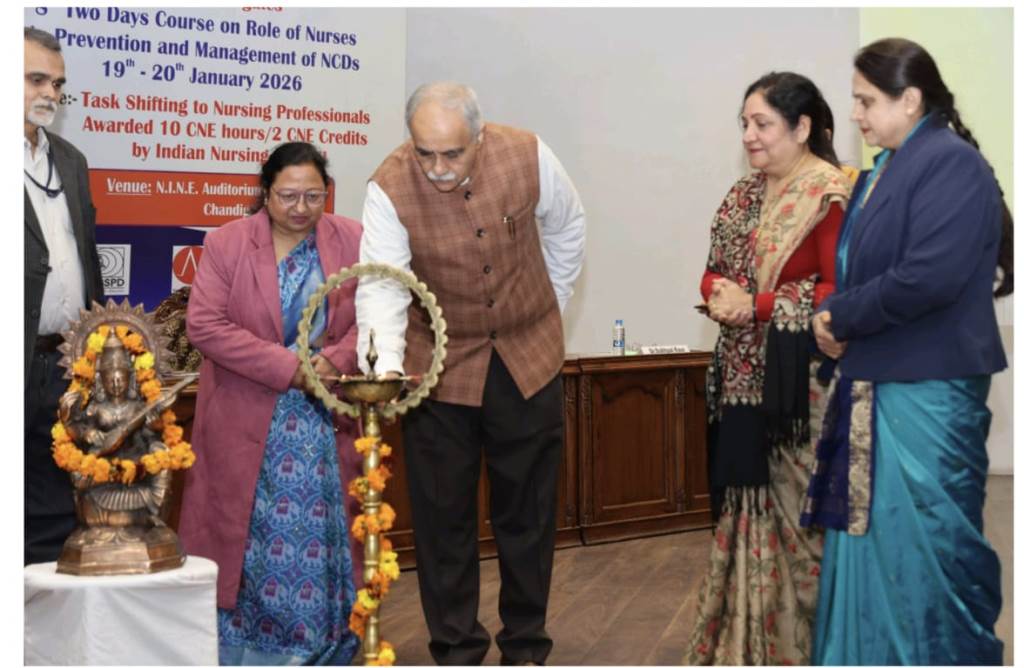
Chandigarh, January 20: The National Institute of Nursing Education (NINE), PGIMER, Chandigarh, in collaboration with the World NCD Federation, successfully organised the eighth two-day course on the “Role of Nurses in Prevention and Management of Non-Communicable Diseases (NCDs)” from January 19 to 20. The theme of the course was “Task Shifting to Nurse Professionals”, highlighting the expanding role of nurses in NCD care.
The course aimed to sensitise and prepare nurses to actively participate in the prevention, early detection and management of NCDs. A total of 110 nurses from Punjab, Chandigarh, Himachal Pradesh, Haryana and Rajasthan took part in the programme.
The course was inaugurated by Prof. Vivek Lal, Director, PGIMER, Chandigarh. In his address, he emphasised that nurses are frontline healthcare workers who play a crucial role not only in hospitals but also in community settings. He underlined that nurses stand at par with doctors in the prevention, management and rehabilitation of NCDs.
Prof. J.S. Thakur spoke about the inception of the World NCD Federation and its contribution towards capacity building of healthcare professionals, including nurses. Dr. Sukhpal Kaur, Principal, NINE, PGIMER, stated that this was the eighth course in the series and would continue in the coming years to empower nurses. She highlighted that nurses, being closest to patients during hospitalisation, are best placed to educate patients and caregivers about healthy lifestyles.
A panel discussion on “Nurse Practitioner in Indian Context,” chaired by Dr. Sushma Kumari Saini, concluded that nurse practitioners can significantly contribute to screening, diagnosis, treatment initiation, monitoring and rehabilitation of NCD patients.
The course covered topics such as cardiovascular diseases, diabetes, hypertension, cancer, COPD, CKD, mental illnesses and population-based screening. Ten CNE hours and two CNE credits were awarded by the Indian Nursing Council. Participants appreciated the initiative, calling it timely and highly relevant.